Second Source Semiconductor: A Guide for Procurement Teams
How second source semiconductor supply works: qualifying an alternate manufacturer for the same part to reduce single-vendor risk and protect the supply chain.
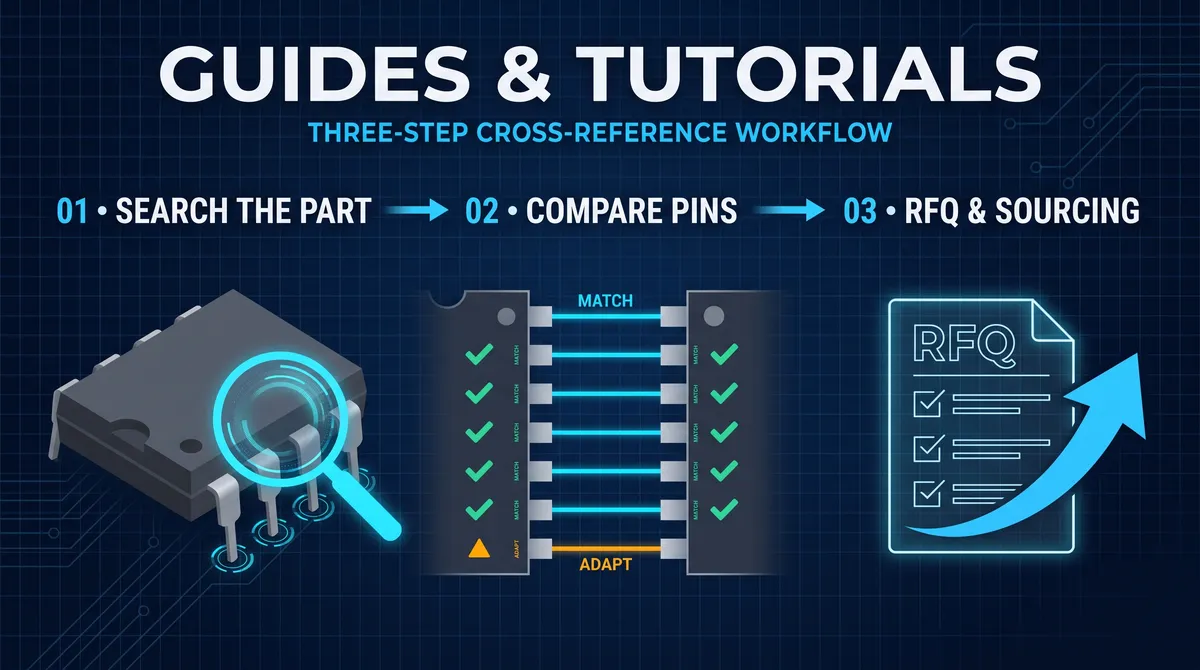
Second source semiconductor is a procurement term that describes having two or more manufacturers able to supply the same part, so that the failure, the price increase, or the shortage of one manufacturer does not stop production. The concept is simple to state and deep in practice: a second source is an alternate manufacturer that produces a part functionally identical, and as far as possible dimensionally identical, to the primary manufacturer's part, so the buyer can source the same board design from either one. The practice grew up in the semiconductor industry because a single-sourced chip is a single point of failure for the whole board, and a fire, a labor strike, a capacity decision, or an end-of-life notice at the manufacturer can remove the part from the market overnight. This guide explains what second sourcing is, why it matters, how a second source is qualified, how it differs from other supply strategies, and how a procurement team builds a second-source strategy across its BOM, so that the resilience that large OEMs have always practiced becomes available to every buyer.
The modern form of second sourcing deserves a precise definition because the term is often used loosely. A second source in today's market is usually not a licensed clone of the original die, though that historical form still exists; it is far more often a pin-compatible alternative, a part from another manufacturer that shares the package and the pinout and meets the electrical specification, so it mounts on the same board and can be qualified for the same job. The domestic Chinese semiconductor industry has made this form of second sourcing extraordinarily common, with manufacturers building pin-and-software-compatible alternatives to mainstream devices, and a buyer can now second-source a microcontroller or a regulator by qualifying the alternative rather than by redesigning anything. This guide treats both the historical licensed form and the modern pin-compatible form, because the qualification discipline is the same and the value is the same: the board keeps its design, and the supply chain gains a second door.
What Second Sourcing Means for Semiconductors
A second source for a semiconductor is an alternate manufacturer that supplies a part the buyer can use in place of the primary part without changing the board design, and the definition has three properties that all must hold. The first is functional equivalence, the second-source part carries out the same function, delivers the same outputs, operates in the same supply range, and behaves the same way in the circuit as the primary part. The second is physical compatibility, the second-source part fits the same footprint, shares the package and pinout, and mounts on the same board without re-layout, which is what makes the second source usable rather than merely possible. The third is qualification, the second-source part has been tested and documented to meet the primary part's specification, because equivalence on paper is not equivalence in production until the test proves it. When all three hold, the buyer has a genuine second source, and the board can be sourced from either manufacturer with the same test program, the same assembly, and the same field behavior. The three properties are also the qualification checklist, which is why the second-source decision is an engineering activity and not only a procurement one.
The term second sourcering has a precise counterpart that the market uses interchangeably and that is worth separating. Second sourcing is the act of establishing an alternate source for a part that already exists, a response to a single-vendor risk that has been identified. Dual sourcing is a procurement strategy that deliberately maintains two sources, and a traditional product, for the same part from the design stage onward, so that neither vendor becomes a single point of failure and both compete on price and supply. In professional use, second sourcing is the establishment of the alternate capability, and dual sourcing is the ongoing operation of two sources, and a mature buyer does both, qualifies a second source when the risk appears and then runs it permanently as dual sourcing. This guide uses second sourcing to cover the whole practice, the qualification of the alternate and the ongoing management of the two-vendor relationship, because the value the buyer wants, a board that cannot be stopped by one vendor, comes from the whole practice rather than from any single event.
Second source versus dual source versus single source
The terminology around sourcing strategy is worth a table because the words decide the plan. A single-sourced part comes from one manufacturer, which maximizes price simplicity and design simplicity but concentrates every risk, the manufacturer's fire, shortage, price shock, and end-of-life decision all land on the buyer. A second-sourced part has an alternate manufacturer that has been qualified, so the board can switch directions when the primary fails or the price rises, the classic resilience answer to a discovered risk. A dual-sourced part is managed as two-permanent from the design stage, with both vendors qualified and run from the start, the most robust but the most expensive to establish, because the qualification cost is paid up front on every part. A multi-sourced part extends the pattern to three or more, and is used for the commodity parts where the qualification is cheap and the supply volatility is high. The practical guidance is to second-source the critical and single-sourced parts on the BOM first, to run the critical ones permanent double, and to reserve single-sourcing for the short-life, low-risk, or genuinely unique parts where the alternate does not exist.
Why Second Sourcing Matters: The Single-Point-of-Failure Risk
The case for second sourcing rests on a supply chain fact that every shortage has re-taught the industry: a semiconductor part that comes from one manufacturer is a single point of failure for every board that uses it. When the manufacturer's capacity is taken by a different product, when a geopolitical event blocks the supply line, when a factory closure stops a wafer line, or when an end-of-life decision retires the product, the buyer of a single-sourced part has no alternative but to redesign, wait, or pay whatever the residual market charges. The semiconductor shortage periods demonstrated the scale of the risk, with production lines across industries halting because a few-dollar part was unobtainable at any price. Second sourcing is the structural answer: it does not remove the risk that any one manufacturer fails, but it removes the dependency that a single manufacturer's failure stops the buyer, because the design has a second door. A buyer who has qualified a second source can move the volume, negotiate the price, and keep the line running while the primary source recovers, and the value of that optionality compounds every time the market tightens.
The risk is not only about failure; it is about price and leverage. A single-sourced part is a captive purchase: the buyer pays whatever the manufacturer and the channel charge, because there is no alternative to switch to, and the negotiation is a matter of asking rather than of choosing. A second-sourced part restores the buyer's leverage, because the supplier knows the volume can move to the alternate, and the price discussion becomes a real competition between two qualified sources. The same leverage applies to delivery, a second source that quotes a faster lead time becomes the source of the moment, and to quality, a vendor that knows its qualification can be revoked by a quality problem ships better. Second sourcing is therefore not a hedge against catastrophe alone, it is a daily pricing and service lever that makes the buyer's relationship with every source stronger. Procurement teams that run second sources describe the same transformation, the part stops being a fact of life and becomes a managed choice.
How component shortages make second sourcing a priority
Shortage events are the sharpest teacher of second sourcing, because they show in real time what a single source costs. During a shortage, the parts that stop the line first are the ones with one vendor, and the buyers who weather the shortage are the ones who had already qualified an alternate, moved the volume, and kept the design running on the second source. The lesson is that second sourcing is a preparation activity, not a response activity: the qualification takes time, samples, testing, and documentation, and a buyer who starts looking for the second source when the shortage hits is months behind the buyer who qualified it during the calm. The professional practice is therefore to second-source the critical parts during the good times, when the alternate manufacturer will take the samples and the engineering time, and to hold the qualification as insurance that pays its premium only when it is tested. The shortage also reshapes the strategy, because the parts that were cheap and abundant become the parts that need the second source most, and the BOM review that finds the single-source parts is the tool that turns a future shortage from a crisis into a plan.
How a Second Source Works: Licensed, Clone, and Pin-Compatible Alternatives
The mechanics of a second source depend on which form it takes, and the three forms coexist in the market today. The licensed second source is the historical form: the primary manufacturer licenses its design to another manufacturer, often under the same or a family part number, and both produce the same part with the original's know-how, which is how the classic logic and regulator families became multi-vendor parts, and it remains the benchmark of compatibility because it starts from the primary design. The clone second source is a manufacturer that reverse-engineers the part to build a functionally equivalent device, which is rarer for modern complex chips and common for simpler analog and discrete parts, and it carries the questions of whether the clone truly matches every parameter and whether the manufacturer has legal rights to the design. The pin-compatible alternative is the dominant modern form: a manufacturer builds its own part designed to the same package and pinout and meeting the electrical specification, so the buyer can substitute it on the same board, and it is the form behind most of the domestic alternatives to mainstream devices. The buyer's decision is the same across all three forms, qualify the physical and electrical compatibility and the supplier's reliability before trusting the volume.
The choice among the forms is a trade between compatibility and independence. The licensed source is the easiest to qualify, because the design is shared, but it is often the least independent, because it may limp when the primary is in trouble, which defeats the resilience purpose. The pin-compatible alternative is the most independent, because it is a separate design with a separate supply chain, and it often adds value of its own, a domestic alternative can be cheaper, more available, and supported by a local vendor, but it demands the full qualification because the difference in the internal design is real. The clone sits between, functionally similar but legally and technically riskier. The professional buyer therefore ranks the sources by the job: the licensed source only makes sense when price stability is the goal, the pin-compatible alternative is the workhorse of resilience, and the clone is treated with the verification discipline of any unfamiliar source. The qualification record records which form the second source is, because the form determines the confidence the tests can grant.
How pin-compatible alternatives serve as second sources
The pin-compatible alternative is the second-source form that most often combines board preservation with genuine independence, and it deserves the attention buyers give it. A pin-compatible part shares the package and the pinout of the primary, so it mounts on the same footprint and runs on the same test program, while its internal design and supply chain are separate, which is the combination a second source exists to create. The microcontroller case is the instructive one: a mainstream device like the STM32 family defines the pinout, and domestic manufacturers build pin-compatible and largely code-compatible parts that can be qualified as second sources with firmware porting checked alongside the pins. The qualification of a pin-compatible second source runs the same three layers as any substitution, the package and pinout comparison, the electrical specification review across the operating range, and the behavior test including the firmware check for digital parts, so the second source earns its place on the BOM with evidence rather than with a datasheet's hopeful labeling. A buyer who builds a second-source program around pin-compatible alternatives gets the resilience that the industry's standard practice promises, and it gets the board that has not changed, which is the reason the phrase second source semiconductor is worth taking seriously in every procurement department.
How to Qualify a Second Source Semiconductor
Qualifying a second source is the step that turns a candidate manufacturer into a working alternate, and it runs the same discipline as any substitution, scaled to the importance of the part. The qualification starts with the manufacturer, its licensing, its history, its capacity, its financial and political risk, and its willingness to support the part, because a second source that fails financially or geopolitically is no source at all. The qualification then runs the engineering verification, the package and pinout comparison against the primary part, the electrical parameter review across the operating temperature range, the behavior test on the board, and, for digital parts and microcontrollers, the firmware and software compatibility test, so that equivalence on the datasheet is proven on the bench. The qualification then runs the reliability and quality checks, the sample quantities across the lot, the ESD and temperature exposure, and the long-running life test where the part's role justifies it, so that the second source matches the primary not only at one point but across the product's life. And the qualification closes with the supply checks, the lead time, the MOQ, the packaging, and the capacity the second source can actually promise, because an alternate that cannot supply the volume is a document rather than a source.
The qualification record is the product of the whole exercise, and it has to stand the test of an audit and a change review. Record the primary part and the second source, the form of the second source, licensed, clone, or pin-compatible, the data that proved the equivalence, the pin table, the electrical comparison, the test results, the quality and reliability evidence, and the supply commitments. Record the review date and the next review date, because a second source that qualified against one revision of the primary can drift as both parts evolve. And attach the qualification to the BOM and the part change record, so that any stakeholder sees that the alternate is not a hope but a documented, tested, and approved supply option. A second source that is qualified and recorded is an asset, and an alternate that is merely listed is a promise, and the entire practice of second sourcing is the discipline of converting the promise into the asset.
What to test when qualifying a second source semiconductor
The test plan for a second source is set by the part's function and its role on the board, and it always includes the layers that prove equivalence rather than similarity. The functional test exercises the part's main function in the board's actual circuit and compares the behavior to the primary part, the regulator reaching its output, the controller driving its peripherals, the memory programming and reading, and it uses the production test program wherever it exists. The parametric test measures the datasheet parameters that matter to the design, the supply current, the output accuracy, the timing, the frequency, the drive capability, and it runs them across the operating temperature range to catch the parts that match at 25 degrees and fail at the extremes. The feature test confirms the functions the firmware and the design actually use, because an alternate that meets the headline parameters but lacks a peripheral, a register, or a mode the firmware calls is not equivalent. The reliability test, for the critical parts, subjects samples to the temperature cycling, the humidity, the ESD, and the life exposure the product will face, so the alternate matches the primary over the long haul. The test record, like the qualification record, is the artifact that survives the review, and it is what lets a second source move from the bench to the BOM with the same confidence the primary part carries.
Second Sourcing in Semiconductor History and Practice
Second sourcing has a long and instructive history in the semiconductor industry, and the history explains why the modern practice looks the way it does. In the early decades, major manufacturers deliberately second-sourced their designs, and the industry grew on the model: a dominant vendor like Texas Instruments defined a part, and licensee or compatible manufacturers produced it under their own prefixes, which is how the 7400 logic family, the 555 timer, and the 78xx regulators became multi-vendor staples with essentially interchangeable pinouts. The Chinese semiconductor industry extended the pattern in the modern era, building pin-compatible and often code-compatible alternatives to mainstream devices, and the result is a market where a buyer can second-source a microcontroller with a domestic part that shares the pins and much of the software. The history matters because it shows that second sourcing is not a niche technique but the normal architecture of the industry's most durable parts, and the parts that last longest in the market are exactly the parts that are easiest to second source. A buyer who learns the history reads the market more accurately, because the well-mapped families are visible at a glance.
The practice of second sourcing has also changed with the industry's economics. The most advanced and largest chips, the processors, the leading-edge FPGAs, and the newest application processors, are effectively single-source, because the investment and the IP make a second source impractical, and for those parts the buyer's resilience tools are the supply contract, the buffer stock, and the lifecycle watch rather than a second door. The mid-tier and mature parts, the regulators, the logic, the timers, the power controllers, and the mid-range microcontrollers, are the natural second-source territory, because their functions and pinouts are standard and the qualification cost is affordable. The practical strategy follows the economics: second-source the mature and mainstream parts where an alternate exists, and mitigate the advanced and unique parts with planning, forecasting, and stock, because the market will not offer a second source where the economics do not support one. A supply chain that reads the industry this way pairs the second source with the right tool for every part, and that pairing is the professional outcome the history teaches.
How to Build a Second-Source Strategy Across the BOM
Building a second-source strategy is a BOM-wide activity that starts with the inventory of risk and ends with a managed portfolio of alternates. The first step is the risk inventory, the list of critical parts, the single-source parts, the parts with long lead times, the scarce parts, and the parts whose failure stops the line, ranked by the cost of a supply disruption. The second step is the candidate screen, for each at-risk part, whether a second source exists, a licensed alternate, a pin-compatible alternative, or a functional equivalent, and whether the qualification cost is proportionate to the risk the part carries. The third step is the qualification queue, running the manufacturer, engineering, reliability, and supply checks on the candidates in risk order, so the critical parts get their alternates first. The fourth step is the operating policy, deciding which alternates run as standby, which run as active dual-source with split volume, and which remain qualified-but-idle until the trigger, and recording the policy with the BOM. The fifth step is the review cadence, revisiting the risk inventory quarterly and re-qualifying the alternates as the parts evolve, so the strategy stays current with the market.
The strategy also has a discipline that prevents it from becoming an empty ledger: the alternates must be real, qualified, and exercisable. A second source that is never tested and never priced is a document, and the buyer does not know whether it still works, whether its capacity still exists, or whether its price is still competitive, so the quarterly review is also an exercise, a sample order, a price check, and a capacity confirmation on the active alternates. The strategy uses the second source as a lever even when it is not switching, asking the primary vendor to match the alternate's price and delivery, and testing the alternate's qualification with an occasional real order, so the second source stays warm rather than theoretical. The payoff of the warm second source is measured in the moments that matter, the shortage that the buyer rides out on the alternate, the price spike that the buyer declines because the alternate is cheaper, and the end-of-life notice that the buyer answers with a qualified replacement instead of a scramble. That is the entire value of the second-source strategy, and it is the reason the phrase second source semiconductor names one of the procurement profession's most durable tools.
Worked Example: Qualifying a Pin-Compatible Second Source for an MCU
Qualifying a pin-compatible second source for a microcontroller is the worked example that shows the whole discipline on the hardest case, and the STM32-to-domestic path is the real-world model. The candidate is a domestic MCU that shares the LQFP48 pinout of the design's STM32, and the qualification starts with the manufacturer and the migration note, the candidate's history, its capacity, its documentation, and the vendor's own statement of which devices its part replaces and what the differences are. The engineering verification runs the three layers, the package and the pinout confirmed against the board, the electrical specification across the operating range, and the firmware check, the firmware compiled for the candidate, the clock and the peripherals exercised, and the behavior compared against the original, and the bring-up is the referee. The reliability and the supply checks close it, the samples across the lots, the temperature soak, the lead time, and the MOQ, and the qualified second source is recorded in the BOM beside the primary. The worked example is the whole second-source qualification on the hardest part, and it is the model the simpler parts follow with the lighter verification.
The worked example also reads the difference between the second source and the primary, because the qualification is a difference review rather than a similarity check. The migration note's list, the clock differences, the peripheral differences, and the driver changes, is the porting scope that the firmware check executes, and the scope is the honest cost of the second source. A second source that ports cleanly and brings up with no differences is the ideal, and one that ports with a documented scope is the realistic case, and the record states which one it is. The worked example is the concrete face of the second-source discipline, and it is the face that the next section's strategy turns into a program, which is the practical link between the qualification and the BOM-wide practice.
Building a Second-Source File and Keeping It Current
The second-source file is the record that the strategy runs on, and building it and keeping it current is the discipline that prevents the second source from decaying into a paper promise. The file carries the part, the primary and the second source, the form of the second source, the licensed, the clone, or the pin-compatible, the qualification evidence, the pin table, the electrical comparison, the firmware bring-up, and the reliability data, and the supply facts, the MOQ, the lead time, the packaging, and the capacity. The file also carries the review schedule and the last review date, because a second source that qualified against one revision of the primary drifts as both parts evolve, and the review is the maintenance of the insurance policy. The file is the artifact that a change-control process accepts and a new engineer reads, and it is the artifact that turns a second source from a hope into an asset. The building of the file is the half of the strategy that the worked example's output feeds, and keeping it current is the half that the quarterly review owns.
Keeping the file current also means exercising the second source, because a second source that is never ordered, never priced, and never tested is a document rather than a door. The quarterly review is also an exercise, a sample order, a price check, and a capacity confirmation on the active alternates, so the second source stays warm rather than theoretical. The exercise surfaces the drift that the static file misses, a price that moved, a lead time that lengthened, a lot that failed, and it keeps the second source ready for the moment it is needed. The discipline of the file and the exercise is the reason the second-source strategy is a live program rather than a ledger, and it is the reason the strategy survives the years between the shortage events, which is the practical completion of the second-source practice.
The Supply Chain Reality of Second Sourcing
The supply chain reality of second sourcing is that a second door can lead to the same room, and the qualification reads the real supply chain rather than the brand. A second source that shares a wafer supplier, a packaging house, or a distribution channel with the primary is a parallel dependency that does not reduce the real risk, so the qualification asks where the second source's silicon comes from, who packages it, and who ships it, and it looks for the genuine separation. The same-foundry reality is common in the semiconductor world, where many brands fabricate at the same leading-edge fabs, and a buyer who second-sources across brands that share a fab has bought a different label for the same single point of failure. The supply chain read is therefore part of the qualification, and it is the read that separates a true second source from a nominal one. The buyer who maps the real chain of both sources knows which parts are genuinely dual-sourced and which are single-sourced in fact, and the map is the honesty of the strategy.
The reality also reads the geopolitical and the capacity dimension, because the supply chain is not only the foundry but the region and the market it serves. A primary and a second source in the same region share the regional risk, a trade restriction, a logistics disruption, or a capacity crunch that hits one hits both, and a second source in a different region, the domestic alternative versus the Western primary, genuinely diversifies the regional risk, which is one of the reasons the Chinese domestic alternatives hold their place. The capacity read is the third, because a second source that cannot scale its volume to the buyer's need is a document, and the qualification confirms the capacity the buyer's forecast demands. The supply chain reality is the dimension that the qualification and the review both read, and it is the dimension that keeps the second-source strategy honest, which is the practical half of the risk section that follows.
The Risks and Limits of Second Sourcing Semiconductors
Second sourcing is a tool with honest limits, and the professional buyer knows them as well as the value. The first limit is that not every part can be second-sourced, the leading-edge and proprietary devices have no alternate, and forcing a pin-compatible substitute where the silicon is genuinely unique risks behavior that the datasheet did not reveal. The second limit is that a second source can be a second door back to the same supply, when the alternate shares a wafer supplier, a packaging house, or a distribution channel with the primary, a parallel dependency that does not reduce the real risk, and the qualification has to check the actual supply chain rather than the brand. The third limit is that a second source can drift, as the alternate's silicon, firmware, or factory changes over time, so the quarterly re-qualification is not optional paper but the maintenance of the insurance policy. The fourth limit is the compliance and approval dimension, for a certified part, a safety-grade device, or a product under an agency approval, the second source has to carry the same certification and the change has to pass the same approval process, which can be the slowest part of the qualification. A strategy that respects these limits second-sources what can genuinely be second-sourced, verifies the real supply chain of each alternate, holds the certification evidence, and plans the buffer stock and the lifecycle watch for the parts where a second door does not exist.
The limits shape where the buyer spends the qualification budget, which is the final wisdom of the practice. Spend on the parts with the highest risk and the highest payoff, the middle-aged, high-value, moderately complex parts where a second source exists and the qualification can actually succeed. Spend lightly on the commodity parts, where any alternate is easily qualified and the volume decides the price, and spend planning effort rather than qualification effort on the leading-edge parts where no alternate will ever exist. The result is a portfolio where the second-source budget lands where the resilience is actually created, and the buyer faces the market with a qualified alternate on the parts that could genuinely stop the line. That portfolio is the completion of the second-source practice, and it is the answer to the question with which the practice began: how does a supply chain stop being stopped by a single manufacturer? This guide's answer, qualify a second source where it exists, manage it as a live asset, and plan around the parts where it does not, is the discipline that keeps a production line running through the shortages, the price spikes, and the end-of-life notices, which is the entire value of the second source semiconductor.
Not sure which sensor fits your project?
Talk to our mmWave application engineers for a free consultation.
Specify your hotel project with our engineers
Send your room count, ceiling type, and protocol preference. We will return a sample plan and quote within 24 business hours.
- Move from general guidance into a product or application discussion.
- Use RFQ when pricing, drawings, MOQ, or launch timing needs structure.
- Keep a direct contact path visible for fast clarifications and handoff.