LM358 vs LM324: Which Op-Amp Should You Choose
LM358 vs LM324: compare the dual and quad op-amp families by supply range, bandwidth, quiescent current, and when to choose each in a circuit.
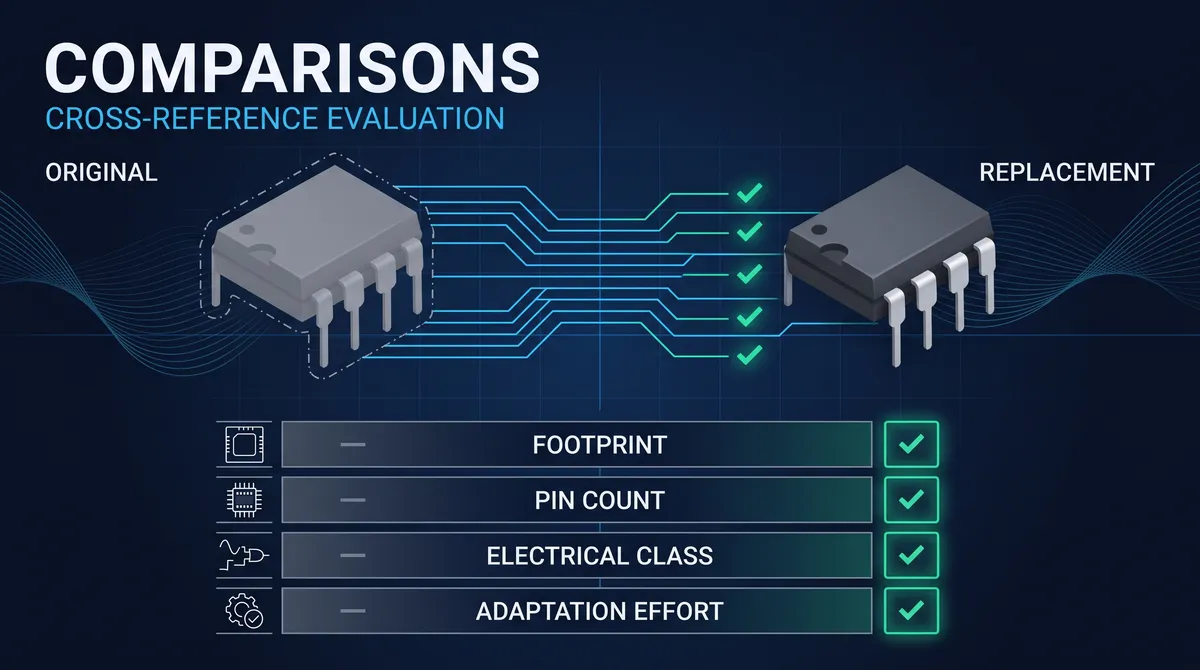
LM358 vs LM324 is one of the most common op-amp comparisons in electronics, because the two parts sit at the center of the general-purpose analog world and every engineer has picked between them at least once. The LM358 is a dual operational amplifier, two independent amplifiers in one package, and the LM324 is a quad operational amplifier, four independent amplifiers in a larger package, and the two share the same internal amplifier design, the same supply range, and the same electrical character, which is why the comparison is less about performance and more about how many amplifiers the board needs and in which package. Both parts run on a single supply from 3 to 32 volts or a split supply, both accept input voltages down to the negative rail, and both are built for the general-purpose tasks, the sensors, the comparators, the buffers, and the signal conditioning, that populate every analog board. This guide compares the two families across the package, the pinout, the supply, the quiescent current, the speed, the precision, and the audio behavior, and it gives the rule for choosing between them, so the next design picks the dual or the quad on the evidence rather than on the habit.
The comparison is also the entry to a family that is unusually easy to replace, which is worth stating at the start because it shapes the sourcing decision. The LM358 and the LM324 pinouts are shared across a wide field of manufacturers, and the market is full of pin-compatible equivalents, the LM2904 and the LM2902 variants, the vendor renumbers, and the domestic parts built to the same footprints, so a board designed around either part has a deep replacement market. The comparison therefore covers not only which of the two to choose but which part to choose when the design is fixed, because the dual-versus-quad decision and the package decision are separate from the vendor decision. This guide walks both, the engineering comparison that picks the family and the replacement view that secures the supply, and it is the working reference an engineer or a buyer keeps beside the datasheet.
LM358 vs LM324: The Core Difference
The core difference between the LM358 and the LM324 is the number of amplifiers in the package, and every other difference follows from that one fact. The LM358 contains two independent op-amps, each with its own non-inverting and inverting input and its own output, in an 8-pin package, and the LM324 contains four independent op-amps of the same design in a 14-pin package. The two parts share the internal amplifier architecture, the same supply range, the same input stage, and the same general-purpose character, so a circuit built around an LM358 amplifier behaves the same way when the same amplifier is built from an LM324, with the qualification that the package and the pin assignments differ. The comparison is therefore not a performance contest, because the performance per amplifier is essentially the same, it is a packaging and a count decision, how many amplifiers the board needs and which package serves them. The engineer who understands that reads the rest of the comparison correctly, the dual for the two-amplifier design and the quad for the four-amplifier design, and the specifications table as the shared character of the family.
The two parts are also the same amplifier design under two package counts, which is a useful mental model for the whole comparison. Texas Instruments originally defined the LM358 as the dual and the LM324 as the quad of the same general-purpose amplifier, and the market reproduced both in the same relationship, so the LM324 is effectively the LM358's amplifier repeated four times in a 14-pin package. The consequence is that the datasheet's per-amplifier specifications, the supply current per amplifier, the bandwidth, the slew rate, and the input offset, are comparable across the two parts, and the differences in the total quiescent current and the package and the pinout are the real differences the selection reads. The model also explains the replacement view: a design that needs four amplifiers can choose the LM324, and a design that needs two can choose the LM358, and both sit in families of pin-compatible parts that the market supplies. The core difference is the count, and the count decides the package, and the package decides the pinout, and the pinout is what the board actually mounts.
How the dual and quad op-amp families compare per amplifier
Comparing the two families per amplifier, rather than as packages, is the honest way to read the specifications. The per-amplifier supply current of the LM358 and the LM324 is the same design figure, roughly a few hundred microamps per amplifier, so the LM358 draws about half of what the LM324 draws when all amplifiers are active, and the quiescent-current difference between the two parts is the count difference rather than an architectural one. The bandwidth and the slew rate are the same per amplifier, the gain-bandwidth product of about 1 megahertz and the slew rate of a few tenths of a volt per microsecond, because the amplifier is the same silicon. The input offset and the bias current are the same per amplifier, with the datasheet's typical and maximum figures applying to each of the amplifiers in both packages. The comparison per amplifier is therefore a comparison of the shared design, and the selection between the LM358 and the LM324 is a selection of the count and the package, which is the distinction that the rest of the guide reads in the datasheet.
Pinout and Package: LM358 vs LM324
The package and the pinout are the physical difference the board cares about, and the comparison is a footprint decision first. The LM358 comes in the 8-pin package, the SOIC-8 and the DIP-8, with two amplifiers: pin 1 and pin 2 and pin 3 serve the first amplifier's output, inverting input, and non-inverting input, pin 5 and pin 6 and pin 7 serve the second, and pin 4 and pin 8 carry the negative and the positive supply. The LM324 comes in the 14-pin package, the SOIC-14 and the DIP-14, with four amplifiers and the supply on pin 4 and pin 11, and its pinout is the classic quad layout that the market reproduces. The board that mounts an LM358 cannot simply mount an LM324, because the packages differ, and the board that needs four amplifiers cannot use two LM358s without doubling the footprint and the cost. The package decision is the first decision of the comparison, and it is the decision that the schematic and the layout both follow.
The pinout also carries the numbering that the designer reads when the board is built. The LM358's 8-pin dual layout places the second amplifier's pins on the opposite side of the package from the first, and the LM324's 14-pin quad layout alternates the amplifiers around the package with the supply pins on the ends. The pin compatibility across the vendors is real: a design that uses an LM358 dual and a vendor's LM358-family part with the same 8-pin layout, and a design that uses an LM324 quad and a vendor's LM324-family part with the same 14-pin layout, both mount the replacement without a board change. The package and the pinout are therefore the anchor of the comparison and the anchor of the replacement market, and the engineer who reads them selects the part that the board can mount and the supplier can serve. The footprint is the physical contract of the comparison, and the pinout is the contract's fine print.
The LM358 8-pin and LM324 14-pin layouts compared
Comparing the 8-pin and the 14-pin layouts side by side makes the difference visual. The LM358's 8-pin dual shares the supplies on pin 4 and pin 8 and gives each amplifier its three pins, the output and the two inputs, on the same side of the package, while the LM324's 14-pin quad puts the supply on pin 4 and pin 11 and alternates the four amplifiers' six signal pins across the middle. The board designer reads the layout as a footprint, the LM358's SOIC-8 pad pattern and the LM324's SOIC-14 pad pattern are distinct, and the selection is locked to the layout the schematic draws. The layout also matters for the two-amplifier design that wants room to grow, because a design that anticipates a third or a fourth amplifier later can choose the LM324 quad now and leave the extra amplifiers unused, or choose the LM358 dual and change the layout when the design grows. The comparison of the layouts is the physical half of the selection, and it is the half that the schematic review resolves before the datasheet review begins.
Supply Range and Quiescent Current: LM358 vs LM324
The supply range of the LM358 and the LM324 is the same, and it is the specification that makes both parts useful across the board's power architecture. Both run on a single supply from 3 volts to 32 volts, and both run on a split supply of plus and minus 1.5 to 16 volts, and both accept input voltages that include the negative rail, which is the input stage's defining feature. The wide supply range means a single design can use either part across a range of products, a 5-volt board, a 12-volt board, and a 24-volt board, without changing the amplifier, and it is the reason the family is so widely applied. The quiescent current differs by the count: the LM358 draws the current for its two amplifiers and the LM324 draws the current for its four, so the LM324's total quiescent current is roughly double the LM358's when all amplifiers are active, and a battery-powered design that runs only one or two amplifiers should read the per-amplifier current and the shutdown behavior rather than the headline total.
The supply comparison also reads the output swing and the common-mode input range, because the parts' single-supply character is what the datasheet highlights. The output of both parts swings close to the positive rail and close to the negative rail, with the classic limitation that neither swings fully rail-to-rail, and the common-mode input range includes the negative rail but stops short of the positive rail, so a signal near the positive rail needs the input stage's headroom. The single-supply design that runs the input near the negative rail, the classic sensor-and-ground arrangement, is exactly what the family was built for, and the comparison reads that behavior as the shared character rather than as a difference. The supply and the quiescent current are the electrical foundation of the comparison, and the count difference is the number the battery design reads, while the shared supply range is the number the whole design reads.
How to read the supply current of the dual and quad parts
Reading the supply current of the dual and quad parts is a matter of the count and the load. The datasheet lists the quiescent current as the current the part draws with the amplifiers not driving a load, and the LM358 and the LM324 share the per-amplifier figure, so the LM324's total is approximately the LM358's total scaled to the two extra amplifiers. The real current the rail sees is the quiescent current plus the current the active amplifiers drive into their loads, and the drive current can dominate the quiescent figure when the outputs drive low-impedance loads. A battery design that uses two of the LM324's four amplifiers should compare the LM324's active quiescent against the LM358's, and a design that needs only two amplifiers on a quad board may still prefer the LM358 for the lower idle draw, or prefer the LM324 for the future headroom, and the trade is the count decision in the current domain. The supply current read is the practical energy decision of the comparison, and it is the number that the battery and the thermal budget use.
Bandwidth, Slew Rate, and Speed: LM358 vs LM324
The speed of the LM358 and the LM324 is the same per amplifier, and it is the general-purpose speed that the comparison always states. The gain-bandwidth product of about 1 megahertz sets the usable bandwidth at a given gain, so a circuit at unity gain passes signals up to roughly a megahertz and a circuit at a gain of ten passes signals up to roughly a hundred kilohertz, and the bandwidth at the design's gain is the number the selection reads. The slew rate of a few tenths of a volt per microsecond sets the large-signal speed, and a circuit that must reproduce a fast, high-amplitude signal reads the slew limit against the signal's rate of change. The speed is adequate for the general-purpose tasks, the sensors, the control loops, the comparators, and the audio line levels, and it is the limit for the high-speed signal processing, which the selection leaves to the faster op-amp families. The comparison of the speed is a comparison of the shared design, and the LM358 and the LM324 are equally fast, which is the honest statement the datasheet makes.
The speed read also sets the expectation for the circuits that push the family. A comparator application that switches a relay or an LED at a slow rate runs the family comfortably, and a filter application that needs a precise response at a few kilohertz reads the gain-bandwidth product at the filter's frequency. A design that needs a settling time for a sample-and-hold or a fast edge for a pulse reads the slew rate against the edge, and the family's modest slew means the fast pulse is limited. The comparison therefore pairs the speed with the application, and the rule is to use the LM358 and the LM324 for the general-purpose and the low-frequency tasks and to reach for a faster part where the bandwidth or the slew is the limit. The speed is the shared boundary of both parts, and the boundary is what keeps the comparison honest and the selection grounded.
How the gain-bandwidth product limits both op-amps
The gain-bandwidth product is the single number that states both parts' speed limit, and it is read at the gain the circuit uses. A voltage-feedback op-amp's gain-bandwidth product is a constant, so the closed-loop bandwidth equals the product divided by the closed-loop gain, and the LM358 and the LM324, with their product of about 1 megahertz, deliver a unity-gain bandwidth of about a megahertz and a gain-of-ten bandwidth of about a hundred kilohertz. A circuit that needs a gain of one hundred reads the bandwidth as ten kilohertz, and a circuit that needs a gain of one thousand reads it as one kilohertz, so the gain-bandwidth product is the boundary that the gain multiplies against. The comparison of the two parts is the same boundary, because the product is the same design figure, and the selection that needs more bandwidth at the same gain leaves the family for a faster part. The gain-bandwidth read is the speed discipline of the comparison, and it is the number that keeps a general-purpose part in its general-purpose lane.
Input Offset, Bias Current, and Precision: LM358 vs LM324
The precision specifications of the LM358 and the LM324 are the same per amplifier, and they define the parts' place in the analog hierarchy. The input offset voltage is typically a couple of millivolts and at most a few millivolts, the input bias current is in the tens of nanoamps, and the input common-mode range includes the negative rail, and the combination describes a general-purpose input stage rather than a precision one. The precision read is the error budget of the circuit: a sensor amplifier that reads a millivolt signal sees the offset as an error, and a level-shifter or a buffer that processes a large signal ignores it, so the application decides whether the family's precision is adequate. The comparison of the LM358 and the LM324 is the same precision, because the input stage is the shared design, and the selection that needs a lower offset or a lower bias current leaves the family for the precision parts. The precision is the honest boundary of the family, and the boundary is the reason the family serves the general-purpose tasks and the precision tasks go elsewhere.
The bias current deserves its own read, because it interacts with the source impedance. The input bias current of the family, in the tens of nanoamps, flows into the inputs and develops a voltage across the source impedance, so a high-impedance sensor source, a photodiode or a high-value divider, sees the bias as an offset that the balance resistor and the calibration correct. The design that runs a high-impedance source reads the bias and the offset against the signal's tolerance, and it adds the compensation the family needs. The comparison of the dual and the quad is the same bias, because the input stage is shared, and the selection between them is the count and the package rather than the precision. The precision read is the circuit-level half of the comparison, and it is the half that the application's error budget decides, which is the reason the guide keeps the precision in its general-purpose frame.
When the LM358 and LM324 precision is good enough
The family's precision is good enough for a wide share of the analog tasks, and naming them sets the expectation. A comparator that switches a threshold at a volt-level signal, a level shifter that maps a signal range, a buffer that isolates a source, a sensor amplifier that reads a signal in the tens of millivolts with a calibration, and an active filter that shapes an audio band, all run the family comfortably, because the offset and the bias are small relative to the signal and the calibration absorbs them. The family is not the right home for the microvolt instrumentation, the precision reference, or the high-accuracy converter front end, where the offset drift and the bias current dominate, and those designs read the precision family instead. The rule is to choose the LM358 or the LM324 when the signal is large relative to the offset and the bias, and to read the precision part when the signal is small. The precision boundary is the boundary that the application draws, and it is the boundary that keeps the general-purpose family in its productive lane.
Audio and Signal Path Considerations
The audio question is one of the most common in the LM358 vs LM324 comparison, and the honest answer is that neither part is a premium audio amplifier. The LM358 and the LM324 deliver the general-purpose speed, a gain-bandwidth product of about a megahertz and a modest slew rate, and they add the crossover distortion of the classic output stage, so a line-level audio path that drives a load hears the crossover and the bandwidth limits. The audio comparison is therefore not a choice between the two, because the two share the behavior, it is a choice about the audio role: a control signal, a tone generator, a level detector, or an LED meter runs the family acceptably, and a critical audio path that the listener judges leaves the family for the audio-grade op-amps, the TL072, the NE5532, and the others that the audio world standardizes on. The audio read is the application boundary of the comparison, and it is the boundary that the guide states plainly rather than flattering the parts.
The audio path that does use the family can still be made serviceable, because the design choices carry most of the quality. A line-level buffer or a tone-control stage built on the family with the right supply decoupling, the moderate source impedance, and the light load runs cleanly enough for the non-critical channels, and a design that needs the audio grade changes the part, often on the same pinout, because the audio op-amp families include pin-compatible options. The audio consideration is therefore a recommendation rather than a prohibition, and the recommendation is to read the audio role before the part, to use the family where the audio is functional rather than critical, and to reach for the audio-grade parts where the listener matters. The audio read completes the application mapping of the comparison, and it is the reason the LM358 and the LM324 stay in the general-purpose world that their speed and their output stage define.
Why audio designs often skip the LM358 and LM324
The audio designs that skip the LM358 and the LM324 do so for two reasons that the datasheet states: the bandwidth and the output stage. The gain-bandwidth product of about a megahertz places the open-loop gain and the distortion behavior at the audio band in a region where the general-purpose part's distortion and its noise matter to a listener, and the classic output stage adds the crossover distortion at the low signal levels that audio spends most of its time in. The audio-grade parts, the TL072 with its JFET input and its cleaner audio character, and the NE5532 with its higher drive and its wider bandwidth, are built for the audio path, and the audio world standardizes on them for a reason. The design that needs a clean audio signal reads the audio role first, selects the audio-grade part, and often finds the pin-compatible layout that the same socket serves, which is the replacement bridge between the general-purpose and the audio families. The audio skip is the application's honest verdict on the family, and the verdict is the reason the comparison keeps the audio role explicit.
When to Choose the LM358 or the LM324
The choice between the LM358 and the LM324 is the count and the package decision, and it reduces to a clear rule. Choose the LM358 dual when the design needs exactly two amplifiers, when the board wants the smaller 8-pin footprint, when the battery wants the lower quiescent current, or when the design is a simple two-stage signal path, and the dual serves the need with the least space and the least current. Choose the LM324 quad when the design needs three or four amplifiers, when the board wants one part instead of two, when the design anticipates growing to four stages, or when the cost per amplifier matters more than the footprint, and the quad serves the need with the one-package economy. The rule is the funnel of the comparison: the amplifier count decides the family, the package and the current refine the choice, and the application's special requirements, the audio, the precision, or the speed, decide the specific part within the family. The choice is the first decision of the analog block, and the rule makes it a decision rather than a guess.
The choice also carries the sourcing view, because the family's pin compatibility is the supply's anchor. A design that chooses the LM358 selects a family that every major vendor and a field of domestic parts reproduce on the 8-pin layout, and a design that chooses the LM324 selects the same field on the 14-pin layout, so the chosen part has a deep replacement market. The sourcing reads the vendor variants, the LM358N, the LM358DR, and the domestic equivalents, and it qualifies the replacement against the same pinout and the same per-amplifier specifications that this comparison laid out. The choice between the LM358 and the LM324 is therefore made once, at the schematic, and the supply is secured many times, at the sourcing, because the family's depth turns the chosen part into a replaceable part. The comparison closes with the sourcing view, and it is the view that turns an engineering decision into a supply decision.
A quick decision table for the LM358 and the LM324
| Decision | LM358 (dual, 8-pin) | LM324 (quad, 14-pin) |
|---|---|---|
| Amplifiers needed | Two | Three or four |
| Footprint | SOIC-8, DIP-8 | SOIC-14, DIP-14 |
| Quiescent current | Lower (two amplifiers) | Higher (four amplifiers) |
| Supply range | 3–32 V single, ±1.5–16 V split | Same |
| Speed per amplifier | ~1 MHz GBW, modest slew | Same |
| Input character | Inputs to negative rail, general-purpose offset/bias | Same |
| Audio | Functional, not critical | Same |
| Best use | Simple 2-stage signal paths, battery rails | Multi-stage analog blocks, cost-per-amplifier |
Worked Example: Choosing the Op-Amp for a Battery-Powered Sensor Board
Choosing the op-amp for a battery-powered sensor board is the worked example that shows the comparison's weights in a real design, and a two-channel sensor signal path is the case. The board runs from a 3.3-volt battery rail, reads a sensor on a two-stage path, an amplification stage and a buffer stage, and it needs two amplifiers, which points to the LM358 dual over the LM324 quad from the start. The application weights the dimensions the battery design cares about: the supply, the 3.3-volt rail inside both parts' range, the quiescent current, the dual's lower draw versus the quad's, the input, the sensor's signal and its offset and bias, the output, the swing that the amplifier and the buffer need, and the speed, the sensor signal's bandwidth inside the family's limit. The candidate that fits the two-stage path is the dual, and the design reads the current and the supply first because the battery is the limit, and the precision and the speed second because the sensor signal allows them. The worked example shows the comparison as a weight-by-application exercise, and it is the exercise the decision table at the end of the guide turns into a glance.
The worked example also reads the checks the battery design adds, because the family's quiescent current and its behavior at the low cell are the battery's real reads. The two active amplifiers draw the family's per-amplifier quiescent current, roughly hundreds of microamps total, which is a real but bounded draw in a battery budget, and the part's behavior at the 3.3-volt rail, and at the lower cell as the battery discharges, is read against the output swing and the input range the design needs. A design that must save the last microamps reads the family's quiescent current and compares it against the low-power op-amps, and the comparison between the family and the low-power parts is the same the audio and the precision comparisons ran, the weight that the application sets. The worked example completes the practical face of the comparison, and it is the face the sourcing view then secures.
How to Source the LM358 and the LM324
Sourcing the LM358 and the LM324 is the practical close for the buyer, because both parts sit in the deepest families the market supplies. The LM358's 8-pin dual layout and the LM324's 14-pin quad layout are reproduced by every major vendor and a field of domestic parts, and the sourcing can move across the vendor field on the same footprint, the LM358N, the LM358DR, the LM2904, and the domestic duals, and the LM324N, the LM324DR, the LM2902, and the domestic quads, which is the second-source depth the market has always used. The sourcing qualifies the alternative the way the series has laid out, the source, the documentation, the test evidence, and the sample, and the verification runs the per-amplifier review that this guide has read, the supply, the input, the output, the offset, and the bias, against the datasheet and the board. The sourcing view turns the LM358 and the LM324 choice into a supply-secured decision, which is the completion of the comparison and the reason the two parts stay the workhorses of the general-purpose world.
An LM358 and LM324 Quick Reference Card
| Question | Answer |
|---|---|
| How many amplifiers does the design need? | Two: LM358 dual. Three or four: LM324 quad. |
| Which package does the board mount? | LM358: SOIC-8 / DIP-8. LM324: SOIC-14 / DIP-14. |
| Is the rail a low-power battery rail? | LM358 draws less (two amplifiers), both are general-purpose. |
| Does the signal need audio or precision quality? | Neither part is audio or precision grade; use the audio or precision families. |
| What supply range do both accept? | 3–32 V single, ±1.5–16 V split. |
| What per-amplifier speed is shared? | ~1 MHz gain-bandwidth product, modest slew rate. |
The quick reference card is the guide's practical summary, and it is the card an engineer keeps beside the bench for the daily LM358-versus-LM324 decision.
LM358 vs LM324: Equivalents and Replacements
The LM358 and the LM324 sit in families that the market supplies with pin-compatible equivalents, and the replacement view is the final section of the comparison. The LM358's 8-pin dual layout is shared by the LM2904 and a field of vendor variants, and the LM324's 14-pin quad layout is shared by the LM2902 and the same field, so a design can source either function from multiple manufacturers and from the domestic parts built to the same footprints. The replacement qualification runs the same discipline as any substitution: confirm the package and the pinout, confirm the supply range and the per-amplifier specifications, confirm the speed and the precision the design needs, and test the replacement on the board across the temperature range. The replacement is pin-compatible because the family's layout is standardized, and it is behavior-compatible because the design is the same general-purpose amplifier, which is the combination that makes the LM358 and the LM324 among the easiest parts in the catalog to replace. The sourcing view closes the comparison with the supply secured.
The comparison also points to the faster and the more precise siblings for the designs that leave the family's lane. The TL072 and the LM833 and the audio-grade parts serve the audio path, the precision parts serve the instrumentation, and the high-speed parts serve the fast signal processing, and each is selected when the application's requirement exceeds the family's boundary that this guide has mapped. The LM358 and the LM324 remain the general-purpose workhorses, the parts that a designer reaches for when the requirement is a stable, single-supply, multi-amplifier block at a sensible cost, and the comparison's honest frame keeps them in that role. A designer who reads the LM358 vs LM324 comparison this way selects the count, the package, and the vendor on the evidence, and the selection is the working answer that the datasheet and the board both accept.
Not sure which sensor fits your project?
Talk to our mmWave application engineers for a free consultation.
Specify your hotel project with our engineers
Send your room count, ceiling type, and protocol preference. We will return a sample plan and quote within 24 business hours.
- Move from general guidance into a product or application discussion.
- Use RFQ when pricing, drawings, MOQ, or launch timing needs structure.
- Keep a direct contact path visible for fast clarifications and handoff.