Industrial Temperature IC Substitute: Finding Wide-Temperature-Range Electronic Components
Find reliable industrial temperature IC substitutes with extended temperature range. Expert guide covers component selection, sourcing strategies, and deployment considerations for extreme-environment electronics.
Industrial Temperature IC Substitute: Finding Wide-Temperature-Range Electronic Components
Industrial temperature IC substitutes are specialized semiconductor components rated for operation across extended temperature ranges, typically from -40°C to +85°C, +105°C, or in harsh-environment variants reaching +125°C and beyond. Unlike commercial-grade integrated circuits rated for 0°C to +70°C, these wide-temperature-range components incorporate enhanced process technologies, premium die materials, and robust packaging to withstand thermal cycling, vibration, and humidity exposure common in factory floors, outdoor installations, and equipment operating in unconditioned environments. The key distinction lies in process node selection—industrial temperature IC substitutes frequently employ older, more proven fabrication nodes (180nm, 350nm) rather than cutting-edge processes, trading raw performance for thermal resilience and long-term reliability. Typical applications include motor drive controllers, sensor interface circuits, power management in HVAC systems, industrial automation PLCs, and outdoor telecommunications equipment where component failure carries significant operational and safety consequences. Selection dimensions center on temperature rating verification, automotive AEC-Q100 or IEC 60068 compliance, packaging thermal resistance, and second-source availability to prevent supply chain disruption.
Why Standard Commercial ICs Fail in Industrial Environments
Commercial-grade integrated circuits are engineered for controlled indoor environments with stable ambient temperatures, minimal vibration, and predictable humidity levels. When deployed in industrial settings, these components frequently fail through several degradation mechanisms that compound over operational lifetime. Thermal fatigue represents the primary failure mode, where repeated expansion and contraction of silicon dies, bond wires, and package materials creates micro-cracks at metallurgical interfaces. Commercial ICs with standard lead-frame packages and epoxy mold compounds lack the thermal cycling endurance required for environments where temperatures swing 40°C or more within minutes.
Humidity ingress compounds thermal stress by introducing moisture into package interfaces, promoting corrosion of aluminum metallization and delamination between die attach and substrate materials. Industrial equipment in processing facilities, coastal installations, or outdoor deployments encounters humidity levels that commercial moisture sensitivity level (MSL) ratings do not adequately address. The typical MSL-3 rating of commercial components (168-hour floor life at 30°C/60% RH) proves inadequate when equipment may be powered continuously in 85% relative humidity conditions.
Vibration and mechanical shock present additional challenges that commercial IC packaging cannot survive indefinitely. Motor-driven equipment, transportation applications, and heavy machinery generate sustained vibrations that stress solder joints and wire bonds. Studies indicate that commercial-grade components in vibrating environments experience failure rates 10 to 100 times higher than in stable laboratory conditions, with bond wire lift-off and solder joint cracking representing the most common mechanical failure modes.
Radiation-induced latch-up and single-event effects become relevant in certain industrial deployments, particularly in high-altitude installations, medical equipment sterilization environments, and locations near radiation sources. Commercial CMOS processes exhibit heightened susceptibility to latch-up phenomena when exposed to ionizing radiation or electrical transients, whereas industrial temperature IC substitutes often incorporate latch-up resistant design techniques and hardened epitaxial layers.
Supply chain continuity risks associated with commercial components also drive adoption of industrial temperature IC substitutes. Manufacturers frequently discontinue commercial-grade ICs with minimal notice, leaving equipment producers scrambling for substitutes. Industrial-rated variants typically enjoy extended lifecycle support—often 10 to 15 years—and second-source manufacturer agreements that provide supply chain stability essential for capital equipment with 20+ year deployment horizons.
Understanding Temperature Range Specifications and Ratings
The semiconductor industry employs standardized temperature grades to categorize ICs by their guaranteed operating ranges, with meaningful distinctions that directly impact reliability in industrial applications. Commercial temperature range spans 0°C to +70°C, designed for office environments and consumer electronics where ambient conditions remain controlled. Industrial temperature range extends this to -40°C to +85°C, accommodating equipment sheds, unconditioned spaces, and outdoor deployments in temperate climates. Extended industrial ratings reach -40°C to +105°C, addressing equipment in poorly ventilated enclosures and warm geographic regions. The automotive temperature grade, -40°C to +125°C, represents the most demanding common specification, developed for under-hood and engine compartment deployments.
The junction temperature—actual temperature of the silicon die during operation—determines IC reliability more directly than ambient temperature specifications. Engineers must calculate junction temperatures using thermal resistance parameters (θJA for junction-to-ambient, θJC for junction-to-case) combined with power dissipation and actual airflow conditions. An IC rated for +125°C maximum junction temperature may specify this limit under specific test conditions that differ substantially from actual deployment scenarios. For example, a voltage regulator with 40°C/W thermal resistance dissipating 500mW creates a 20°C temperature rise above ambient, meaning a device rated for +125°C junction temperature experiences accelerated degradation when ambient exceeds +105°C.
Temperature hysteresis and thermal shock resistance represent additional specification parameters that determine long-term reliability. Industrial temperature IC substitutes undergo more rigorous temperature cycling tests than commercial components—typically 1000 cycles from -40°C to +125°C rather than the 100 cycles specified for commercial grade. These extended cycling tests reveal package cracking, delamination, and wire bond degradation that would not appear in shorter-duration commercial qualification testing.
Datasheet specification interpretation requires careful attention to parameter characterization conditions. Many IC specifications—particularly analog parameters like offset voltage, bandwidth, and noise—are characterized only at +25°C or across the commercial temperature range. The industrial temperature rating may apply only to digital functionality and basic DC parameters, with analog performance specified separately across extended temperature. Engineers must verify that all critical parameters are guaranteed across the full intended operating temperature range rather than assuming blanket coverage.
Process node selection significantly influences temperature performance characteristics. Mature process nodes (180nm to 1μm) exhibit higher inherent radiation tolerance, better latch-up immunity, and more predictable aging behavior across temperature extremes compared to advanced sub-micron processes optimized for speed and density. Industrial temperature IC substitutes frequently employ these proven processes, sacrificing absolute performance for guaranteed behavior across the temperature range and extended product lifecycles.
Key Specifications for Industrial Temperature IC Substitutes
Selecting appropriate industrial temperature IC substitutes requires systematic evaluation of electrical, thermal, and mechanical specifications that collectively determine fitness for specific deployment environments. Understanding these parameters enables engineers to match components to application requirements rather than defaulting to maximum temperature ratings that may prove unnecessary or insufficient for particular use cases.
Operating temperature range specification defines the boundaries within which the IC guarantees electrical performance. The datasheet specifies minimum and maximum temperatures—typically -40°C to +85°C, +105°C, or +125°C—along with conditions under which these limits apply. Premium datasheets distinguish between functional operating range (device survives but may have degraded performance) and specified operating range (all parameters meet datasheet limits). Engineers must confirm that all critical parameters are specified across the intended deployment temperature range rather than assuming linear degradation or accepting characterization at representative temperatures.
Power supply voltage tolerance encompasses both absolute maximum ratings and recommended operating conditions across temperature. Silicon carrier mobility decreases as temperature rises, effectively reducing transistor drive strength and potentially slowing digital switching speeds. Conversely, subthreshold leakage currents increase exponentially with temperature, potentially causing functional failure in low-power circuits. Industrial temperature IC substitutes characterize voltage ranges at temperature extremes, providing design margins that commercial datasheets often omit. Input thresholds, output drive strength, and reference voltage accuracy all vary with temperature, requiring datasheet verification for all critical parameters at deployment temperature extremes.
ESD (electrostatic discharge) robustness determines component survival during handling, assembly, and field service. Industrial equipment frequently encounters higher ESD exposure than consumer electronics due to longer cable runs, larger enclosures with accumulated charge, and human operators wearing standard work clothing rather than ESD-safe garments. Industrial temperature IC substitutes typically specify ESD tolerance of ±2kV to ±8kV human body model (HBM), substantially exceeding the ±500V to ±1kV common in commercial components.Latch-up immunity testing per JEDEC JESD78 characterizes IC susceptibility to latch-up phenomena induced by transient current injection. Commercial ICs may exhibit latch-up triggering at currents as low as 100mA, while industrial variants typically withstand 200mA to 500mA without latch-up, providing crucial margin against supply transients and ground bounce encountered in industrial power distribution systems.
Thermal resistance parameters (θJA, θJC, θJB) enable junction temperature calculation under actual deployment conditions. These values vary significantly with PCB layout, copper weight, via density, and airflow conditions. Datasheet values typically represent worst-case conditions (still air, minimal copper) that may substantially underestimate thermal performance achievable with proper thermal management design. Engineers should request thermal characterization reports from manufacturers or perform thermal simulation to verify junction temperatures remain below datasheet limits under worst-case deployment scenarios.
Mechanical specifications including package type, lead finish, and moisture sensitivity level (MSL) determine assembly compatibility and long-term reliability. Industrial temperature IC substitutes commonly employ NiPdAu (Nickel-Palladium-Gold) or matte-tin lead finishes that withstand multiple reflow cycles and resist whiskering better than pure tin finishes. MSL ratings of Level 1 (unlimited floor life) or Level 2a (four weeks floor life at 30°C/60% RH) indicate packages suitable for industrial storage and assembly conditions without special moisture protection handling.
Finding Reliable Substitutes for Common IC Families
Systematic substitution of commercial ICs with industrial temperature equivalents requires understanding which IC categories benefit most from extended temperature ratings and where functional equivalence can be achieved without compromising system performance. Several IC families present common substitution opportunities across industrial equipment designs.
Operational amplifiers represent perhaps the most frequently substituted IC category, as analog signal conditioning circuits often deploy in thermally challenging locations distant from temperature-controlled electronics enclosures. Industrial temperature op-amp substitutes maintain specification across -40°C to +125°C, with typical specifications including input offset voltage drift below 2μV/°C, common-mode rejection exceeding 90dB, and output swing within 1.5V of supply rails under full load. Popular industrial substitute families include rail-to-rail input/output variants, precision instrumentation amplifiers with sub-microvolt offset, and high-speed amplifiers with 50MHz+ bandwidth for data acquisition applications. Cross-reference tools and parametric search engines at distributors like Digi-Key, Mouser, and Arrow enable identification of pin-compatible industrial substitutes for commercial op-amp packages including SOIC-8, TSSOP-14, and MSOP-8.
Voltage regulators and power management ICs require careful substitution consideration due to thermal sensitivity of regulation accuracy and efficiency. Industrial temperature LDOs (low-dropout regulators) specify output voltage accuracy across temperature—typically ±1% to ±2% from -40°C to +125°C—along with dropout voltage and quiescent current specifications at temperature extremes. Switching regulators present additional complexity as inductor saturation characteristics, MOSFET on-resistance, and control loop stability all vary with temperature. Industrial substitutes for common linear regulators (78xx series, LM317, AMS1117) and switching controllers (LM2575, LM2596) offer drop-in compatibility with enhanced thermal performance. Some manufacturers produce industrial-grade versions of these classic regulators with identical pinouts but extended temperature ratings and guaranteed specifications to +125°C.
Microcontrollers and embedded processors represent high-value substitution opportunities where pin compatibility enables board re-use while extended temperature ratings support industrial applications. ARM Cortex-M based MCUs from major manufacturers including STMicroelectronics, NXP, Renesas, and Microchip offer industrial temperature grades with guaranteed operation to +105°C or +125°C. Selection criteria include temperature-rated flash memory endurance (most industrial MCUs specify 10k write cycle minimum vs. 1k for commercial), extended bootloader and middleware support lifecycles, and long-term availability commitments from manufacturers. 32-bit MCUs in LQFP-32 through LQFP-144 packages provide upgrade paths from aging 8-bit architectures while maintaining board layout investment.
Interface ICs including RS-485/RS-422 transceivers, CAN controllers, and USB hub chips require industrial temperature substitution when deployed in equipment with extended cable runs or external connectivity. These circuits experience larger common-mode voltage swings, greater ESD exposure, and more thermal cycling than internal components, making robust industrial grades essential for reliable communication. Industrial substitutes feature ±15kV ESD protection, extended common-mode input ranges (±25V vs. ±7V for commercial variants), and thermal shutdown protection that prevents latch-up damage from bus faults.
Memory ICs including serial EEPROM, parallel flash, and SRAM require industrial temperature substitution when deployed in equipment storage or data logging applications operating across wide temperature ranges. Industrial EEPROM substitutes specify 1 million write cycle endurance and 100-year data retention across -40°C to +125°C, compared to 100k cycles and 10-year retention for commercial equivalents. NAND flash substitutes for embedded applications employ error correction and wear-leveling controllers optimized for industrial temperature operation with extended cycling requirements.
Sourcing and Procurement Considerations
Securing reliable supply of industrial temperature IC substitutes requires strategic engagement with distribution channels, manufacturer relationships, and inventory management practices that differ substantially from commercial component procurement. The extended product lifecycles and smaller market volumes characteristic of industrial components create distinct supply chain dynamics that procurement teams must navigate effectively.
Authorized distribution remains the primary sourcing channel for industrial temperature IC substitutes, providing traceability, warranty support, and protection against counterfeit components. Major franchised distributors including Arrow Electronics, Avnet, Digi-Key, and Mouser maintain stocked inventories of industrial-grade components from established manufacturers, typically with same-day or next-day shipping for standard orders. These distributors provide datasheet access, technical support, and parametric search tools that enable engineers to identify appropriate substitutes during design phases. Premium pricing at authorized channels—typically 50% to 200% above commercial equivalents—reflects the added value of supply chain integrity and manufacturer support.
Independent distribution (broker) sourcing becomes necessary for obsolete industrial components, large volume requirements exceeding franchised inventory, or cost-sensitive applications where authorized pricing proves prohibitive. Broker sourcing requires robust counterfeiting mitigation practices including visual inspection, X-ray fluorescence material analysis, date code verification, and functional testing before deployment. Organizations lacking in-house verification capabilities should engage independent test houses or require certificates of conformance from brokers with established quality management systems.
Manufacturer direct procurement offers advantages for high-volume industrial applications where volume pricing, custom configuration, and extended support agreements justify the additional procurement complexity. Direct relationships with manufacturers like Texas Instruments, Analog Devices, STMicroelectronics, and Microchip enable volume pricing negotiations, product lifecycle visibility, and access to industrial temperature variants not stocked by distribution. Long-term supply agreements (LTSAs) commit manufacturers to extended availability—typically 10 to 15 years—providing supply chain predictability essential for equipment with multi-decade deployment horizons.
Lifecycle management practices must track industrial component availability and trigger substitution activities well before end-of-life announcements create procurement crises. Most major semiconductor manufacturers publish product lifecycle timelines indicating active, nrfnd (not recommended for new designs), and obsolete status. Engineering change notification (ECN) programs provide advance warning of discontinuations, enabling proactive qualification of substitute components before legacy parts become unavailable. Organizations lacking formal lifecycle management processes face significant risk of production interruptions when industrial substitutes suddenly become unavailable.
Inventory buffering strategies for critical industrial components balance carrying cost against supply disruption risk. For components with proven reliability issues or constrained supply, maintaining 6 to 12 months of inventory provides time to qualify alternate sources or engineering changes. Just-in-time inventory practices appropriate for high-volume commercial production prove risky for industrial applications where substitution qualification may require 3 to 6 months and alternate source qualification 6 to 12 months. Risk assessment frameworks that categorize components by criticality, substitutability, and supply risk enable targeted inventory investment.
Quality Assurance and Testing for Industrial Deployment
Deploying industrial temperature IC substitutes in mission-critical equipment requires quality assurance practices that verify component authenticity, specification compliance, and fitness for the intended deployment environment beyond manufacturer datasheet specifications. Comprehensive testing programs mitigate risks from counterfeit components, batch-to-batch variation, and deployment conditions more severe than datasheet characterization conditions.
Incoming inspection testing validates that received industrial temperature IC substitutes meet specification before board assembly and system integration. Basic incoming inspection includes visual inspection for physical defects, lead finish quality assessment, and datasheet parameter verification on sampling basis. Critical parameters for industrial IC verification include functionality at temperature extremes (chamber testing from -40°C to +125°C), ESD withstand voltage, and supply current under no-load conditions. Organizations lacking in-house test capabilities should establish relationships with independent test laboratories capable of performing temperature cycling, electrical characterization, and failure analysis on sampled components.
Counterfeit detection has become essential for all industrial component sourcing, given the proliferation of remarked, recycled, and counterfeit integrated circuits in global distribution channels. Comprehensive counterfeit detection programs employ multiple complementary techniques including X-ray inspection for die authenticity and bond wire integrity, acoustic microscopy for package delamination and die attach voids, scanning electron microscopy with energy dispersive X-ray spectroscopy (SEM/EDS) for lead finish composition verification, and decapsulation inspection for die markings and construction. These techniques detect common counterfeit indicators including die mismatches, lead finish composition deviations, and package modifications that compromise reliability.
Extended temperature testing beyond datasheet specifications provides confidence margins for deployment in thermally challenging environments. While datasheet specifications guarantee performance at rated temperature extremes, additional margin testing to +150°C or cold testing to -55°C reveals latent defects and design margins that predict field reliability. Temperature cycling tests with dwell times and ramp rates exceeding datasheet conditions accelerate failure mechanisms and reveal design weaknesses. Organizations deploying industrial ICs in outdoor equipment, unventilated enclosures, or geographic regions with extreme climates should consider qualification testing that exceeds published specifications by 10% to 20%.
Statistical process control and lot tracing enable continuous improvement of industrial component quality and rapid response to field reliability concerns. Recording lot codes, date codes, and supplier information for each component placement enables correlation of field failures with specific component lots, identifying whether issues represent systemic problems or isolated incidents. When field failures occur, lot tracing enables targeted recall of affected equipment while avoiding unnecessary service actions on unaffected units. Quality management systems conforming to ISO 9001 provide frameworks for systematic quality data collection and analysis.
Supplier quality audits verify that component sources maintain manufacturing processes, testing capabilities, and quality management systems appropriate for industrial applications. For critical components, site audits assess assembly facilities, testing laboratories, incoming material controls, and statistical process control practices. Audit findings enable informed sourcing decisions and may identify process improvements that reduce component defects. Organizations relying on broker sources for industrial components should audit those brokers' verification capabilities and quality management systems.
Common Applications in Industrial Environments
Industrial temperature IC substitutes serve diverse applications across manufacturing, infrastructure, energy, and transportation sectors where component reliability directly impacts operational safety, productivity, and maintenance costs. Understanding typical deployment scenarios guides specification decisions and helps engineers anticipate environmental challenges that influence component selection.
Motor control and power conversion applications deploy industrial temperature IC substitutes extensively due to thermal challenges from power dissipation and environmental exposure. Variable frequency drives (VFDs), servo drives, and motor soft-starters operate in enclosures with significant heat generation from IGBT modules and DC link capacitors. Ambient temperatures in factory floors without climate control can reach +50°C during summer months, while equipment operating outdoors experiences temperatures from -30°C to +60°C across seasonal cycles. Industrial op-amps for current sensing, gate drivers for switching devices, and isolated CAN or RS-485 interface ICs for communication must all withstand these conditions while maintaining precise control over motor operation. Failure of motor control electronics can cause equipment damage, production downtime, and safety hazards, making industrial temperature IC substitutes essential rather than optional.
Industrial automation and process control equipment including programmable logic controllers (PLCs), distributed I/O modules, and human-machine interfaces (HMIs) deploy industrial temperature IC substitutes throughout. These systems often control manufacturing processes requiring ambient temperatures from 0°C to +45°C per IEC 61131-2 standards, but control cabinets may be located in areas with poor ventilation, near heat sources, or subject to direct sunlight heating. PLC processors, communication controllers, analog input modules, and relay driver ICs all benefit from industrial temperature ratings that provide margin against thermal excursions. The modular architecture of PLC systems enables field replaceable units (FRUs) that can be swapped during maintenance windows, but system availability requirements drive selection of highly reliable industrial components.
Building automation systems covering HVAC control, lighting management, fire detection, and access control deploy industrial temperature IC substitutes in both indoor and outdoor locations. Thermostats, zone controllers, and occupancy sensors located in building zones experience temperature ranges determined by HVAC setpoints and occupancy patterns, often from +10°C to +35°C, but field devices in unconditioned spaces like parking structures, mechanical rooms, and exterior locations may experience full outdoor temperature ranges. BACnet, Modbus, and KNX communication transceivers, along with temperature sensor interface ICs and display driver electronics, require industrial temperature ratings for outdoor deployments. Building automation equipment often operates continuously for 20+ years without major overhaul, making component lifecycle and long-term availability critical selection factors.
Transportation applications including railway, marine, and heavy equipment electronics present particularly demanding requirements for industrial temperature IC substitutes. Rolling stock electronics experience vibration, wide temperature ranges (typically -40°C to +70°C for exterior equipment), and power quality challenges from traction system interference. Marine electronics face salt spray exposure, humidity, and vibration from vessel operation. Heavy equipment electronics in construction, mining, and agricultural machinery experience shock loading, contamination, and extreme temperature cycling as equipment moves between shaded and sun-exposed locations. These applications frequently require automotive-grade (AEC-Q100) components with extended temperature ratings to +125°C, along with vibration and humidity resistance exceeding standard industrial specifications.
Energy infrastructure including solar inverters, wind turbine controllers, battery management systems, and smart grid communication equipment deploy industrial temperature IC substitutes for outdoor installations across diverse climatic conditions. Solar inverters mounted on rooftops or ground-mounted arrays experience panel surface temperatures reaching +85°C in direct sun, with wide temperature swings between day and night operation. Wind turbine nacelles maintain moderate internal temperatures but experience vibration from turbine operation and electrical transients from grid disturbances. Battery management systems for stationary storage experience thermal gradients across battery strings and must maintain measurement accuracy across wide temperature ranges to ensure safe charging and discharging. These applications require careful thermal management design combined with industrial temperature IC substitutes that provide reliable operation across the full deployment temperature range.
Regulatory Compliance and Industry Standards
Industrial temperature IC substitutes must satisfy various regulatory and industry standards that define minimum requirements for safety, electromagnetic compatibility, and environmental resilience. Understanding which standards apply to specific applications enables engineers to select components with appropriate certifications, reducing compliance testing burden and accelerating time to market.
The AEC-Q100 standard from the Automotive Electronics Council defines stress test qualification requirements for automotive-grade integrated circuits, including temperature range specifications, accelerated life testing, and failure criteria. AEC-Q100 grades define temperature ranges from Grade 0 (-40°C to +150°C junction) through Grade 3 (-40°C to +85°C), with higher grades required for more thermally demanding automotive applications. While designed for automotive applications, AEC-Q100 qualification provides strong confidence in component reliability for industrial applications with similar environmental challenges. Equipment manufacturers in transportation, heavy equipment, and outdoor industrial applications often specify AEC-Q100 qualified components as a quality differentiator.
IEC 60068 environmental testing standards define test methods for electronic equipment resilience to temperature, humidity, vibration, shock, and other environmental stressors. IEC 60068-2-1 (cold), IEC 60068-2-2 (dry heat), and IEC 60068-2-14 (temperature change) define test procedures for temperature testing, while IEC 60068-2-78 defines damp heat testing. Components meeting these test requirements demonstrate environmental resilience documented in standardized formats that simplify compliance verification for equipment manufacturers. Industrial equipment destined for European markets must often demonstrate compliance with these standards as part of CE marking requirements.
UL and CSA safety certifications address fire and electrical safety hazards from electronic equipment, with specific requirements for components that may affect safety functions. Safety-critical applications including motor controls, power supplies, and fire detection systems may require components with recognized safety ratings (UL 60950-1, UL 62368-1, or newer UL 62368-1) indicating evaluation by safety certification organizations. Industrial temperature IC substitutes used in safety-critical functions should carry appropriate safety ratings or be qualified through equipment-level safety evaluation.
Electromagnetic compatibility (EMC) requirements including CISPR, FCC, and IEC 61000 standards address radiated and conducted emissions, along with immunity to electromagnetic interference. Components with integrated EMI mitigation features—spread-spectrum clocking, controlled edge rates, and integrated filtering—simplify EMC compliance for end equipment. Industrial equipment meeting EMC requirements for heavy industrial environments (Class A per CISPR 11) may require careful component selection and PCB layout practices that industrial temperature IC substitutes with integrated EMI features support.
The Restriction of Hazardous Substances (RoHS) directive restricts lead, mercury, cadmium, and other materials in electronic equipment sold in European markets. Industrial temperature IC substitutes are universally available in RoHS-compliant versions with matte-tin or NiPdAu lead finishes, though some specialty components may only be available with standard lead-frame plating. Engineers specifying components for European market equipment must verify RoHS compliance for all components, including industrial substitutes for previously available commercial parts.
China RoHS (Management Methods for Controlling Pollution Caused by Electronic Information Products) establishes similar restrictions for products sold in China, requiring material declaration and environmental protection use periods. Industrial equipment exported to China requires components with appropriate China RoHS declarations, typically documented through manufacturer environmental compliance databases accessible to procurement and engineering teams.
Conflict minerals reporting under Section 1502 of the Dodd-Frank Act requires companies to disclose use of tantalum, tin, tungsten, and gold from conflict sources in the Democratic Republic of Congo region. Major semiconductor manufacturers provide conflict minerals statements and supply chain due diligence documentation, enabling equipment manufacturers to comply with disclosure requirements. Industrial temperature IC substitutes from established manufacturers typically include conflict-free sourcing declarations.
Alternative Approaches and Emerging Technologies
While industrial temperature IC substitutes provide reliable solutions for wide-temperature-range applications, emerging technologies and alternative design approaches offer new possibilities for engineers facing extreme environmental challenges. Understanding these alternatives enables informed decisions about component selection and system architecture.
Wide-bandgap semiconductors including silicon carbide (SiC) and gallium nitride (GaN) enable power electronics operating at junction temperatures exceeding 200°C, potentially simplifying thermal management in high-power industrial applications. SiC MOSFETs and Schottky diodes now achieve commercial temperature ratings to +200°C, enabling power conversion equipment with reduced cooling requirements and improved power density. However, these devices require different gate drive, protection, and layout considerations compared to silicon IGBTs and MOSFETs, and availability of SiC and GaN ICs with matching temperature ratings remains limited. Engineers considering wide-bandgap adoption should evaluate system-level benefits against increased design complexity and component sourcing challenges.
Solid-state electronics using GaN processes offer inherent advantages for high-temperature operation due to higher carrier mobility and breakdown field strength compared to silicon. GaN ICs for RF amplification, power conversion, and sensing applications are emerging in industrial temperature grades, though market availability remains narrower than for silicon-based alternatives. The higher cost of GaN components may be justified by system-level benefits including reduced passive component sizes, improved efficiency, and extended temperature operation.
Integrated sensor solutions combining sensing elements with signal conditioning electronics in single packages simplify industrial temperature sensor design while improving measurement accuracy. Industrial temperature sensor ICs integrating RTD or thermocouple interfaces with cold-junction compensation, PGA (programmable gain amplifiers), and digital output interfaces like SPI or I2C reduce component count and board area compared to discrete implementations. These integrated solutions often specify performance across -40°C to +125°C or wider ranges, providing turnkey solutions for industrial temperature measurement applications.
Wireless connectivity ICs with industrial temperature ratings enable remote monitoring and control in applications where wiring proves impractical or cost-prohibitive. Industrial wireless MCUs with integrated sub-GHz or 2.4GHz transceivers, certified for operation from -40°C to +85°C or +105°C, support industrial IoT deployments for asset tracking, environmental monitoring, and predictive maintenance applications. Low-power wireless protocols including Bluetooth Low Energy, sub-GHz proprietary, and emerging standards like Wi-SUN provide flexibility in range, power consumption, and network topology.
Machine learning accelerators and edge AI processors with industrial temperature ratings enable deployment of intelligence at the network edge for industrial applications including visual inspection, predictive maintenance, and process optimization. These processors, increasingly available from semiconductor manufacturers like NVIDIA, Intel, and dedicated AI chip companies, enable sophisticated analytics without cloud connectivity, reducing latency and addressing data privacy concerns in industrial environments. Industrial temperature AI processors typically rate to +85°C or +105°C, enabling deployment in factory environments with appropriate thermal management.
System-in-package (SiP) solutions integrating multiple ICs, passive components, and sometimes complete functional subsystems in single packages offer compelling advantages for industrial applications. By moving interconnections inside the package, SiP solutions reduce board area, improve signal integrity, and enable use of ICs that might not be available in suitable individual packages. Industrial temperature SiP solutions for power management, sensor interface, and communication applications continue expanding as packaging technologies mature and demand grows.
Flexible and printed electronics using organic semiconductors and printed conductors offer unique capabilities for temperature and pressure sensing on non-flat surfaces, though temperature ratings currently lag behind silicon-based alternatives. These technologies enable sensing integration on curved surfaces, flexible cables, and wearable devices for industrial worker safety monitoring. As organic semiconductor stability improves, these technologies may find additional industrial applications where conventional electronics cannot be deployed.
Conclusion and Selection Best Practices
Finding appropriate industrial temperature IC substitutes requires systematic evaluation of application requirements, component specifications, and supply chain considerations that collectively determine successful deployment. The investment in proper component selection pays dividends through reduced field failures, improved system reliability, and extended product lifecycles that justify premium component pricing.
Successful industrial temperature IC selection begins with thorough characterization of the deployment environment, including temperature extremes, humidity exposure, vibration levels, and EMC challenges. Over-specifying temperature ratings wastes cost and may limit component availability, while under-specifying creates reliability risks. Engineers should obtain environmental data from similar equipment deployments, equipment location specifications, and industry standards applicable to their application category.
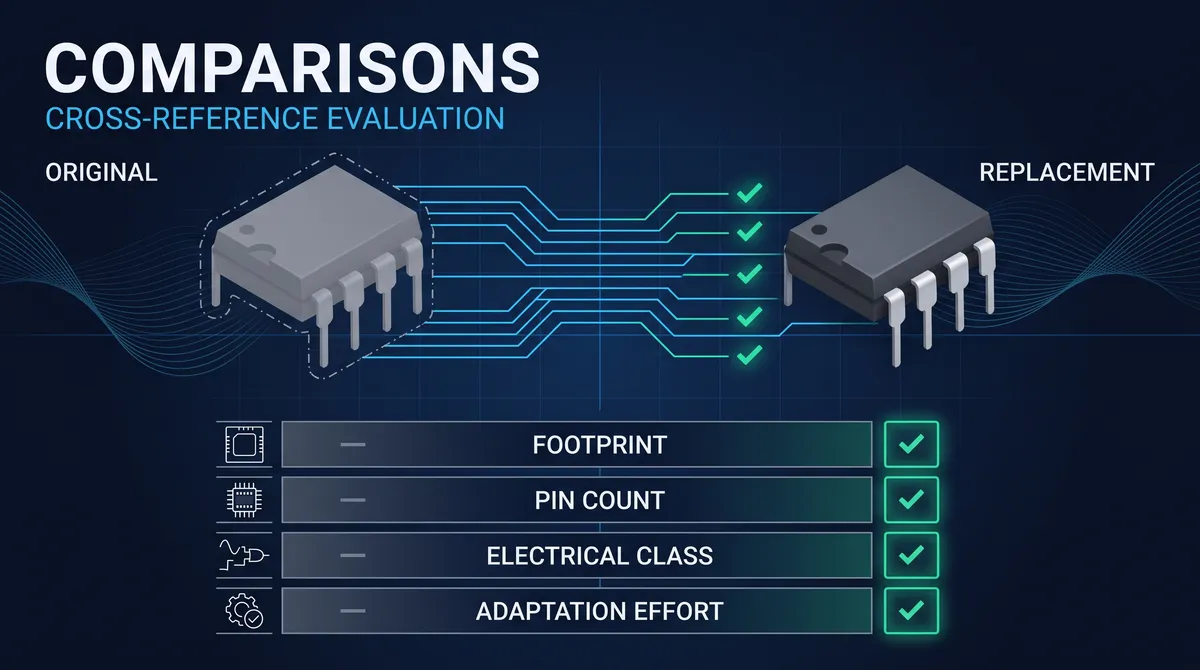
Parametric search tools at major distributors enable systematic identification of industrial temperature IC substitutes meeting electrical, thermal, and mechanical requirements. Beginning with base function search (op-amp, voltage regulator, microcontroller) and filtering by temperature range, package type, and key specifications narrows candidate lists to manageable numbers for detailed evaluation. Cross-reference databases link commercial parts to industrial equivalents, identifying drop-in substitutes where pin compatibility enables board re-use.
Verification testing of candidate components under actual deployment conditions provides confidence that datasheet specifications translate to reliable field operation. In-system characterization, temperature chamber testing, and long-term reliability testing under accelerated conditions reveal issues not apparent from datasheet review alone. Organizations lacking in-house testing capabilities should engage independent test laboratories or request characterization data from component manufacturers.
Supply chain planning ensures industrial temperature IC substitutes remain available throughout the equipment lifecycle. Establishing relationships with authorized distributors, qualifying alternate sources, and maintaining appropriate buffer inventory mitigates risks from component discontinuation, supply constraints, or quality issues. Lifecycle management practices that track component status and trigger substitution activities proactively prevent production interruptions.
Documentation practices capture selection rationale, verification results, and supplier information in design records that support future maintenance, redesign, and regulatory compliance activities. As industrial equipment often operates for 20+ years, documentation enabling component identification and sourcing decades after original design proves invaluable for maintenance and obsolescence management.
The growing availability of industrial temperature IC substitutes across diverse IC categories—microcontrollers, analog components, power management, communication interfaces, and sensors—enables deployment of sophisticated electronics in previously impractical locations. Engineers who invest appropriately in component selection and verification can confidently deploy feature-rich industrial equipment across the full range of industrial environments.
Not sure which sensor fits your project?
Talk to our mmWave application engineers for a free consultation.
Specify your hotel project with our engineers
Send your room count, ceiling type, and protocol preference. We will return a sample plan and quote within 24 business hours.
- Move from general guidance into a product or application discussion.
- Use RFQ when pricing, drawings, MOQ, or launch timing needs structure.
- Keep a direct contact path visible for fast clarifications and handoff.