How to Source Obsolete Electronic Components
How to source obsolete electronic components: qualify independent distributors, verify stock with certificates and tests, and plan last-time-buy and EOL stock.
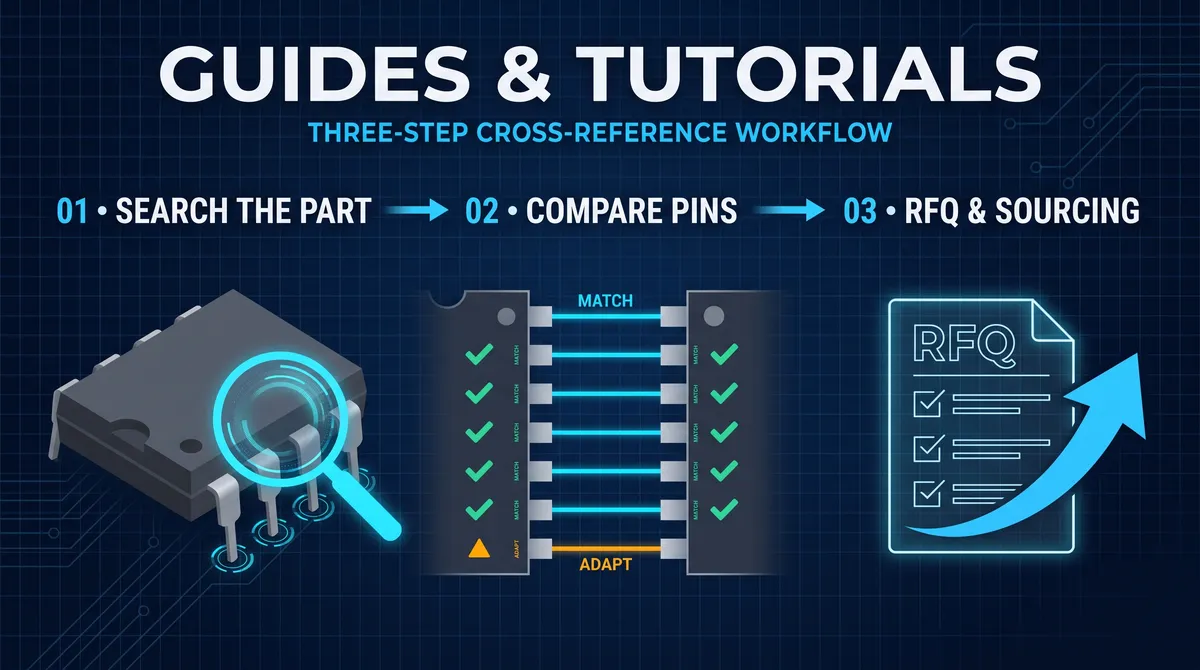
How to source obsolete electronic components is a supply chain question that every product with a long life eventually faces, because the semiconductor industry moves faster than the products built on it. An obsolete electronic component is a part the original manufacturer no longer produces, either because it went end-of-life, because the process technology is retired, or because the market moved to a newer function, and the product built around it still needs to ship for months or years after the part disappears from the normal channel. The sourcing answer is not one destination but a market, made up of authorized distributors with residual stock, independent distributors who hold legacy inventory and run test laboratories, brokers who trade across the gray market, and online marketplaces that aggregate them, each with its own reliability, price, and verification requirements. This guide explains how that market works, how to qualify the suppliers in it, how to verify that the parts they sell are authentic and usable, and how to plan the whole activity as a discipline, last-time-buy orders, EOL watches, and BOM planning, so that an obsolete part becomes a scheduled procurement event instead of a production crisis.
The stakes of obsolete sourcing are higher than a normal parts buy, because the market is thinner, the part is no longer produced, and a bad acquisition cannot simply be replaced next week. A counterfeit or failed lot of an obsolete part can halt a production line for weeks while the substitute is found, damage a product's reputation in the field, and consume engineering time that a redesign budget was never given. That is why the professionals who source obsolete parts well run the same discipline every time: they qualify the source before they trust it, they verify the part before they spend on the quantity, and they carry the planning documents, the EOL notices, the last-time-buy quantities, and the verification records, from the first signal to the last shipment. This guide gives that discipline a repeatable shape, so that the next obsolete part on the BOM is handled the way the last one was, with evidence, schedule, and a source that has already earned the trust.
How to Source Obsolete Electronic Components: The Market and Its Players
The obsolete components market is a supply chain with its own structure, and understanding who sells what is the first step in sourcing it safely. The first player is the authorized distributor, which can hold residual stock of a recently discontinued part because it bought ahead of the end-of-life notice, and which sells that stock with the manufacturer's documentation, but whose inventory of an obsolete part is finite and disappears quickly. The second player is the independent distributor of obsolete and hard-to-find components, which buys end-of-life stock, holds legacy inventory acquired over decades, and buys from verified sources, and which is the backbone of the market because it is organized around exactly the parts the mainstream channel has abandoned. The third player is the broker, which trades across the market and can find almost any part at almost any price, but which carries the highest risk because a broker's stock has no built-in provenance and the quality depends entirely on the broker's own verification. The fourth player is the online marketplace and auction platform, which aggregates many sellers and shifts the verification responsibility onto the buyer. A sourcing strategy that understands the four players chooses the independent distributor for the long-term supply and treats the broker and the marketplace with the full verification discipline rather than with convenience.
The market's economics explain why the players exist. An obsolete part has no manufacturer to replenish it, so every unit of the part in the world is a finite pool, and the value of that pool rises with the part's scarcity and the length of the products still needing it. Authorized distributors clear their residual stock quickly and at competitive prices, then the independent distributors service the decade-long tail, buying the surplus, holding it in controlled storage, and releasing it as the market draws down, and finally the brokers trade the last and most fragmented units at the highest margins. The sourcing professional reads this ladder by the part's age: a part discontinued in the last year is found at an authorized distributor or a well-stocked independent, a part discontinued five years ago is found at an independent with legacy inventory, and a part discontinued twenty years ago may only exist in the broker channel. Knowing where the part sits on that ladder sets the sourcing expectation, the price, the lead time, and the level of verification required, before a single quote is requested.
How the obsolete parts market prices and moves stock
The price of an obsolete part is set by supply and demand on a finite pool, and it behaves unlike a normal catalog price. When the end-of-life notice is issued, the price holds at normal levels through the last-time-buy for authorized orders, then it rises as the available surplus shrinks and the remaining buyers compete for the remaining units, and for a genuinely scarce part the late-market price can be many times the original price. The sourcing professional responds to this curve by buying at the controlled points: placing the last-time-buy order at the normal price for the volume the product really needs, topping up from independent distributors while the surplus is still being worked, and paying the premium only for the genuinely scarce late units. The pool also moves physically, from the manufacturer through the authorized channel and the independent inventory, then through the retail and repair channels, and the sourcing activity tracks the flow, because the parts that sit in an independent's clean lifetime buy are more trustworthy than the parts that circulate through repeated resale. Every sourcing decision is therefore a decision about where the part sits on the supply-and-price curve, and the professional makes it with the curve in mind rather than reacting to a single quote.
How to Qualify an Obsolete Component Supplier
Qualifying the supplier is the highest-leverage step in obsolete sourcing, because a verified source makes every part that follows easier, while an unverified source makes every part a gamble. The qualification starts with the supplier's business itself: how long it has traded, whether it specializes in obsolete and hard-to-find parts, whether it operates from real facilities, and whether it can show references from buyers in the same industry. The qualification then moves to the supplier's verification capability, because the best obsolete suppliers run their own test departments, X-ray and decapsulation partners, and inspection processes, and a supplier that cannot show a laboratory usually cannot show a genuine part. The qualification then checks the documentation the supplier can produce, the certificates of conformance, the lot traceability, the test reports, and the datasheets, because documents are how a supplier proves it is not merely a desk with a telephone. And the qualification closes with a small transaction, a sample order, a test the buyer performs on the sample, and an evaluation of how the supplier responds, because a supplier that ships a tested sample and stands behind it is a supplier worth scaling to the production quantity.
The qualification lives on a material difference: an independent distributor of obsolete parts is not the same as a broker, and the two should never be managed the same way. The independent distributor buys lifetime buy surplus and legacy inventory, stores it under controlled conditions, tests the incoming lots, and ships with documented verification, and its business model depends on long-term relationships with buyers who return for the next obsolete part. The broker sources on demand from a network and carries stock that has passed through unknown hands, and its only promise is that it can find the part, leaving the authenticity burden on the buyer. The qualification therefore weights the distributor's evidence, its test reports, its references, and its willingness to discuss engineering, while it treats the broker's quote as a lead to be fully verified rather than as a source to be trusted. A buyer who sources obsolete parts at volume keeps a short list of qualified independents and uses brokers only for the parts the independents cannot supply, and runs the full verification ladder on anything that comes from the broker channel.
What documents a qualified obsolete supplier should provide
The documents that separate a qualified obsolete supplier from a reseller are concrete and checkable. The certificate of conformance states that the part meets the buyer's specification and that it is authentic, and a good certificate names the part number, the lot number, the quantity, the manufacturer, the date code, and the tests that were run, rather than a vague guarantee. The test report shows what the supplier actually verified on the lot, the visual inspection photographs, the electrical test data, the X-ray or decapsulation results, and it is the evidence behind the certificate. The lot traceability ties the part back to the manufacturer, the date code, and the purchasing channel, so the buyer can see where the part came from and how many hands it passed through. The datasheet archive supplies the original document when the manufacturer has removed it, and it is proof of what the part should be. A qualified supplier produces these documents routinely and can show samples of them for a past sale, while a marginal source produces a single line certificate or nothing at all. The buyer's standard is simple, the documents must name the lot and the tests, the evidence must match the part in hand, and anything less is a statement rather than a verification.
How to Verify Obsolete Stock: Authenticity and Usability
Verifying an obsolete lot is more demanding than verifying a normal lot, because the purpose of the buy is to close a supply gap for years, so the parts have to be authentic and they have to survive in the product for the long haul. The authenticity verification runs the same ladder that protects every serious buy: visual inspection of the markings, package, leads, and body, electrical verification of the part's function and parameters against the archived datasheet, and physical verification with X-ray and decapsulation for the risky or critical lots. The visual inspection is the first filter and catches the recycled part, the remarked part, and the blacktopped part that dominate the counterfeit supply of obsolete components, and the electrical verification catches the part whose date code and repeated resale have degraded its behavior. The verification continues with the usability question, which is specific to obsolete stock: a part that sat in storage for years must be checked for moisture sensitivity, for oxidation on the leads, for solderability, and for shelf-life marks, because an authentic part that cannot be reflowed cleanly is useless on the line. The verification record, the photographs, the test data, and the X-ray images, is the same record that protects the buyer in an audit and that the production team can rely on.
The verification is also the buyer's defense against the obsolete part's special risks. A remarked part is common in the obsolete channel because a cheaper legacy device can be marked as a scarce one, and only careful marking and electrical comparison catches the swap. A pulled part, recycled from a used board, is common because the end-of-life pool is full of salvaged units, and only the solder residue and the stress test catch the wear. A counterfeit clone is rarer for obsolete parts because imitating a legacy die pays less, but it appears on the most valuable numbers, and it demands the physical inspection. The sourcing professional therefore scales the verification with the price and the criticality of the part: a commodity legacy logic chip gets visual and electrical sampling, while a scarce, expensive, or safety-critical obsolete part gets the full ladder including X-ray and decapsulation. The scaling rule is the same rule the aerospace industry codified, verify to the risk, and the obsolete supplier that runs the same rule is a supplier the buyer can plan around.
The Last-Time-Buy Decision and an Obsolete Watch Program
The planned side of obsolete sourcing is the last-time-buy, and running it properly removes most of the emergency from the whole subject. When an end-of-life notice arrives, the buyer calculates the total remaining demand, the current forecast, the installed-base spares, and the future service stock, and decides the quantity to order at the normal price within the last-time-buy window, weighing the cost of holding the inventory against the risk of running out of a part that will never be made again. The calculation is deliberately conservative on the upside, because holding a few extra obsolete parts is cheaper than halting a line or re-engineering a board, and the buy quantity becomes the baseline stock that carries the product through its remaining life. The complementary planning activity is the obsolete watch, a quarterly review of the BOM's critical parts against the manufacturers' lifecycle notices, the listing changes, and the availability signals, which catches the next end-of-life months before the stockout. A team that runs the watch finds the end-of-life notice with enough time to place the last-time-buy at the normal price and to qualify a replacement at leisure, and that timing is the entire payoff of the planning.
The last-time-buy and the watch belong together with the sourcing activity in a single program. The watch identifies the at-risk parts and the last-time-buy covers the ones whose replacement is not worth qualifying, while the sourcing plan covers the ones whose supply the remaining channel will provide, and the replacement qualification covers the ones where a pin-compatible or equivalent part is the better long-term answer. The program documents all four tracks in the same record, the part number, the manufacturer's notice, the buy quantity, the sourced volume, and the replacement status, so that any stakeholder can see the state of every obsolete part at a glance. The program also assigns owners, the buyer owns the stock, the engineer owns the replacement, and the program manager owns the schedule, because an obsolete part is a project, not a line item. The outcome is a BOM whose end-of-life parts are handled one at a time, on schedule, with a stock buffer and a verified source, instead of in a cascade of emergencies.
How to calculate a last-time-buy quantity for discontinued parts
The last-time-buy quantity is a calculation between two failure modes, over-buying dead inventory and under-buying a production halt, and the method balances them. Start with the total demand horizon, the shipment forecast per period multiplied by the product's remaining life, add the installed-base and service demand, the spares, the repairs, and the warranty obligations, and add a safety stock percentage that reflects the confidence in the forecast and the cost of a halt. Then discount by the obsolescence of the product itself, a product near its own end does not need a gap-year of parts, and by the storage cost and the capital cost of the inventory, because the purchased parts sit on the balance sheet until they ship. The result is a quantity that covers the horizon with a safety buffer, and the buyer records the calculation alongside the order so that a later auditor sees the reasoning. The safety buffer is usually the part of the decision that gets argued, and the rule that settles it is symmetric: the cost of one extra holding-year of obsolete parts is small and the cost of one halted month is large, so when the forecast is uncertain, the buffer leans high.
How to BOM-Plan Around Obsolete Components
The discipline that prevents the obsolete problem from recurring is BOM planning, because the parts that run dry first are the parts the team never watched. The BOM planning starts at design time, when the engineer is asked to prefer parts that sit in well-mapped families with multiple manufacturers, a 78xx regulator or a standard 74-series logic part has the pinout and the supplier base to survive a single vendor's exit, while a proprietary ASIC has no such cushion. The BOM review then tracks the lifecycle of every critical part, its status in the manufacturer's catalog, the availability at more than one distributor, and the history of price and lead time movements, and it flags the parts that have moved to NRND, mature, or limited status before the end-of-life notice arrives. The BOM also carries the cross-reference for each critical part, the verified alternatives, their pinout and electrical differences, and their sources, so that when a part goes unavailable the fallback is already documented. A BOM that is designed with margin, reviewed for lifecycle, and cross-referenced for alternatives is a BOM that turns most obsolete events into a documented substitution instead of a design panic.
The BOM planning also decides, part by part, where obsolete sourcing fits relative to replacement. A part near the end of its product's life is sourced, because carrying it to the finish with stock is cheaper than engineering a substitute. A part with years of life left in a well-mapped family gets a pin-compatible or equivalent replacement, because the substitution preserves the board and resets the supply. A part that is central and proprietary is redesigned, because no source and no substitute can carry it, and the redesign cost amortizes over the years the product still ships. The BOM records every decision and its reasoning, the last-time-buy quantities, the sourced volumes, the qualified replacements, and the redesign schedule, so the plan is a living document rather than a static list. The sourcing skill from this guide and the replacement skill from the substitution guides combine in the BOM to make obsolescence a managed cost, and that is the professional outcome every long-lived product should expect.
How to Source an Obsolete Replacement When the Original Cannot Be Found
When an original obsolete part is sourced dry, the answer moves to a sourced replacement, and the sourcing skill merges with the substitution method. A pin-compatible replacement shares the package and the pinout of the original and mounts on the same footprint, so it is sourced the way the original would be, but with the added discipline of verifying the compatibility claim against the archived original datasheet rather than taking the distributor's word. A functional equivalent meets the specification in a different package or with minor differences, and it is sourced with the plan to adapt the board or the build process. The sourcing of a replacement works best through the independent distributors who specialize in pin-compatible and hard-to-find parts, because those suppliers carry not only legacy stock but also the cross-reference notes and the qualified alternatives that a buyer searching for a replacement needs. The verification then runs in the same shape, the samples, the functional and parametric test, the thermal exposure, and the record, so the replacement is qualified before it is added to the BOM. Sourcing a replacement is the correct move when the original is gone and the product has life left, and it converts the obsolete part from a dead end into a documented transition.
The sourcing decision between original and replacement is an economic one with a simple formula. Cost the original across its remaining demand, using the last-time-buy and the sourced volume, and cost the replacement across the same horizon, using the qualification effort, the sample and test cost, and the per-unit price. When the original is available at a reasonable price and the product is near its end, the original wins, because it carries no substitution risk. When the original is scarce, expensive, or the product has years of life, the qualified replacement wins, because it resets the supply and removes the scarcity premium. The formula produces a number, but the judgment sits in the risk side, the confidence in the source, the forecast, and the qualification result, which is why the decision is recorded with the evidence rather than made on price alone. A sourcing program that can run both tracks, original and replacement, has the complete set of answers to the obsolete part, and that is the capability this guide exists to create.
Worked Example: Sourcing a Legacy Regulator
Sourcing a legacy regulator is the worked example that turns the sourcing method into a concrete order, and a retired 78xx-style regulator shows the whole path. Capture the part first, the exact number and the package suffix, and confirm its EOL status through the manufacturer's lifecycle page or the availability signals, because the plan depends on where the part sits on the market's ladder. Request the quotes second, from the three or four shortlisted independents that specialize in the legacy power parts, and compare the unit price, the MOQ, the lead time, the packaging, and the landed cost, because the quote that looks cheap at the unit price can be expensive at the MOQ and the freight. Verify the lot third, order the samples and run the visual and the electrical check against the archived datasheet, the markings, the leads, the output at the load, and the thermal, because a legacy regulator that cannot hold its rail is a regulator that fails on the line. Place the volume fourth, on the verified lot with the terms that match the risk, and record the order, the certificates, the test report, and the traceability, so the sourcing of the legacy regulator is a documented, repeatable event. The worked example is the model for the whole category, and it is the model the scorecard and the cautionary walkthrough build on.
The worked example also reads the prices and the margins that the legacy market sets, because the regulator's price reflects its place on the supply-and-price curve. A part discontinued a year ago quotes near the normal price with the fresh surplus still being worked, and a part discontinued five years ago quotes at the legacy premium with the stock drawn down, and the buyer reads the quote against the curve rather than against the memory of the original price. The MOQ and the lead time join the price, because the specialist that holds the stock ships quickly and the broker that finds the part ships slowly, and the sourcing compares the total, the price, the terms, and the reliability, not the unit number alone. The worked example is the arithmetic of the sourcing, and it is the arithmetic that the scorecard turns into a scoring, which is the next section of the method.
A Supplier Scorecard for Obsolete Parts
A supplier scorecard for obsolete parts is the tool that turns the qualification from a feeling into a number, and it weighs the criteria that this guide has read. Score the history and the focus, the years trading and the specialization in obsolete parts, because a specialist with the legacy inventory is a different supplier from a desk that lists everything. Score the verification capability, the test laboratory, the marking and the electrical inspection, and the X-ray access, because the supplier that verifies its own lots protects the buyer before the buyer inspects. Score the documentation, the certificates that name the lot, the test reports that back them, and the traceability, because the documents are the evidence trail. Score the inventory, the in-house stock against the listed catalog, because the supplier that holds the parts ships them and the supplier that lists them brokers them. Score the terms, the MOQ, the lead time, the payment, and the references, and the total score ranks the suppliers for the order. The scorecard is the qualification made repeatable, and it is the tool that a buyer uses the same way for every legacy part.
The scorecard also carries the weights that the risk sets, because not every criterion matters equally on every part. A scarce and safety-critical part weights the verification and the documentation heaviest, and a commodity legacy logic chip weights the price and the lead time heavier, and the buyer adjusts the weights per part rather than scoring every part the same way. The scorecard's output is the short list, the suppliers that clear the bar, and the worked example then runs the quotes and the verification on the shortlist, which is the sequence the whole method has used. The scorecard is the middle of the sourcing method, and it is the piece that the cautionary walkthrough then justifies, because the scorecard is the tool that prevents the failure that the walkthrough describes.
The Cost of Not Verifying: A Cautionary Walkthrough
The cost of not verifying an obsolete lot is best seen in a cautionary walkthrough, and the scenario is the one the market warns about. A buyer needs a scarce legacy part and finds a quote far below the shortlisted independents, from a broker that lists the part and promises the delivery, and the price saves the day on paper. The lot arrives, the packaging looks plausible, and the line runs the parts, until a batch fails in the field, and the failure is traced to the lot, and the inspection that was skipped would have caught it: the remarking that the marking comparison would have seen, the recycling that the solder-residue check would have seen, or the clone that the electrical or the X-ray would have caught. The cost is now the rework of the line, the recall of the field, the warranty, and the engineering hours, and it dwarfs the price that the cheap quote saved. The cautionary walkthrough is the reason the sourcing method verifies the lot before the volume, and it is the reason the shortlist and the scorecard exist, because the parts that the verified specialist ships carry the test evidence that the cheap broker cannot.
The walkthrough also reads the cost of the verification itself, because the inspection is not free and the buyer balances it against the risk. The visual and the electrical sampling of a commodity lot costs a bench afternoon, and the X-ray and the decapsulation of a critical lot costs the laboratory fee, and both are small against the rework and the recall that a counterfeit costs. The sourcing method therefore scales the verification to the risk, the sampling for the commodity, the full ladder for the critical, and the scale is the balance that the cautionary walkthrough justifies, because the buyer who verifies to the risk pays the small cost and the buyer who skips it pays the large one. The cautionary walkthrough is the honest close of the sourcing method, and it is the close that the scorecard and the worked example both serve.
How Sourcing Differs by Part Type
Sourcing an obsolete part differs by the part type, because the verification that a part needs follows the behavior it carries. An obsolete analog part, a regulator or an op-amp, is verified by the electrical test, the output, the dropout, the offset, and the thermal, against the archived datasheet, because the analog behavior is the part's value. An obsolete logic part is verified by the function, the levels, and the timing, because the logic behavior is the part's value, and a fast functional and parametric check covers it. An obsolete memory or a programmable part is verified by the programming and the read-back and, for the MCUs, the firmware bring-up, because the digital and the software behavior is the value, and the verification is heavier than the analog or the logic one. A passive component, an obsolete resistor, capacitor, or inductor, is verified by the value, the tolerance, and the rating, which is the lightest verification of all. The sourcing method adapts the ladder to the type, and the adaptation is the reason a buyer who sources a whole BOM of obsolete parts runs different checks per line rather than one blanket inspection.
The type also sets the risk and the sourcing weight, because the counterfeit market targets the parts that are scarce and valuable, and the type that is scarce and valuable gets the heavier verification. The obsolete power parts and the MCUs that the market still needs are the counterfeits' targets, and the legacy passives are less worth the counterfeiter's trouble, so the verification scales with the type's value as well as its behavior. The sourcing of a mixed BOM therefore runs the scorecard and the ladder per part, the commodity lines at the sampling, the critical lines at the full check, and the whole exercise is the method this guide has laid out, from the market map to the verification record. The part-type read is the final refinement of the sourcing method, and it is the refinement that keeps the verification cost proportionate to the value, which is the practical close of the obsolete sourcing discipline.
A Workflow for Sourcing Obsolete and Hard-to-Find Components
The full obsolete sourcing process fits into a workflow that any buyer runs in the same order, and it is the operating shape of everything in this guide. First, watch, run the quarterly BOM review of lifecycle notices, availability, and price movements, and capture the end-of-life signal early. Second, decide, for each at-risk part, whether to source the original, qualify a replacement, or redesign, on the evidence of remaining product life, part rarity, and board complexity, and record the decision. Third, buy, place the last-time-buy at the normal price for the volume the horizon needs, with a safety buffer, and record the calculation. Fourth, source, qualify the supplier for the parts the last-time-buy does not cover, checking the business, the verification capability, the documents, and a sample transaction, and keep a short list of trusted independents. Fifth, verify, run the visual, electrical, and physical tests on the incoming lot, scale the depth to the risk, and keep the verification record. Sixth, plan, update the BOM with the sourced quantities, the qualified replacements, and the next watch date, so the program rolls forward. That sequence is the answer to how to source obsolete electronic components, and it turns the scariest single point in the supply chain into a scheduled, documented, managed activity.
The workflow is also the reason the phrase obsolete electronic component does not need to frighten a production team. With a watch in place, the end-of-life notice arrives as a calendar event with months of runway. With a source list in place, the scarce part has a qualified supplier before the search begins. With a verification record in place, the lot that arrives is proven before it is trusted. And with a BOM plan in place, the replacement is already identified and sometimes already qualified. Sourcing obsolete parts is ultimately a matter of structure, not of luck, structure in the watch, structure in the source list, structure in the verification, and structure in the BOM, and a team that runs this workflow source its parts from the same market the urgent buyer faces, but it faces that market with a plan, a buffer, and a record, which is the entire difference between a sourcing program and a rescue mission.
Not sure which sensor fits your project?
Talk to our mmWave application engineers for a free consultation.
Specify your hotel project with our engineers
Send your room count, ceiling type, and protocol preference. We will return a sample plan and quote within 24 business hours.
- Move from general guidance into a product or application discussion.
- Use RFQ when pricing, drawings, MOQ, or launch timing needs structure.
- Keep a direct contact path visible for fast clarifications and handoff.