How to Cross-Reference Electronic Components
How to cross-reference electronic components: use distributor, aggregation, and dedicated tools, read results by trust tier, then verify against the datasheet.
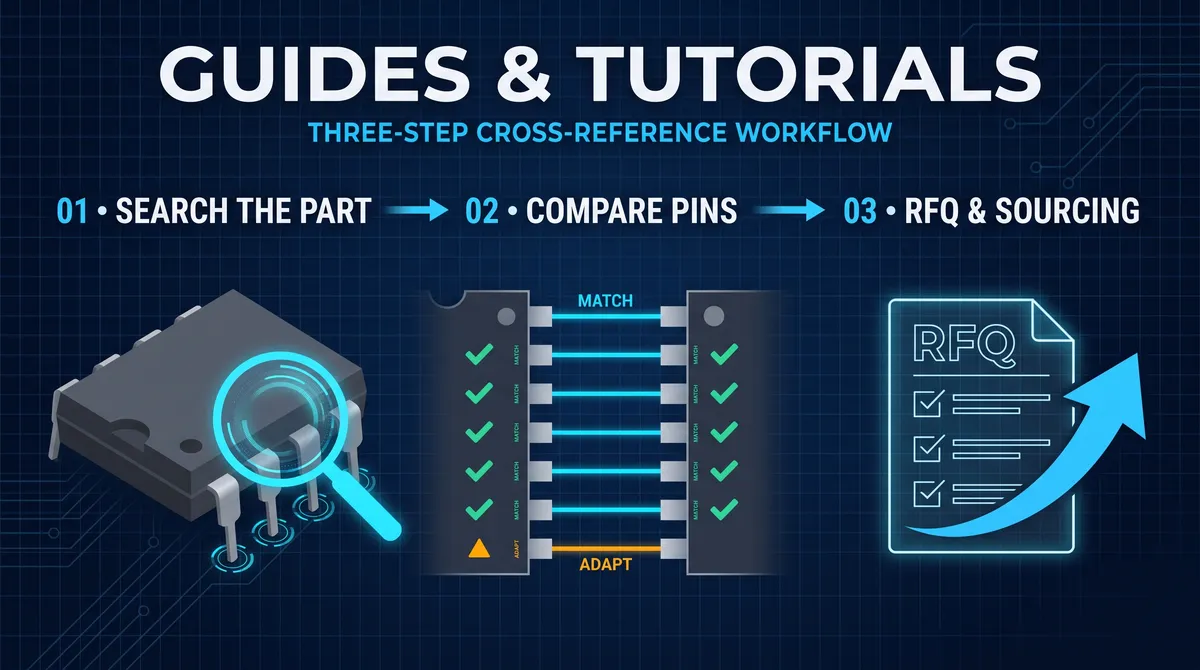
How to cross-reference electronic components is a core skill for every engineer, buyer, and repair technician, because it is the way a known part number becomes a set of compatible alternatives when the original is unavailable, end-of-life, single-sourced, or priced out of range. A component cross-reference is a lookup that maps one part number to other part numbers that can substitute for it, either because they share the same pinout and function, or because they are the same part under a different manufacturer's prefix, or because they meet the same electrical specification in a compatible package. The value of the skill is that it turns a part problem into a supply solution without starting from zero: instead of searching an entire catalog for something that might work, the cross-reference returns the short list of parts that the industry has already judged interchangeable, and the buyer or engineer then applies the verification steps that turn a short list into a qualified choice. This guide explains what cross-referencing actually is, where to do it, how to read the results by trust tier, how to verify a match against the datasheet, and how to use the whole method inside a BOM workflow, so that the next time a part number runs dry, the alternative is minutes away instead of days.
The skill rests on one fact that makes it reliable: most electronic components are not unique. A dominant manufacturer defines a part, and then competitors build the same function to the same pins to capture the market, which is how the 78xx regulators, the 555 timer, the 7400 logic family, and a large share of op-amps and interface chips all became multi-vendor parts with essentially interchangeable pinouts. The same pattern extends to microcontrollers, where a family like the STM32 defines a pinout that domestic manufacturers reproduce with pin and software compatibility in mind. Because the pattern is widespread, cross-reference databases exist in three tiers, the authorized distributors with their alternative-part features, the aggregation platforms that index millions of part numbers, and the dedicated cross-reference engines built specifically to map part numbers to equivalents. This guide treats each tier honestly, because the biggest mistakes in cross-referencing come from trusting a result without knowing which tier produced it and what the result actually means.
How to Cross-Reference Electronic Components: The Core Method
Cross-referencing an electronic component is the practice of taking a known part number and using a database to find other part numbers that can replace it, and the core method has three steps that every reliable cross-reference obeys. The first step is to capture the original part's full identity, the exact part number including its package suffix, its function, its package, and its key electrical parameters, because the suffix and the package decide whether a candidate is truly compatible. The second step is to search the part number in the appropriate tool and collect the candidate list, from an authorized distributor's alternative-part feature, an aggregation platform like Octopart or Findchips, or a dedicated cross-reference engine, and to collect from more than one source because every database has gaps. The third step is to qualify the candidates, applying the same pinout, package, and electrical review that any substitution requires, so the cross-reference result becomes a decision instead of a guess. The method is deliberately database-agnostic because the tools change but the discipline does not: the search finds candidates, and the datasheet review decides which candidate is the part.
The discipline that separates a skilled cross-referencer from a careless one is the refusal to treat a cross-reference result as a finished answer. A database row that says part B is an equivalent of part A is a claim about interchangeability, and the claim is only as strong as the source behind it: a manufacturer's own alternate-part note carries the weight of the company that designed the part, while an algorithmically inferred match from a crowd-sourced database carries whatever weight the contributors gave it. The skilled user therefore reads every result with its trust tier in mind, verifies the highest-value candidates against the datasheet, and keeps the verification record. The practical payoff is speed with safety, because the cross-reference eliminates the wasteful part of the search while the datasheet review eliminates the risky part of the substitution. In that sense the core method is the entire point of this guide, a method that is fast enough to use in production and careful enough to use in production.
Where to Cross-Reference Electronic Components: The Three Tool Tiers
The tool landscape for cross-referencing has three tiers, and knowing which tier you are using changes how much you trust the result. The first tier is the authorized distributor, such as DigiKey or Mouser, whose alternative-part and parametric-search features are backed by manufacturer relationships, so a result that comes from a distributor often carries the manufacturer's own compatibility data and the distributor's stock and price in the same row. The second tier is the aggregation platform, such as Octopart, Findchips, and the component search engines, which index part numbers, datasheets, stock, and price across many suppliers, and which are the right place to answer the buying question, where to source, alongside the compatibility question, what to use. The third tier is the dedicated cross-reference engine, such as the X-refs family and the independent equivalent finders, whose entire database is built on part-to-part mapping and which are often the fastest way to find a candidate for an obscure or obsolete part because mapping is their only job. The practical rule is to start where the data is most likely to be complete for the type of part, a distributor for a mainstream catalog part, an aggregator for a stock-and-price question, a dedicated engine for an obscure or legacy part, and to check at least two tiers before accepting any single answer.
The tiers differ in what they prove. A distributor's alternative-part feature proves availability in its own stock, which is a commercial fact, and it often carries the manufacturer's compatibility note, which is an engineering fact. An aggregator proves that a part number exists across the indexed suppliers, and its cross-reference rows reflect whatever mapping data the platform maintains. A dedicated engine proves that someone, somewhere, recorded a mapping between the two part numbers, and the quality of that mapping depends on the engine's data curation. None of the tiers proves compatibility in the engineering sense, because compatibility is decided by the datasheet, not by the database, and that is exactly why the method reads the result by tier and then verifies. A user who understands the tiers reads a distributor result with commercial trust, an aggregator result with source-checking, and a dedicated engine result with verification, and applies exactly the level of caution each tier deserves.
How to pick the right tool for a component cross-reference
Choosing the right tool for the part in hand is a small decision with a large payoff. For a mainstream catalog part with a standard function, such as a 78xx regulator, a 555 timer, or a 74HC logic chip, start at the authorized distributor, because the alternative-part feature returns the vendor variants and the stock in one view and the part is common enough that the manufacturer data is complete. For a part where the question is really about price and stock, an end-of-life part being sourced across the remaining channel, an aggregation platform shows the suppliers, the quantities, and the prices side by side. For an obscure, obsolete, or proprietary part, start at a dedicated cross-reference engine, because its database was built to handle exactly the mapping that the mainstream catalogs do not index, and follow it with the archived datasheet when the manufacturer has removed the original document. For a microcontroller, start at the manufacturer's own pin-compatibility and migration pages, because the silicon vendor's statement of which devices share a pinout and which code changes are needed is the most authoritative mapping in existence. The rule is simple, start where the data for that kind of part is richest, and use the second and third tiers as the cross-check rather than as the starting point.
How to Run a Cross-Reference Search Step by Step
A cross-reference search is a sequence of small decisions, and running it the same way every time makes it fast and repeatable. Write down the exact part number, and separate its segments, because a part number like LM7805 or STM32F103C8T6 or 74HC595D encodes the family, the variant, the package, the temperature grade, and the packaging, and searching the wrong segment returns the wrong family. Enter the full part number in the tool, and if the tool supports it, set the package and the key parameters as filters so that the candidate list is already narrowed to the parts that could physically fit. Read the candidate list with the trust tier in mind, and note which candidates carry a manufacturer note, which carry a distributor's stock, and which are algorithmically inferred. For each high-value candidate, open its datasheet and confirm the package, the pinout, and the electrical specification against the original, using the same review the substitution requires. Record the result, the candidate, the source, the verification, and the date, in the part's change log, because the record is what makes the cross-reference reusable and auditable. The whole sequence takes minutes for a common part and a little longer for an obscure one, and the habit of running it identically is what turns cross-referencing from a search into a practice.
The search tactics that experienced cross-referencers use are worth collecting. Search the base family name rather than only the exact number when the exact number returns nothing, because older parts were second-sourced under different prefixes on the same base. Search the function rather than the number when the part is unmarked or the number is illegible, using terms like voltage regulator, shift register, or dual op-amp, plus the package and the key parameter, and let the parametric filter do the narrowing. Check the suffix codes, because LM7805CT and LM7805T differ in package and the wrong suffix can be a completely different footprint. Search in more than one tool for a critical part, and compare the candidate lists, because the union of two databases covers the gaps of either. And for the parts that matter, go to the manufacturer's cross-reference and migration pages last but never skip them, because the vendor's own note settles a mapping that the aggregate listings can only guess at. These tactics are the difference between a search that finds a candidate and a search that finds the right candidate.
How to Read a Cross-Reference Result by Trust Tier
Reading a cross-reference result correctly begins with asking what the result actually claims, and the trust tiers give the answer a shape. The strongest result is the manufacturer's own compatibility statement, a migration note, a pin-compatibility matrix, or an alternate-part recommendation in the datasheet, which claims compatibility with the authority of the company that designed the silicon. The next strongest is a distributor's alternative-part result that carries a manufacturer note or a documented reason for the mapping, which inherits the manufacturer authority through the distributor relationship. Below that sits the curated cross-reference engine's record, which claims compatibility on the strength of the engine's own curation, and its reliability depends on the engine's process for verifying a mapping. At the bottom sits the algorithmically inferred or crowd-sourced match, which claims only that some signal suggested the two parts are related, and it deserves the full verification treatment before anything depends on it. The practical discipline is to sort the candidate list by trust tier before spending time on verification, so that the engineering review starts where the evidence is strongest.
The reading also distinguishes the two things a result can mean, and mixing them causes real mistakes. A result can mean direct replacement, the same part under a different manufacturer or grade, which carries the lowest risk, or it can mean functional equivalent, a different part that meets the specification in a compatible package, which carries the risk of a pinout or behavior difference that only the datasheet review reveals. When a database row uses the word equivalent without a note, the user cannot tell which meaning applies, and the verification step exists precisely to find out. The verification therefore checks the package, the pinout, and the electrical parameters against the original, and it records whether the candidate is a direct match, a pin-compatible match, or a functional equivalent that needs a footprint change. The trust-tier reading plus the equivalence-type reading is what turns a raw result list into a ranked, verified short list, and that is the output a production decision can use.
How to Verify a Cross-Reference Result Against the Datasheet
The verification of a cross-reference result is the same three-layer review that defines any safe substitution, and it is the step that makes the database answer an engineering answer. The first layer is the package: confirm the candidate's package code and body size match the original, because a cross-reference row that ignores the package can pair a through-hole part with a surface-mount footprint. The second layer is the pinout: compare the two pin diagrams pin by pin, confirming that every pin position carries the same function, because a result that says equivalent can still hide a functional pin that differs. The third layer is the electrical specification: compare the supply range, the output ratings, the timing and frequency, and the temperature grade against the original, and flag every parameter where the candidate is worse, different in a behavior-changing way, or unpublished. For a microcontroller or digital part, add the software layer, the register map, the peripheral set, and the firmware build, because a pin-clean result that needs porting is a different project from a drop-in. A candidate that passes the three layers is qualified, and the record of the comparison is what a change control process accepts.
The verification also carries the two habits that make it reliable in repeat use. First, verify against the original datasheet rather than against memory, and use the archived datasheet when the manufacturer has removed the current one, because the pinout in a forum post is no substitute for the manufacturer's diagram. Second, test when the datasheet comparison is close, because a candidate that matches on paper but differs in behavior, timing, or temperature needs a sample on the board before production, and the sample test is the final referee of every cross-reference. A cross-reference program that always verifies with the datasheet and tests with the board inherits the safety of a full qualification at a fraction of the cost, because the database narrows the field and the review and the test confirm the pick. The verification is the difference between a cross-reference that produces candidates and a cross-reference that produces working parts, and it is the reason the method in this guide always ends at the board rather than at the database.
How to verify a cross-reference for a microcontroller or digital part
Digital parts and microcontrollers add the software layer to the cross-reference verification, and skipping it is the most common way a clean result becomes a field failure. For a microcontroller, the verification compares the core architecture and instruction set, the flash and SRAM sizes against the application's needs, the register map for the peripherals the firmware actually uses, the pin multiplexing of the GPIO and the communication peripherals, and the boot behavior, and it does so from the manufacturer's migration note where one exists. The firmware is then compiled and run against the candidate on a reference board, exercising the clock tree, the timers, the serial peripherals, and the interrupts, and the bring-up test surfaces the register differences that the datasheet review missed. For a logic or interface part, the digital verification compares the logic family, the speed grade, the input thresholds, the output drive, and the propagation delay against the receiving circuit's timing budget. The pattern is the same across digital parts, the cross-reference result narrows the candidates, the datasheet review checks the physical and electrical layers, and the firmware and timing test checks the layer that only execution reveals. A cross-reference that ends in a tested part is a cross-reference that ends in a production line that keeps running.
Cross-Referencing by Component Family: Regulators, Logic, Op-Amps, and MCUs
The cross-reference method becomes sharper when it is applied to specific families, because each family has its own mapping pattern. Regulators cross-reference by their family pinout and their electrical output, so the 78xx series maps across vendor prefixes on the same TO-220 and surface-mount footprints, while the LM317 adjustable regulator maps to its vendor variants and the LM2596 and LM2576 switching regulators map within their switching-family pinouts. Logic parts cross-reference by their 74-series function number and logic family, so a 74HC595 and a 74HCT595 share the pinout with family differences in speed and input levels, and the mapping has to respect the family suffix because a 74HC part is not automatically the same as a 74LS part. Op-amps and comparators cross-reference by their configuration, supply range, and package, so the LM358 dual and the LM324 quad map across a wide vendor field while a single, dual, and quad configuration never substitutes across configurations. Microcontrollers cross-reference through the manufacturer's own compatibility matrices, where a family like the STM32 defines the pinout that the domestic alternatives reproduce, and the mapping always carries the code-compatibility question alongside the pins. Each family's mapping pattern is learnable in one pass, and once learned it makes the next cross-reference for that family a matter of seconds.
The family patterns also reveal which cross-references are safe and which are not. A safe cross-reference is one within the same family standard, a 78xx to another 78xx, a 74HC595 to another 74HC595 logic family, an LM358 to a compatible dual op-amp, where the pins, the package, and the specification are designed to match. A risky cross-reference is one across families or across functions, an LM358 to an LM324 regardless of the pin count difference, a 74HC part to a 74LS part without checking the input levels, a regulator to another regulator without checking the dropout and the current, where the pins may look similar but the behavior differs. The discipline is to treat the family standard as the safe zone and to verify everything outside it, and to use the cross-reference result as a prompt for that verification rather than as a conclusion. A buyer or engineer who knows the family patterns of the parts they use runs the cross-reference with confidence in the safe zone and caution outside it, and that is the practical mastery the method is designed to produce.
When a Cross-Reference Is Not Enough: Custom Parts and Safety Applications
Cross-referencing has honest limits, and knowing them keeps a buyer from substituting where a substitution cannot be trusted. The first limit is the custom or proprietary part: a part designed for a single customer, an application-specific IC, a module with vendor firmware, or a safety-critical part approved for one design has no reliable cross-reference, because no database maps a proprietary part to an equivalent that shares its approval. The second limit is the certified or approved part: a component that carries an agency certification, a flammability rating, a functional safety approval, or a medical or aerospace qualification is not interchangeable with a cross-referenced alternative unless the alternative carries the same certification, and the certification is per-part, not per-function. The third limit is the part whose behavior is load-dependent in a way the datasheet cannot express, where only the physical test on the actual board decides, and the test is the cross-reference's final gate. For these parts the honest answer is to keep the original, to source the original through the legacy channel, or to redesign the board around a qualified current part, and to record the decision rather than to force a substitute. A cross-reference program that knows its limits is a program that avoids the worst failures, because the failures come not from the parts it substitutes but from the parts it should not have substituted.
The same limits define when the cross-reference result is enough on its own. For a mainstream part in a standard function, a commodity regulator or a logic chip with a verified manufacturer mapping, the cross-reference plus a datasheet check is sufficient for most orders, because the part's interchangeability is well established and the risk is low. For a critical, certified, or safety-related part, the cross-reference is only the starting point, and the qualification runs the full ladder, the datasheet review, the sample test, the temperature and reliability exposure, and the certification check, before any production order. The judgment of where a part sits between those two poles is the buyer's core skill, and it is learned by treating every substitution as an evidence question: what does the cross-reference claim, who stands behind the claim, and what does the board prove? That evidence habit is the whole method, and it is what turns the phrase how to cross reference electronic components from a lookup into a reliable engineering practice.
Worked Example: Cross-Referencing a Regulator by Family
Cross-referencing a regulator by family is the worked example that shows the method on the friendliest part, and an LM7805 in a TO-220 shows the whole path. Capture the exact part first, the LM7805 with the TO-220 package and the 5-volt output, and search the number in the distributor and the cross-reference tools, and the candidate list returns the family, the L7805, the KA7805, the MC78M05, and the domestic 7805 parts, each sharing the three-terminal layout. Filter the list by the physical first, the TO-220 footprint, and confirm the pinout, the input, the ground, and the output in the same positions, because a SOT-223 variant is a different footprint even under the same number. Filter by the electrical second, the 5-volt output, the current rating, the input range, and the dropout, and the candidates that pass the physical and the electrical are the shortlist. Verify on the bench third, mount the candidate, run the board's load, and compare the output, the regulation, and the thermal against the original, and the verified candidate earns its place in the BOM and the cross-reference library. The worked example is the whole method on the friendliest family, and it is the model the harder parts follow with the trust-tier reading added.
The worked example also reads the trust tier that the regulator's cross-reference carries, because the 78xx family has the strongest mappings in the industry. The vendor alternate notes and the family's decades of standardization make a 78xx cross-reference the high-trust row, and the engineer can move between the family members with confidence after the datasheet check, while a cross-reference for an obscure or a new part is the low-trust row that demands the full verification. The trust-tier reading is what the earlier section described, and the worked example shows it in action, the regulator's family as the high-trust starting point and the datasheet and the bench as the confirmation. The regulator cross-reference is the easiest case of the method, and it is the case that teaches the trust-tier and the verification habits the harder parts need.
How to Cross-Reference by Function When the Number Is Unknown
Cross-referencing by function is the method for the part whose number is unknown, unmarked, or obliterated, and it runs on the parameters rather than the identity. Describe the function first, a dual op-amp with a certain supply range, a 3.3-volt LDO in the SOT-223, a hex inverter in the 14-pin, and state the package and the key parameters, and the parametric search returns the parts that meet the description. Narrow by the package and the pinout second, because a functional match in the wrong footprint is a redesign, and a dual op-amp in the SOIC-8 versus the SOIC-14 is a different board. Read the candidates by the parameters the circuit needs third, the supply, the speed, the output, and the timing, and the shortlist is the set of functionally matching parts. The verification then runs in full, because a function-based match has no original number to anchor the pinout, so the package, the pins, and the electrical behavior are all checked against the circuit's requirements. The function-based cross-reference is slower than the number-based one, but it reaches the parts the number search cannot, and it is the method for the unmarked and the obscure component.
The function search also reads the unmarked part's clues, because the package, the pin count, the supply, and the behavior identify the family before the exact part. An eight-pin dual op-amp that runs from a single supply and sits in a feedback stage points to the dual-op-amp family, and a sixteen-pin logic part with the shift-register behavior points to the 74HC595 family, and the identification narrows the search before the parametric filter runs. The engineer who reads the clues, the package, the pin count, the supply, and the function, cross-references the unknown part in minutes that a blind search would spend in hours, and the identification is the skill the function-based method turns on. The function search is the fallback of the cross-reference method, and it is the fallback that keeps the toolkit complete when the number fails, which is the practical half of the unknown-part problem.
Common Cross-Reference Mistakes and How to Avoid Them
The cross-reference mistakes that cost the most are the ones the method is designed to catch, and naming them sharpens the practice. The first is trusting a single tool, because each database has its gaps and its stale rows, and a candidate from one tool is cross-checked in a second before it is trusted. The second is skipping the package, because a cross-reference that pairs a through-hole part with a surface-mount footprint is a row that the physical filter catches, and the package is read before the electrical. The third is trusting the word equivalent, because the word does not state whether the match is a drop-in, a pin-compatible, or a functional equivalent, and the grade is found in the datasheet rather than in the listing. The fourth is ignoring the manufacturer's note, because the vendor's own alternate and migration document outranks an algorithmically inferred row, and the note is read at the top of the trust tier. The fifth is skipping the bench, because the datasheet is the claim and the board is the referee, and a candidate that passes the paper and fails the board is the expensive discovery the bench prevents. The mistakes are the map of the failure, and the method's steps are the correction of every one.
The mistakes also cluster by the part type, because the analog, the logic, and the digital parts fail in their own ways, and the type-aware read catches them. An analog cross-reference fails on the electrical detail, the offset, the dropout, the thermal, and the speed, and a logic cross-reference fails on the levels, the family, and the special type, the open-collector and the Schmitt, and a digital cross-reference fails on the registers, the firmware, and the timing, so each type's verification reads its own failure mode. The type-aware correction is the refinement of the method, and it is the refinement that the frequent tool users internalize, because the same cross-reference habit applied with the type in view catches the failures that the generic habit misses. The common mistakes are the practical half of the method, and they are the half that the worked examples and the trust-tier section make concrete, which is the value the cross-reference guide delivers. Together with the family maps and the verification steps, the mistakes list is what an engineer returns to when a cross-reference candidate misbehaves, and the checklist turns a puzzling failure into a named step that the method already answers.
A Cross-Reference Workflow for the BOM
The full method compresses into a BOM workflow that any team runs in the same order, and it makes cross-referencing a standing practice rather than an emergency response. Build the BOM's cross-reference library as parts are qualified, so each part number carries its verified alternatives, its source notes, and its test record, and the next time that part is unavailable the answer is already filed. Run the cross-reference check at the design stage for every new part that is added, so that a part with no cross-reference is flagged before it becomes a single point of failure, and prefer parts that sit in well-mapped families. Run the lifecycle watch alongside the cross-reference, so that an end-of-life notice on a mapped part triggers the verified alternative immediately rather than at stockout. And for the parts that matter, the critical, scarce, and certified ones, run the full verification ladder, the datasheet review, the sample test, and the certification check, and record the evidence with the part. The workflow ties the cross-reference skill to the supply chain, which is where it actually earns its value.
The payoff of the workflow is a supply chain that treats part unavailability as a routine event. When a 78xx regulator, a 555 timer, or a STM32-class microcontroller goes scarce, the BOM already carries the verified alternatives, the cross-reference already maps the family, and the sourcing already knows the verified suppliers, so the response is a purchase order instead of a redesign meeting. That is the entire point of cross-referencing done well, it converts the highest-stress moment in component management into the best-documented one, and it does so by the simple method this guide has laid out, capture the part, search the tiers, verify the datasheet, test the board, and record the evidence. Whether the tool is a distributor's alternative-part page, an aggregation platform, a dedicated cross-reference engine, or a manufacturer migration note, the method is the same and the result is the same: a known part number becomes a verified choice, and the production line keeps running on a board that never had to change.
Not sure which sensor fits your project?
Talk to our mmWave application engineers for a free consultation.
Specify your hotel project with our engineers
Send your room count, ceiling type, and protocol preference. We will return a sample plan and quote within 24 business hours.
- Move from general guidance into a product or application discussion.
- Use RFQ when pricing, drawings, MOQ, or launch timing needs structure.
- Keep a direct contact path visible for fast clarifications and handoff.