Drop-In Replacement IC: What It Means and How to Find It
Drop-in replacement IC guide: what a drop-in IC is, how it differs from a pin-compatible or equivalent part, and how to find and verify a true drop-in.
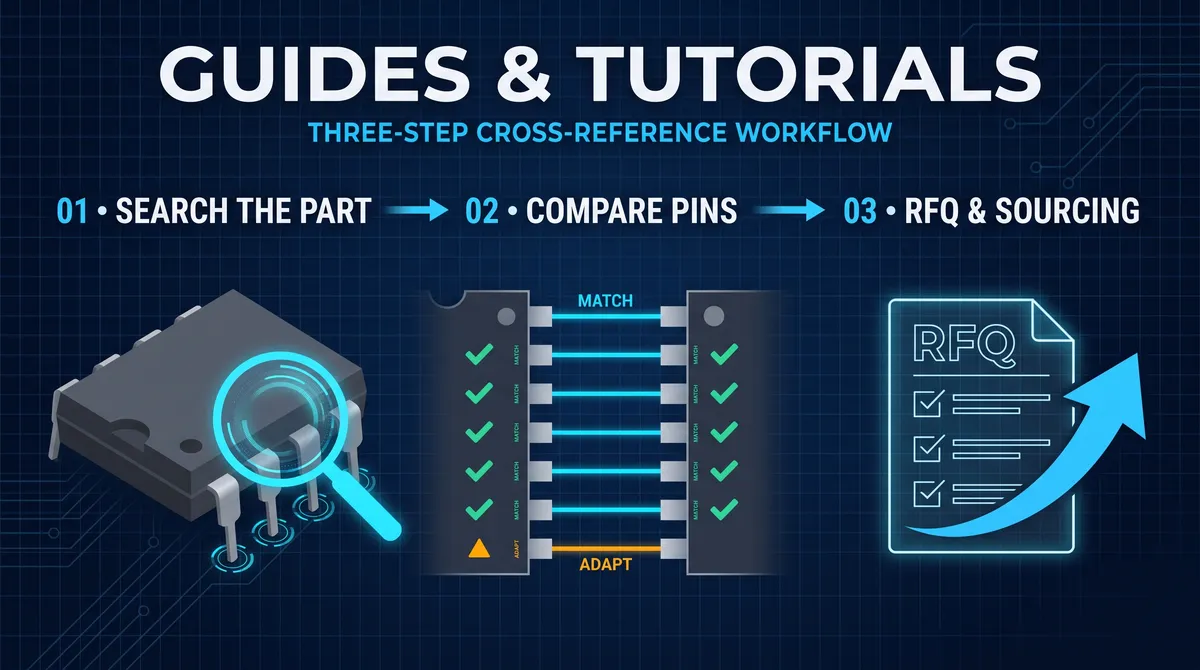
A drop-in replacement IC is a part that can take the place of another part with no change to the board, no change to the assembly, and, in the true sense, no change to the firmware or the surrounding circuit, and it is the highest grade of compatibility that the electronics world recognizes. The phrase drop-in describes the ideal substitution: the new part drops into the footprint the old part occupied, the board's design does not move, and everything downstream of the physical swap keeps working the way it did. Because that grade is rare and valuable, the phrase is also the one most loosely used, and a buyer searching for a drop-in replacement IC has to separate the true drop-in from the pin-compatible part, the functionally equivalent part, and the catalog's marketing copy, which is the work this guide does. This guide explains what a drop-in replacement IC really is, how it sits at the top of the compatibility grades, how to find and verify one, and how to respond when a true drop-in does not exist, so the search for the phrase ends in a verified part rather than a guess.
The guide also resolves the confusion that surrounds the bare term, because drop-in is used across the entire world as a figure of speech. A search for drop in replacement without the ic returns hip replacements, water filters, linguistics discussions, and refrigerators, none of which is an integrated circuit, and the ambiguity is why buyers search the longer form, drop in replacement ic, and why this guide reads the term in the electronics world. Within electronics, the drop-in grade still has its own hierarchy to respect, the drop-in that also preserves the firmware, the pin-compatible part that preserves the board but may need the software work, and the functional equivalent that preserves the function but may need the footprint work, and the guide maps the three. The drop-in replacement IC is the top of that map, and the map is the working reference a buyer keeps beside the search.
What a Drop-In Replacement IC Means
A drop-in replacement IC is a part that substitutes for another part without changing the board, the assembly, or, in the full sense, the surrounding design, and the definition has three properties that all must hold. The first is the physical drop-in: the package and the pinout match, so the part mounts on the same footprint and solders the same way, and the board designer does not touch the layout. The second is the electrical drop-in: the part operates on the same supply, meets the same specification, and behaves the same way in the circuit at the output, the timing, the temperature, and the margins, so the surrounding circuit does not need re-tuning. The third, for the digital and the programmable parts, is the software drop-in: the firmware, the drivers, and the configuration run unchanged on the replacement, so the codebase does not move. A part that clears all three is a drop-in replacement, the part that the phrase describes, and the grade is the benchmark that the looser uses of the term are measured against. The three properties are also the verification checklist, which is why the drop-in is proved on the bench rather than claimed on the listing.
The practical meaning of the three properties is that a drop-in replacement is invisible to the design. The board does not change, so the pick-and-place, the test fixture, the assembly, and the field hardware all stay as they were. The circuit does not change, so the resistors, the capacitors, the loads, and the firmware all keep their values and their behavior. The only thing that changes is the part itself, and the change is a sourcing decision rather than an engineering one, which is the value the drop-in grade represents. That value is why the phrase is so sought after, and it is why the grade is rare, because matching all three properties across a different manufacturer's silicon is a real engineering achievement rather than a catalog default. The drop-in replacement IC is the part the buyer hopes the search finds, and the guide reads the hope through the three properties that make it real.
How drop-in compares to pin-compatible and equivalent
The drop-in grade sits at the top of a compatibility ladder that the industry uses, and reading the ladder places the drop-in precisely. At the top is the drop-in replacement, the part that matches the package, the pinout, the electrical behavior, and the software, so the board, the circuit, and the firmware all keep working, and the swap is invisible. Below it is the pin-compatible part, which matches the package and the pinout but may need electrical or software adaptation, so the board is preserved and the software is the work. Below that is the footprint-compatible or package-compatible part, which matches the pad footprint but may need jumpers where the pin functions differ. At the bottom of the ladder for replacement purposes is the functional equivalent, which matches the function but in a different package or pinout, so the board must be redesigned to use it. The drop-in is the top grade, and the gap between the top and the pin-compatible grade is the difference between changing the part and changing the software, which is why the phrase drop-in is used so carefully by the legitimate suppliers and so loosely by the rest.
Why the Drop-In Term Gets Confused
The term drop-in is confused for two reasons, and the guide resolves both. The first is the world's use of drop-in as a figure of speech, where any replacement that slots into a prior arrangement is called a drop-in, a hip implant, a refrigerator filter, a golf component, whatever the field uses it for, and a bare search for the phrase returns those other worlds rather than the electronics one. The second is the electronics marketing use, where a part that is merely pin-compatible, or even merely functionally related, is labeled a drop-in to make the substitution sound easier than it is. The buyer who searches drop in replacement ic has already solved the first confusion by adding the ic, and the guide's job is to solve the second, by defining the true grade and by teaching the verification that separates a real drop-in from a labeled one. The confusion is the reason the term deserves a definition and a method rather than a catalog sort.
The electronics context also narrows the phrase usefully, because within electronics the drop-in question is about the interface to the board and the circuit rather than about the world's general usage. An engineer who asks whether part B is a drop-in for part A is asking whether the board that holds A holds B unchanged, whether the circuit that surrounds A tolerates B's behavior, and, for a programmable part, whether the firmware that runs on A runs on B. That is a checkable question, and the check is the datasheet comparison and the bench test, which is what this guide teaches. The buyer and the engineer therefore use the term with the electronics definition in mind, and the guide's glossary and the verification method are the tools that keep the use honest. The confused term is resolved by the disciplined definition, and the disciplined definition is the guide's starting point.
The words that mean almost the same thing in electronics
The electronics vocabulary around the drop-in has a set of near-synonyms that each shift the meaning, and the reading of them is part of the resolution. A drop-in, in the full sense, drops in with no changes at all. A direct replacement is the vendor's claim that a part substitutes for another, and the claim carries the vendor's authority but still deserves the verification. A cross reference or cross-ref is the mapping between parts that the databases and the catalogs maintain, and a mapping is a candidate list rather than a verdict. An equivalent or equivalent part is the general-purpose word for a part that can substitute, and its grade is left to the datasheet to reveal. A substitute, a replacement, and an alternative are the everyday words for the same idea, each carrying a slightly different tone. The guide reads the words as the market uses them, and it applies the same three-property test to every one, because the word on the listing is the candidate and the three properties are the decision.
How to Find a Drop-In Replacement IC
Finding a drop-in replacement IC runs through the same channels as any component search, with the three-property test as the filter. The search starts at the cross-reference, a distributor's alternative-part feature, an aggregation platform, or a dedicated cross-reference engine, entering the original part number and collecting the candidates that the databases and the vendors have mapped to it. The candidates are then filtered by the first two properties, the package and the pinout, because a candidate that does not fit the footprint is out before the electrical check begins, and the filter narrows the list to the physical fits. The remaining candidates are read by the third property, the electrical and the software behavior, against the datasheet and the board, and the survivors are the short list of the genuine drop-in candidates, ready for the bench. The search habit is the series' habit, collect from more than one source, sort by the trust tier, and verify against the datasheet, and the habit is the search's discipline.
The search also reads the manufacturer's own statements, because the most authoritative drop-in answers come from the silicon vendor. A manufacturer that publishes a direct-replacement note, an alternate-part table, or a migration guide for a recognized family is making the strongest claim a drop-in can have, and the buyer weighs that statement at the top of the trust ladder. The 78xx family's vendor notes, the MCU migration guides, and the alternate tables of the standard families are the documents that answer the drop-in question with the highest authority, and the buyer reads them before the aggregate listings. The search therefore goes to the vendor first for the well-mapped families and to the cross-reference for the obscure parts, and it collects the candidates from both before the verification. The finding of a drop-in is a search and a read, and the read of the vendor's statement is the strongest part of it.
How to search for a drop-in equivalent by part number
Searching for a drop-in equivalent by part number is a habit with a few reliable moves. Enter the exact part number first, including the package suffix, because the suffix names the footprint and the drop-in has to fit it, and read the candidate list the search returns. Search the base family second, dropping the prefix and the suffix, because the family name, the 7805, the 555, the 74HC595, reaches the parts that the exact-number search misses, and the family's vendor variants are the most likely drop-ins. Search the function and the package third, when the number is obscure or obsolete, and let the parametric filter constrain the candidate list by the footprint and the key parameters. Cross-check the candidates in a second tool, because each database has its gaps and the intersection carries the information. And read the datasheets of the shortlist, because the catalog says possible and the datasheet says fit, which is the reversal that the drop-in search depends on. The number search is the fast path, and the datasheet is the safe path, and the two together find the drop-in.
How to Verify a Drop-In Claim
Verifying a drop-in claim is the three-property test applied to the candidate, and it is the step that separates a true drop-in from a labeled one. The first verification is the physical: confirm the package code and the body match the board's footprint, and walk the pinout pin by pin, comparing the power, the ground, the signal, and the control pins between the original and the candidate, so the board really mounts it unchanged. The second verification is the electrical: compare the supply range, the absolute maximum ratings, the output, the timing, the frequency, and the temperature grade against the datasheets, and confirm the candidate meets the specification the board's circuit requires, so the circuit really runs it unchanged. The third verification, for the digital and the programmable parts, is the software: confirm the firmware and the configuration run unchanged on the candidate, through the compile and the bring-up test, so the code really stays put. A candidate that clears the three is a verified drop-in, and a candidate that clears two is pin-compatible with the remaining work, which the buyer labels honestly in the record.
The verification also runs the bench test, because the datasheet is the claim and the board is the referee. Mount the candidate on the board that held the original and run the same functional test the original passed, exercising the design's signals, the loads, the timing, and the temperature, and compare the measurements against the original's recorded readings. A true drop-in reproduces the original's behavior within the tolerance, and a near-drop-in shows the difference that the datasheet review predicted, the output that sags, the timing that shifts, or the software that needs the change. The bench test completes the three-property verification, and the record, the pin table, the electrical comparison, and the test log, is the evidence that moves a drop-in from a claim to a qualified replacement. The verification is the entire value of the term, because a drop-in is only a drop-in the design has proven, which is the honest standard of the grade.
The three checks that prove a drop-in replacement
The three checks that prove a drop-in replacement are the physical, the electrical, and the software, and each has its own test. The physical check confirms the part fits: the same package, the same footprint, and the same pinout, proved by the datasheet comparison and the mounted part. The electrical check confirms the part works: the same supply, the same specification, and the same behavior at the output and the timing and the temperature, proved by the datasheet comparison and the bench measurements. The software check, for the programmable parts, confirms the part runs: the same firmware, the same configuration, and the same peripheral behavior, proved by the compile and the bring-up test. The three checks are run in order, and a part that clears all three earns the drop-in label, while a part that clears the first two is pin-compatible and earns that label instead. The three checks are the definition made testable, and they are the reason this guide can answer the drop-in question with evidence rather than with marketing.
Common Drop-In Families
The drop-in grade is easiest to find in the families that were standardized by design, and naming them makes the search concrete. The 78xx regulator family is the archetype: a 7805 from one vendor and a 7805 from another share the package, the pinout, the output voltage, and the behavior, so they are drop-ins for each other on the standard footprint, and the same holds across the 78xx line. The 555 timer family follows, with the NE555 and its vendor variants sharing the 8-pin layout and the timing behavior, and the 74-series logic families, where the same function number in the same logic family and package is a drop-in across the vendors. The LM1117-family LDOs and the 1117-style parts, the 4094 and the CD4000-family parts, and the standard linear regulators all sit in families where the drop-in is common because the pinout and the function were standardized long ago. The family knowledge turns the drop-in search from a query into a short list, because the design that uses a well-mapped family knows the drop-in exists before the search starts.
The families also teach the exception that makes a drop-in not a drop-in, because the same function number is not automatically a drop-in across the logic families. A 74HC595 and a 74HCT595 share the function and the pins but differ in the input thresholds, so one logic family is not a drop-in for the other on every circuit, and a 74LS and a 74HC part differ in the levels and the drive. The family's standardization gives the candidate and the family's detail gives the exception, which is the read the verification performs. A buyer who knows the family map finds the drop-ins and expects the exceptions, and the three-property test resolves each one, which is the practical mastery of the drop-in search. The families are the drop-in's home ground, and the verification is the boundary within it.
When a Drop-In Is Not Enough
The honest limits of the drop-in grade appear when the true drop-in does not exist, and the response is the standard source, substitute, or redesign. The source answer covers the part that the original manufacturer still provides or the independent channel still holds, and it is the answer when the drop-in truly does not exist and the original is still available. The substitute answer covers the pin-compatible or the functionally equivalent part, verified to the board and the circuit, and it is the answer when the board can be preserved and the software or the periphery can adapt. The redesign answer covers the part whose function, package, or certification forces the board to change, and it is the answer when the part is proprietary, certified, or beyond any alternative. The response is chosen on the evidence, the remaining product life, the part's availability, and the cost of each path, and the choice is recorded with the comparison, so the drop-in search that finds no drop-in still ends in a plan.
The limits also carry the compliance and the certification dimension, because a certified part is a drop-in only if the alternative carries the same certification. A part approved for a safety, a medical, or an aerospace design is not interchangeable with a pin-compatible alternative unless the alternative holds the same approval, and the certification is per-part rather than per-function, so the drop-in question becomes an approval question. The buyer reads the certification before the substitution, and the compliance record travels with the change. The limits are the boundary of the grade, and the response is the method beyond the boundary, which is the discipline that keeps a drop-in search from becoming a field failure when the drop-in does not exist. The drop-in is the goal, and the plan is the fallback, and the guide provides both.
Worked Example: Verifying a Drop-In Regulator
The verification of a drop-in regulator is the worked example that turns the three-property test into a procedure, and a 78xx family swap shows the whole path. Take a board that used an LM7805 in a TO-220, and a candidate from another vendor in the same TO-220: the physical check confirms the package and the pinout, the three leads and the tab in the same positions, so the board mounts the candidate unchanged, and the electrical check compares the two datasheets, the 5-volt output, the current rating, the input range, and the dropout, and finds the candidate within the family's specification. The bench test mounts the candidate and runs the board's load, the output at the no-load and the full-load, the load step, and the temperature, and the measurements land within the original's recorded readings, so the candidate is a verified drop-in for this board. The label is honest: the part that cleared the three properties is recorded as a drop-in, and the record, the pin table, the electrical comparison, and the test log, travels with the BOM. The worked example is the same procedure every drop-in claim goes through, and it is the procedure that separates the genuine swap from the labeled one.
The worked example also shows the boundary of the drop-in, because a candidate that passes the physical and the electrical but not the load's behavior is not a drop-in. Take a 5-volt rail that draws 800 milliamps at the worst case, and a candidate whose datasheet matches the LM7805 but whose actual part runs hot at the current, or sags under the step: the bench test catches the difference, the output droops or the part shuts down, and the candidate is labeled pin-compatible rather than drop-in, with the thermal or the current work recorded. The label is the discipline, because a drop-in that fails in the field is a disaster that the bench test exists to prevent, and a pin-compatible part that is honestly labeled carries the work that makes it safe. The worked example is therefore the model for every verification, the three properties, the bench referee, and the honest label, and it is the model this guide applies to every part it checks.
The Drop-In Question for Programmable Parts
The drop-in question for a programmable part, a microcontroller, a memory, or a configurable logic device, carries the software property that the analog parts do not have, and it is the layer where most MCU drop-in claims fail. A microcontroller that matches the package, the pinout, and the electrical specification can still fail the drop-in test because its register map, its peripheral set, its clock tree, or its instruction-level behavior differs from the original, and the firmware that ran on the original does not run unchanged on the candidate. The verification therefore adds the software property to the three-property test, the compile and the bring-up, the firmware builds against the candidate's device definition, the clock and the peripherals are exercised, and the behavior is compared against the original, and only the candidate that runs the firmware unchanged earns the drop-in label. The STM32-to-GD32 case that this site's comparison guide covers is the instructive example, the GD32F103 is pin-compatible and largely software-compatible, and it earns the drop-in only where the firmware ports cleanly and the bring-up confirms it, while the areas where the registers and the peripherals differ are honestly labeled as the migration work.
The programmable drop-in also reads the toolchain and the ecosystem, because the software property depends on the tools as well as the silicon. A candidate that needs a different IDE device pack, a different startup file, or a different peripheral library still runs the firmware, but the migration and the re-compile are the work that the pure drop-in does not require, so the label reflects the work. The buyer of a programmable part therefore searches for the drop-in with the software property in view, and the engineer qualifies it with the bring-up rather than with the datasheet alone, because a microcontroller that drops into the socket but not into the firmware is not a drop-in at all. The programmable drop-in is the hardest form of the grade, and it is the form that the software property defines, which is the answer the buyer of a microcontroller replacement needs.
Common Mistakes in the Drop-In Search
The drop-in search fails in consistent ways, and naming the mistakes is part of the method. The first mistake is trusting the package alone, because two parts in the same body with the same pin count can assign different functions to the pins, and the board that mounts them is not a board that works, so the pinout comparison must walk every position. The second mistake is trusting the cross-reference listing, because a database row that says equivalent does not state whether the part is a drop-in, a pin-compatible, or a functional equivalent, and the grade is the datasheet's finding rather than the listing's. The third mistake is skipping the temperature and the timing, because a part that matches the pins and the voltage but runs a different speed grade, a different temperature grade, or a different propagation delay fails at the margin, so the electrical comparison reads the operating range rather than the nominal point. The fourth mistake is assuming that a like number is a like part, because a suffix change, a 74HC to a 74HCT, a 7805 to a 7806, changes the behavior that the drop-in needs, so the part number is read in full. The fifth mistake is skipping the bench, because the datasheet is the claim and the board is the referee, and a candidate that passes the paper and fails the board is the expensive discovery that the bench test prevents. The mistakes are the map of the failure, and the three-property test is the correction of every one.
The mistakes also cluster by the part's type, because the analog, the logic, and the programmable parts fail in their own ways. The analog part fails on the electrical detail, the dropout, the offset, the thermal, and the output, and the logic part fails on the levels, the speed, and the special type, the open-collector and the Schmitt, and the programmable part fails on the software, the registers, the peripherals, and the firmware, and each type's failure is caught by the property it carries. The buyer who knows the type's failure mode reads the verification with the type in view, the analog review for the analog part, the logic review for the logic part, and the bring-up for the programmable part, and the type-specific read is the refinement of the three-property test. The mistakes and their corrections are the practical half of the drop-in method, and they are the half that the worked examples in this guide make concrete. The review habit closes the half, because the pin table, the electrical comparison, and the bench log that this guide keeps are not paperwork but the working memory of the team, and the next drop-in search starts from the last verified record rather than from the last guess. A team that files the drop-in verifications builds a library that makes every later substitution faster and safer, because the candidates that were already checked and the failures that were already caught are written down, and the library is the asset that turns the drop-in method from a one-off procedure into a compounding discipline. The same library is what a supplier and a buyer share, because a verified record that protects one board protects the next board that mounts the same part.
The Drop-In in the Supply Chain
The drop-in question also lives in the supply chain, because a part that is a drop-in for the board is also a part that the sourcing can move between the vendors, and the drop-in is the supply's friendliest option. A design that uses a part in a well-mapped family, the 78xx regulators, the 555 timers, the 74-series logic, and the standardized LDOs, has a field of drop-in vendors on the same footprint, and the buyer can hold two sources and move the volume between them on the same board and the same test, which is the second-source depth that the supply chain rewards. The drop-in reduces the supply risk, because the board no longer depends on a single vendor's part, and it reduces the price risk, because the volume can move to the cheaper source, and it reduces the obsolescence risk, because the family's alternatives survive the single part's retirement. The supply-chain value of the drop-in is the reason the search for the phrase is so common, and it is the reason the drop-in grade is the prize of the substitution method.
The supply-chain view also carries the verification and the qualification that the sourcing requires, because a drop-in is only a drop-in after the board has proven it. The buyer qualifies the drop-in vendor the way the series has laid out, the source, the documentation, the test evidence, and the sample, and the engineer verifies the drop-in part the way this guide has described, the three properties and the bench, and the verified drop-in is recorded in the BOM and the cross-reference, so the sourcing moves between the drop-in vendors on the documented evidence rather than on the label. The supply chain is where the drop-in earns its keep, and the verification is the toll, which is the practical completion of the drop-in method in this guide.
A Workflow for a Drop-In Replacement
The full method fits into a workflow that a buyer and an engineer run in the same order. First, define the original, its package, its pinout, its specification, its firmware, and its place on the board, and pull its datasheet. Second, search, the cross-reference and the catalog and the manufacturer's tables, entering the number and the family, and collect the candidates. Third, filter by the physical drop-in, the package and the pinout, and read the shortlist by the electrical and the software compatibility against the datasheet. Fourth, verify on the bench, mount the candidate, run the original's test, compare the measurements, and run the software bring-up for the programmable part, and record the results. Fifth, label honestly, the drop-in for the part that cleared the three, the pin-compatible for the part that cleared the two, and the equivalent for the part that matches the function, and record the grade. Sixth, source, the verified candidate through the qualified channel, and record it in the BOM and the cross-reference. That sequence is the drop-in replacement method, and it is the same method whether the part is a regulator, a timer, a logic chip, or a microcontroller.
The workflow is the reason the phrase drop in replacement ic names a real, verifiable engineering outcome rather than a marketing phrase. With the original defined, the search is grounded. With the physical filter, the board is preserved. With the bench verification, the part is proven. And with the honest label, the record is true. The entire value of the method is that the highest compatibility grade in electronics, the drop-in that changes nothing, is earned on the datasheet and the bench rather than taken from the listing, and the discipline is what keeps a substitution invisible to the design and to the field. A buyer and an engineer who run this workflow find a drop-in replacement IC with a verified part, an honest grade, and a documented record, which is the entire point of a drop-in replacement done right.
Not sure which sensor fits your project?
Talk to our mmWave application engineers for a free consultation.
Specify your hotel project with our engineers
Send your room count, ceiling type, and protocol preference. We will return a sample plan and quote within 24 business hours.
- Move from general guidance into a product or application discussion.
- Use RFQ when pricing, drawings, MOQ, or launch timing needs structure.
- Keep a direct contact path visible for fast clarifications and handoff.