How to Find a Discontinued Electronic Components Supplier
How to find a discontinued electronic components supplier: qualify distributors and specialists, and verify stock, authenticity, and documentation.
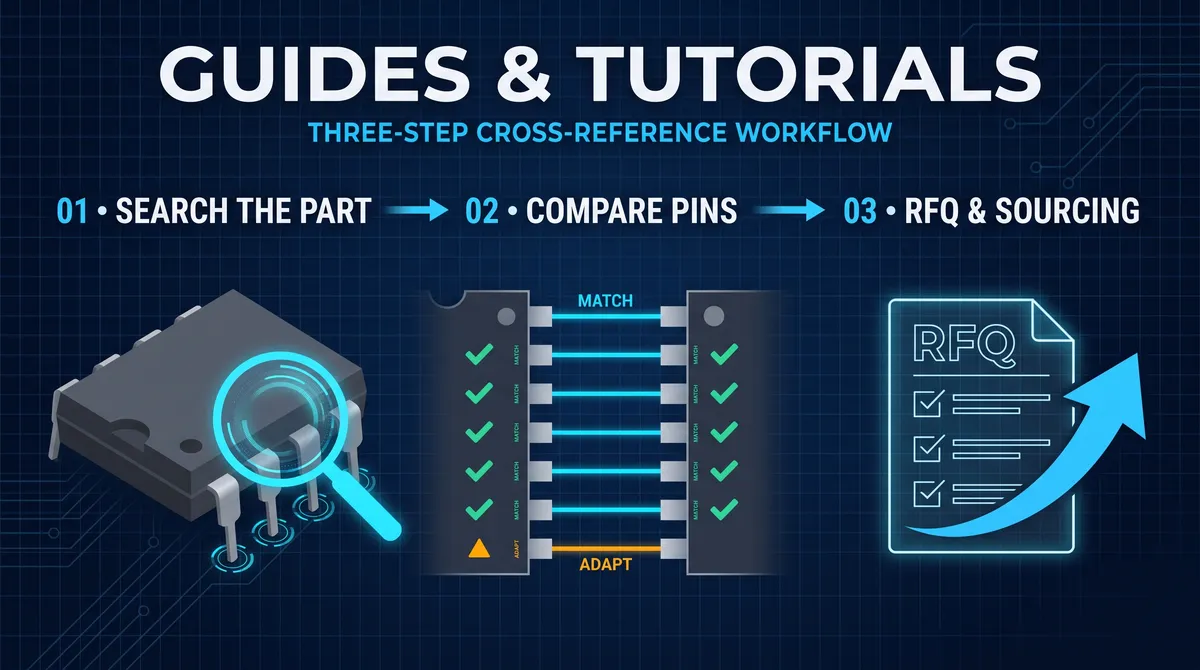
Finding a discontinued electronic components supplier is the task that every long-lived product eventually requires, because semiconductor manufacturers retire parts on their own schedule while the products built on them keep shipping for years. A discontinued electronic component is a part the original manufacturer no longer produces, and the channel that supplied it, the authorized distributor and the manufacturer's own catalog, no longer lists it, which leaves the buyer facing a thinner, less standardized market made of the suppliers who hold the remaining stock of legacy parts. The reliable way into that market is not a single supplier but a short list, built by knowing who the players are, what documents prove a source is trustworthy, and how to verify the stock before money moves. This guide gives the method for finding and qualifying a discontinued electronic components supplier, so that the next legacy part on the BOM has a vetted source before the stock runs out, rather than a desperate search when the line stops.
The stakes of choosing a discontinued parts supplier are higher than a normal parts buy, because the part is finite, the market is thin, and a bad supplier can deliver a counterfeit that halts production or a lot that fails in the field. The same discipline that protects any critical component applies with more force: qualify the supplier before the order, verify the part before the volume, and keep the documentation that survives the audit. The professional buyers who handle legacy parts well all run the same sequence, they know the market's players, they weigh the supplier's history and verification capability, they check the certificates and the traceability, and they test the samples before they scale the order. This guide turns that sequence into a repeatable method, so that the phrase discontinued electronic components supplier stops being a search term and becomes a managed, qualified relationship.
Discontinued Electronic Components: The Market and Why It Is Different
A discontinued electronic component exists only in the inventory that was built before production stopped, which makes its market structurally different from the normal catalog market. The authorized channel clears its residual stock quickly after the end-of-life notice, the independent distributors hold the legacy inventory and the lifetime-buy surplus that carries the decade-long tail, and the brokers and the marketplaces trade the last fragmented units, so the same part can sit at very different places in the market depending on its age and its scarcity. The difference that shapes the buyer's behavior is that the supply is finite and falling: every unit of a discontinued part in the world is a unit that will not be replaced, and the value of the remaining units rises as the stock draws down. The buyer of a discontinued part is therefore not shopping a recurring catalog, it is negotiating a finite pool, and the negotiation changes the supplier relationship, the pricing, the verification, and the planning in ways the normal buy does not see. Understanding that the market is a drawn-down pool is the first step in sourcing discontinued parts well.
The market's structure also sets the expectations for price and availability. A part discontinued in the last year is still findable at reasonable prices through the authorized channel and the well-stocked independents, because the surplus is still being worked. A part discontinued five years ago lives at the independents who bought the stock and stored it, and its price reflects the scarcity and the years of storage. A part discontinued twenty years ago exists only in the deep legacy inventories and the broker channel, and its price can be many times the original because the pool is nearly gone. The buyer who reads this ladder knows where to look first, and it knows what the price should look like, before a single quote is requested. The market's structure is the map, and the rest of this guide is the method for moving on that map, qualifying the suppliers, verifying the stock, and building the relationship that carries the product through its remaining life.
Why the discontinued parts market is thinner and riskier
The discontinued parts market is thinner because the number of suppliers who actually hold legacy inventory is small, and it is riskier because the remaining units have passed through more hands. The authorized channel clears out quickly, the independent specialists are a short list that every buyer in the industry knows, and the brokers who can find anything are also the channel with the least provenance, so the market offers a few reliable sources and a wide field of unverifiable ones. The risk follows the thinness: a counterfeit or a bad lot in the discontinued market cannot be simply replaced, because the part is finite and the next lot may not exist, and a failure that halts a production line costs the rework, the downtime, and the field reputation that a normal catalog order never risks. The buyer's response is to concentrate the verification where the risk is, qualify the source hard, verify the lot thoroughly, and keep the evidence, because the thin market rewards the discipline that the deep market never demands. The risk is manageable, but only by buyers who treat a discontinued part as a legacy asset to be proven, rather than as a line item to be bought.
Who Sells Discontinued Electronic Components: The Player Types
The discontinued parts market has a small number of player types, and knowing them is the first qualification a buyer performs. The authorized distributor is the first player, holding the residual stock of a recently discontinued part bought ahead of the end-of-life notice, and selling it with the manufacturer's documentation, but its inventory of a discontinued part is finite and disappears quickly. The independent distributor that specializes in obsolete, discontinued, and hard-to-find components is the backbone of the market, holding legacy inventory acquired over decades, buying lifetime-buy surplus, storing it under controlled conditions, and testing the lots it ships, and it is the source a buyer builds a long-term relationship with. The broker trades across the market and can find almost any part, but carries the least provenance and demands the most verification from the buyer. The marketplace and auction platform aggregates many sellers and shifts the verification burden onto the buyer's own inspection. The buyer's strategy is to build the short list around the independent specialists, use the authorized channel for the fresh discontinuances, and treat the brokers and marketplaces as the last resort with full verification.
The player types differ in what they can promise, which is what the qualification reads. An independent specialist promises long-term availability, because it bought the inventory and holds it, and it promises verification, because its business depends on shipping authentic, tested legacy parts that the same buyers come back for. A broker promises reach, because it can find the rare part across its network, but it cannot promise provenance, because the stock it found has passed through unknown hands. An authorized distributor promises documentation, because the residual stock came from the manufacturer relationship, but only for the short window of a fresh discontinuance. The buyer matches the source to the job: the specialist for the parts the product will need for years, the authorized channel for the parts that just went end-of-life, and the broker for the parts that only the gray market still holds. The match is the second qualification, after the player type, and it is the one that decides where the buyer's trust and the buyer's money go.
How an independent discontinued parts distributor works
The independent distributor that specializes in discontinued parts runs a business that is organized around exactly the problem the buyer faces. It buys the lifetime-buy surplus when a part goes end-of-life, it acquires the legacy inventories of suppliers who are closing or clearing, it stores the parts under controlled temperature and humidity to protect the solderability and the shelf life, and it tests the incoming lots, marking inspection, electrical verification, and sometimes X-ray, before it ships. Its catalog is not the manufacturer's current lineup but the legacy tail, the parts the mainstream channel has abandoned, and its value to the buyer is the intersection of the finite pool and the verification discipline. A well-run independent can show the buyer the lot's history, the certificates, the test reports, and the references, and it treats the buyer's repeat business as its asset, because the next discontinued part the buyer needs is likely another part the same distributor already holds. Understanding the specialist's model tells the buyer what to ask for, the stock, the test evidence, and the long-term commitment, and it tells the buyer why a relationship with a specialist is worth building before the emergency arrives.
What Makes a Discontinued Electronic Components Supplier Reliable
Reliability in a discontinued parts supplier is a combination of four things, and the qualification checks all of them rather than any single signal. The first is history and focus, how long the supplier has traded, whether it specializes in discontinued and hard-to-find parts, and whether it operates from real facilities with real inventory, because a specialist with a decade of legacy parts is a different proposition from a desk that lists everything. The second is verification capability, whether the supplier tests its stock, runs marking inspection, electrical testing, and physical analysis, and whether it can show the test reports, because the supplier that verifies its own lots protects the buyer before the buyer ever inspects. The third is documentation, whether the supplier can produce certificates of conformance, lot traceability, and datasheets, because the documents are the evidence trail that a lot is what its label claims. The fourth is the relationship behavior, whether the supplier answers engineering questions, ships samples that match the data, and stands behind the parts, because the relationship is what carries the buyer through the next discontinued part. A supplier that scores on all four is a reliable source; one that scores on price alone is a gamble.
The qualification also reads the supplier against the buyer's own standard, which is the standard every serious organization applies to its critical suppliers. The buyer visits or audits the facility where the risk justifies it, checks the references from buyers in the same industry, reviews the quality system and the test procedures, and runs a small sample order through the full inspection before scaling the volume. The qualification is recorded in the supplier file, the history, the verification capability, the documents, the references, and the audit findings, and it is revisited on a schedule because a supplier can drift. The supplier file is the artifact that makes the qualification defensible and repeatable, and it is the reason a buyer who has qualified one discontinued parts specialist can add the next one faster, because the file shows the standard the market has to meet.
Red flags that rule out a discontinued parts supplier
The qualification also runs the red-flag screen, and several patterns rule a supplier out before the detailed check begins. A supplier that cannot name the lot, the date code, or the source of the parts it lists is a desk, not a distributor, and it is out. A supplier that produces a certificate without test data, a single line stating authentic, with no lot number and no report, is a statement, not evidence, and it is out. A supplier whose price is dramatically below the market for a scarce part is either listing a counterfeit, a remark, or a part that does not exist, and it is out. A supplier that refuses samples, refuses documentation, or only communicates through an unverifiable channel is out. A supplier that claims every part in the catalog is always in stock is a broker listing everything, and it is handled with full verification rather than trust. The red-flag screen is fast and it is the highest-leverage part of the qualification, because it removes the field of unverifiable sources before the engineering time is spent. A buyer who runs the screen on every candidate keeps the qualification budget for the sources that can actually pass it, which is where the reliable part of the market lives.
The Documents That Prove a Discontinued Parts Supplier
The documents that separate a real discontinued parts supplier from a reseller are concrete and checkable, and the buyer should expect them before the volume order. The certificate of conformance states that the part meets the buyer's specification and is authentic, and a good certificate names the part number, the lot number, the quantity, the manufacturer, the date code, and the tests that were run, while a weak certificate names nothing and certifies nothing that a counterfeit cannot print. The test report shows what the supplier actually verified, the visual inspection photographs, the electrical test data, the X-ray or decapsulation results, and it is the evidence behind the certificate. The lot traceability ties the part back to the manufacturer, the date code, and the purchasing channel, so the buyer sees how many hands the lot passed through. The datasheet archive supplies the original document when the manufacturer has removed it, and it is the standard the part must meet. A supplier that produces these documents routinely is a source; a supplier that produces a one-line certificate is a risk.
The buyer's reading of the documents is critical, because the value depends on what is actually certified. Read the certificate against the lot in hand, the part number must match the label, the lot and date code must be consistent, and the quantity must match the shipment. Ask for the reports that back the certificate, and treat a certificate without supporting data as a statement rather than evidence. Confirm the traceability goes back to a source the buyer recognizes, a manufacturer's lifetime-buy surplus or a known legacy inventory, rather than to a chain of brokers. And keep the documents with the purchase order and the inspection record, so that the same evidence protects a later dispute and a later audit. The documents are the supplier's claim, and the reports and the traceability are the proof, and a verification program that accepts the claim without the proof is trusting the party it is guarding against.
How to Verify the Stock and Authenticity of Discontinued Parts
The stock and the authenticity of a discontinued lot are verified with the same ladder that protects any critical part, scaled to the higher risk of the legacy market. The authenticity verification starts with the visual inspection, the markings, the package, the leads, and the body, under magnification, and it catches the recycled, remarked, and blacktopped parts that dominate the counterfeit supply of discontinued components. It moves to the electrical verification, the functional and parametric testing against the archived datasheet, which catches the part whose repeated resale has degraded its behavior, and it finishes with the physical verification, X-ray and decapsulation for the risky or critical lots, which proves the internal die matches the authentic layout. The verification continues with the usability question specific to legacy stock, the solderability of the leads after years of storage, the moisture sensitivity of the package, and the shelf-life marks, because an authentic part that cannot be reflowed cleanly is useless on the line. The verification record, the photographs, the test data, and the X-ray images, is the same record that protects the buyer in an audit and that the production team relies on.
The verification is also the buyer's defense against the discontinued part's special risks. The remarked part is common in the legacy market because a cheaper device can be marked as a scarce one, and only the marking comparison and the electrical test catch the swap. The pulled part is common because the end-of-life pool is full of salvaged units, and only the solder residue check and the stress test catch the wear. The counterfeit clone is rarer but appears on the most valuable numbers, and it demands the physical inspection. The buyer scales the verification with the price and the criticality, a commodity legacy chip gets visual and electrical sampling, a scarce or safety-critical part gets the full ladder including X-ray. The scaling rule is the rule the aerospace industry codified, verify to the risk, and a supplier that runs the same rule is a supplier the buyer can plan around, because the stock it ships has already passed the test the buyer would have run anyway.
How to test a sample from a discontinued parts lot
Testing a sample from a discontinued lot is the buyer's final referee before the volume order, and it runs the same method every time. Request samples before the quantity, and take the samples through the visual inspection and the electrical test against the archived datasheet, confirming the function, the parameters, and the temperature behavior. For the risky lot, add the physical inspection, the X-ray of the internal die, and compare it to the authentic layout. Mount the sample in the actual board or the product's test fixture, run the production test and the thermal stress pass, and compare the measurements to the original part's readings. For a lot that will sit in inventory for years, confirm the solderability with a test reflow, and confirm the moisture sensitivity handling with the bake and the dry-package check. The sample test converts the supplier's claim into the buyer's evidence, and it is the step that catches the failures the documents cannot reveal. A sample that passes is the authorization for the volume, and a sample that fails is the end of the candidate, with the record kept either way.
Pricing and Negotiating for Discontinued Components
Pricing a discontinued part is the negotiation that the finite pool shapes, and the buyer who understands the price curve negotiates from strength. The price of a discontinued part rises as the pool draws down, the last-time-buy orders at the normal price, the surplus years at a premium, and the final units at scarcity multiples, so the buyer's leverage is the timing, the volume, and the relationship. Buy the volume the horizon needs at the reasonable points, the lifetime-buy quantity and the surplus-year stock, rather than buying piecemeal as the pool shrinks, because each incremental buy pays a higher price for the same part. Negotiate with the qualified relationship rather than with the spot market, a specialist that knows the buyer's repeat business prices the long-term relationship differently from a broker that quotes a one-off. And hold the price against the alternatives, the qualified replacement, the redesign, and the wait, because the buyer's real option is not only this supplier's price but the cost of the alternatives. The negotiation is a comparison of the pool's price against the buyer's alternatives, and the buyer who knows both negotiates the price that makes the legacy part the cheapest option.
The negotiation also carries the discipline of the recorded comparison. Record the pool's price, the quantity, the lead time, and the alternative's cost, the replacement qualification, the redesign schedule, and the redesign budget, and the decision falls out of the comparison rather than out of the quote. When the legacy part's price passes the replacement's total cost, the replacement becomes the answer, and when the replacement's qualification cannot cover the horizon, the legacy part at any price under the redesign's cost is the answer. The recorded comparison is the artifact that makes the pricing decision defensible, and it is the reason the buyer negotiates the discontinued part from the same evidence base as every other supply decision. The price of a discontinued part is a number, and the negotiation is the process of holding that number against the real alternatives, which is the only standard that keeps a legacy buy rational.
Worked Example: Choosing a Supplier for a Legacy Memory Part
Choosing a supplier for a legacy memory part is the worked example that shows the supplier method on a part with real risk, and a retired EEPROM or SRAM on a running product is the classic case. The history is typical: the part has shipped for years, the manufacturer retired it, and the product still needs it, so the buyer enters the legacy market for the first time. Map the part on the ladder first, a memory discontinued long enough that the authorized channel is dry and the independent specialists hold the stock, which tells the buyer which channel to source. Build the candidate list second, the two or three independents that specialize in the legacy memory, and run the qualification, the history, the test capability, the documentation, and the references, and the scorecard ranks them. Request the quotes and the samples third, compare the unit price, the MOQ, the lead time, and the landed cost, and verify the samples, the marking, the packaging, the programming and the read-back, and the temperature behavior, against the archived datasheet. Place the volume on the verified lot with the terms the risk sets, and file the order, the certificates, the test report, and the traceability. The worked example is the whole supplier method on the risky part, and it is the model the next sections' negotiation and relationship guidance build on.
The worked example also reads the memory part's specific verification, because the legacy memory is verified by the programming and the read-back rather than by the function alone. Write and read the test pattern across the address range, confirm the retention and the data integrity, and check the package and the marking against the archived datasheet, because a remarked memory is a common counterfeit and the read-back test catches the clone that the marking inspection misses. The memory's verification is the ladder adapted to the digital part, and it is the adaptation the worked example demonstrates, which is the practical link between the supplier method and the verification ladder. The legacy memory is the model for the whole category of risky legacy parts, and it is the model the negotiation and the relationship sections then apply to the commercial half.
Negotiating Price and Payment Terms in the Legacy Market
Negotiating in the legacy market is different from negotiating a catalog order, because the price is set by the finite pool and the payment terms by the relationship and the risk. The price negotiation reads the supply-and-price curve, the part's age and its scarcity set the ceiling, and the buyer's leverage is the volume, the relationship, and the alternatives, the replacement and the redesign that the buyer can name. The buyer negotiates the volume the horizon needs at the reasonable points rather than piecemeal as the pool draws down, because each incremental buy pays a higher price, and the buyer holds the price against the alternatives' cost, because the legacy part at any price under the replacement or the redesign cost is the rational buy. The payment negotiation reads the risk, the open terms for the proven independent, the secured or the staged terms for the new source, and the escrow or the letter of credit for the large and the distant order, and the terms match the verification the lot requires. The negotiation is the commercial half of the supplier method, and it is the half that the worked example's quotes set up.
The negotiation also carries the documentation that keeps the deal defensible, because the price and the terms are recorded with the reasoning. The order file carries the quotes, the landed-cost comparison, the alternatives' costs, and the chosen terms, so the negotiation is a documented decision rather than a hunch, and the file is what a later review and an audit read. The negotiation that ends in a file is the negotiation that the buyer can repeat for the next legacy part, because the cost benchmarks and the supplier behavior are recorded, and the records compound into the buyer's market knowledge. The negotiation is the practical close of the sourcing transaction, and it is the close that the relationship section then carries forward into the long-term partnership, which is the structure the workflow executes.
Managing the Supplier Relationship for Legacy Parts
The relationship with a discontinued parts supplier is a long-term asset, and the buyer manages it the way a partnership is managed rather than a vendor list. Keep the qualified supplier informed of the product's life, the forecast, and the future needs, so the supplier can hold the stock and price the relationship with the horizon in view. Give the qualified supplier the first look at the next legacy need, because a supplier that knows the buyer's business returns the loyalty with the availability and the price. Review the relationship quarterly, the stock the supplier holds, the price it quotes, the test capability it maintains, and the references it can show, because a relationship that is not reviewed drifts. And keep the file, the qualifications, the orders, the verification records, and the reviews, because the file is the memory of the relationship and the defense in an audit. A buyer who manages the legacy supplier as a partner carries the product's discontinued parts on a relationship that has already been proven, rather than on a search that has to be repeated.
The relationship also carries the ethical and compliance dimension that the legacy market deserves. The buyer sources from suppliers that can prove the parts are authentic and the documentation is real, refuses the parts that cannot be traced, and reports the counterfeit and the bad lots rather than quietly returning them, because a counterfeit that goes back into the market will eventually reach another production line. The buyer keeps the verification records for the part's life, because a discontinued part that ships into a long-lived product carries its evidence with it. The ethical sourcing of legacy parts is not an afterthought, it is the condition that keeps the market trustworthy for every buyer, and it is the reason the qualified supplier, the document, and the verification are the standard rather than the exception. A buyer who manages the relationship this way sources discontinued parts with a partner, a file, and an evidence trail, which is the professional outcome this guide exists to create.
Auditing a Legacy Parts Supplier
Auditing a legacy parts supplier is the step that moves the qualification from the paper to the facility, and it is the step the riskiest parts justify. A visit or a remote audit of the supplier's facility confirms the real inventory, the warehouse, the storage conditions, the test equipment, and the process, and it verifies the claims the qualification read, the stock in the catalog versus the stock in the warehouse, the test reports against the equipment that produced them, and the staff against the process the documents describe. The audit also reads the supplier's own sourcing, the upstream channels that fed its inventory, the lifecycle buys, the acquired lots, and the broker purchases, because the upstream is the provenance that the buyer inherits. The audit findings go into the supplier file, and the file's review date and the audit schedule keep the supplier qualified over the years, because a supplier that drifts, sells its inventory down, or changes its process is a supplier that has to be re-qualified. The audit is the deepest rung of the qualification, and it is the rung that the aerospace and the defense buyers run as a matter of course, which is the standard the legacy market inherits from the industries that cannot afford a counterfeit.
The audit also reads the practical signals that the paper qualification cannot, because the facility tells the true story of the business. The real warehouse with the organized, traceable inventory is the independent distributor, and the office with the brokers' desk is the trading company, and the audit places the supplier on that spectrum before the volume. The test bench with the real equipment, the scope, the multimeter, the curve tracer, and the X-ray access, is the verification capability, and the process that logs every lot is the quality system that the test reports claim. The audit is therefore the physical confirmation of the whole qualification, and it is the confirmation that the worked example's scorecard feeds, which is the practical link between the paper and the facility.
Working with a Legacy Parts Supplier Through the Product's Life
Working with a legacy parts supplier through the product's life is the relationship that carries a long-lived product, and it is the half of the sourcing that the transaction does not capture. The relationship starts at the first order, the supplier that ships a verified lot and answers the engineering questions earns the repeat, and the repeat builds the trust that the market's thinness rewards. The buyer keeps the supplier informed of the product's life, the forecast, the remaining demand, and the future needs, so the supplier holds the stock and prices the relationship with the horizon in view, and the supplier returns the loyalty with the availability and the price when the pool draws down. The buyer gives the qualified supplier the first look at the next legacy need, because a supplier that knows the buyer's business is the fastest source when a new obsolete part appears, and the buyer reviews the relationship quarterly, the stock, the price, the test capability, and the references, so the relationship that is not reviewed drifts. The relationship is the long-term asset of the legacy sourcing, and it is the asset that the workflow's final step manages, which is the practical completion of the supplier method.
A Workflow for Choosing a Discontinued Electronic Components Supplier
The full method for finding a discontinued electronic components supplier fits into a workflow that any buyer runs in the same order. First, map the need, the part, the quantity, the horizon, and the risk, and identify the part's place on the market ladder, a fresh discontinuance, a legacy inventory, or a broker-only scarcity. Second, build the candidate list, the authorized channel for the fresh part, the independent specialists for the legacy tail, and the brokers as the last resort. Third, qualify the candidates, the history, the verification capability, the documents, and the references, and run the red-flag screen to remove the desk suppliers. Fourth, verify the stock, the samples through the visual, electrical, and physical tests, and the usability checks for the years of storage, before the volume order. Fifth, negotiate the price against the alternatives, the replacement, the redesign, and the wait, and buy the volume the horizon needs. Sixth, manage the relationship, keep the file, review quarterly, and give the qualified supplier the first look at the next legacy need. That sequence is the method for choosing a discontinued electronic components supplier, and it is the same method whether the part is a recently discontinued regulator or a decades-old logic device.
The workflow is the reason the phrase discontinued electronic components supplier does not have to mean an emergency. With the market mapped, the candidates are known. With the qualification run, the source is proven. With the stock verified, the part is authentic. And with the relationship managed, the next legacy need has a partner before it becomes a problem. The entire value of the method is that a discontinued part, the finite, risky, legacy part at the edge of the catalog, is handled with the same evidence, schedule, and relationship discipline as the most ordinary buy, and that discipline is what keeps a long-lived product shipping on parts the world stopped making. A buyer who runs this workflow sources discontinued parts with a qualified partner, a verified lot, and a documented record, which is the entire point of choosing a discontinued electronic components supplier well.
Not sure which sensor fits your project?
Talk to our mmWave application engineers for a free consultation.
Specify your hotel project with our engineers
Send your room count, ceiling type, and protocol preference. We will return a sample plan and quote within 24 business hours.
- Move from general guidance into a product or application discussion.
- Use RFQ when pricing, drawings, MOQ, or launch timing needs structure.
- Keep a direct contact path visible for fast clarifications and handoff.