74HC595 Pin-to-Pin Alternatives: Finding the Right Shift Register Replacement for Your Project
Explore pin-to-pin alternatives to the 74HC595 shift register. Compare TPIC6595, 74HC164, 74HC594 and other 74HC595 equivalent alternative options for your designs.
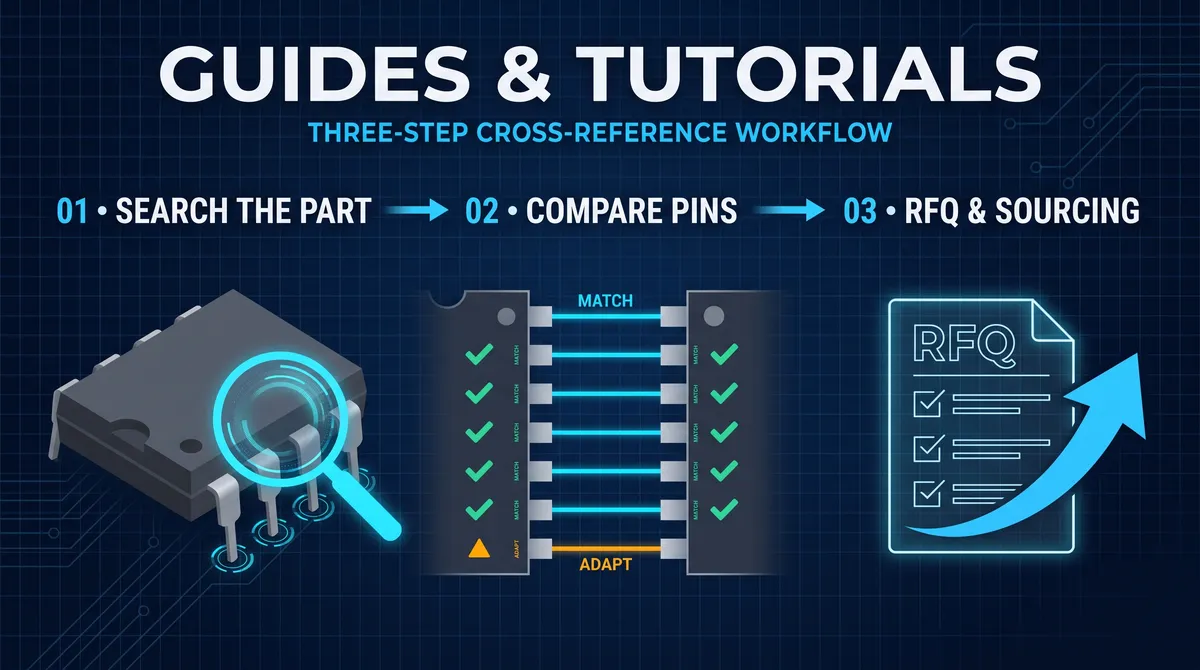
74HC595 Pin-to-Pin Alternatives: Finding the Right Shift Register Replacement for Your Project
The 74HC595 is an 8-bit serial-in, parallel-out shift register that operates at speeds up to 25 MHz with a maximum output current of 35 mA per output pin. This widely-deployed device, originally introduced by Philips (now NXP), remains a staple in LED matrix driving, industrial automation control panels, and embedded system expanders due to its three-state serial output and integrated output latches. When supply constraints, updated system requirements, or manufacturer discontinuations push engineers toward a 74HC595 equivalent alternative, understanding the nuanced differences in pinout compatibility, current sinking capabilities, voltage tolerances, and propagation delays becomes essential for maintaining design integrity.
The decision to select a 74HC595 equivalent alternative typically stems from one of three scenarios: the original component becomes unavailable through authorized distributors, the application's current or voltage requirements exceed the 74HC595's specifications, or a more feature-rich alternative offers cost or performance advantages for high-volume production. This guide examines the leading pin-to-pin compatible replacements, provides detailed electrical specification comparisons, and delivers practical selection criteria for engineers working across consumer electronics, industrial controls, automotive systems, and hobbyist projects. Each alternative discussed maintains functional pinout equivalence with the original 74HC595, enabling drop-in replacement in most circuit designs while addressing specific performance trade-offs that may better suit particular applications.
Why Engineers Seek a 74HC595 Equivalent Alternative
The 74HC595 shift register has enjoyed decades of dominance in digital electronics due to its straightforward serial interface, cascadeable architecture, and reliable performance across a wide voltage range of 2V to 6V. However, even the most successful components eventually face end-of-life announcements, and the semiconductor industry continuously introduces improved alternatives that address the original device's limitations. Understanding why engineers specifically search for a 74HC595 equivalent alternative helps clarify which replacement candidates deserve serious evaluation for any given project.
Supply chain disruptions have made component obsolescence a critical concern for production schedules, particularly for older 74HC595 variants manufactured by secondary sources. When major distributors report extended lead times exceeding 20 weeks for standard 74HC595 units, procurement teams actively seek drop-in replacements that maintain backward compatibility while offering more reliable availability. The TPIC6595 from Texas Instruments exemplifies this category, providing pin-to-pin functionality with enhanced current handling specifically designed for applications where the standard 74HC595 output stage proves insufficient.
Current limitation represents the most common technical constraint driving the search for alternatives. Each 74HC595 output pin can sink approximately 35 mA, but the total device current is typically limited to 70 mA when all outputs are active simultaneously. This restriction creates challenges for LED matrix applications where individual LEDs require 20 mA and larger displays demand higher aggregate current delivery. Engineers frequently discover that a 74HC595 equivalent alternative with open-drain outputs or higher current ratings provides a more elegant solution than adding external driver circuitry.
Voltage compatibility issues also prompt reconsideration of the standard 74HC595. While the HC family operates from 2V to 6V, some modern systems use 1.8V logic levels that approach the lower limit of reliable HC-series operation. Alternatives in the LV (low-voltage) or LVC (low-voltage CMOS) families offer guaranteed compatibility at these lower voltage rails while maintaining the same pinout and functional behavior. Additionally, automotive and industrial applications requiring operation across extended temperature ranges may benefit from alternatives specified for -40°C to 125°C operation rather than the commercial 74HC595 rating of -40°C to 85°C.
Top Pin-to-Pin Alternatives to the 74HC595
Several manufacturers produce devices specifically designed as direct substitutes or enhanced replacements for the 74HC595. These alternatives span the full spectrum from basic functional equivalents to feature-rich upgrades, allowing engineers to select the optimal balance of cost, performance, and availability for their specific requirements. The following analysis covers the most viable candidates, organized by their primary differentiation from the original device.
TPIC6595: High-Current Driving Capability
The TPIC6595 stands as the most prominent high-current alternative to the standard 74HC595, offering pin-to-pin compatibility while dramatically improving output current capability. Where the 74HC595 provides 35 mA per output, the TPIC6595 delivers 250 mA per output channel, making it ideal for driving high-brightness LEDs, relays, or other loads that exceed standard TTL current levels. This device uses DMOS transistor outputs configured as open-drain, requiring pull-up resistors but providing substantially higher current handling than the 74HC595's push-pull architecture.
The TPIC6595 maintains the same serial interface as the 74HC595, including the serial data input, shift register clock, latch clock, and output enable functions. Engineers can substitute this device directly in existing designs, adding only the necessary pull-up resistors to complete the interface. The device operates across the same 4.5V to 5.5V supply range as standard TTL logic, ensuring compatibility with legacy 5V systems while the DMOS outputs tolerate higher voltages than standard CMOS transistors.
Thermal considerations differ significantly between these devices. The 74HC595 can operate without external heatsinking at rated current, while the TPIC6595 requires careful attention to thermal design due to its higher power dissipation. Junction temperature must remain below 150°C, necessitating thermal analysis for designs driving multiple outputs at high current levels simultaneously. The datasheet provides detailed thermal resistance data and application examples for LED driving and relay control that help engineers implement reliable designs.
One notable limitation of the TPIC6595 is its slower maximum clock frequency compared to the 74HC595. While the 74HC595 supports serial clock rates up to 25 MHz, the TPIC6595 typically operates reliably at frequencies up to 10 MHz. This difference rarely impacts practical applications since most microcontrollers communicate with shift registers at significantly lower speeds, but high-speed applications requiring rapid updates may encounter timing constraints when switching to this alternative.
74HC164: The Simple Shift Register Alternative
The 74HC164 represents the closest functional equivalent to the 74HC595 among standard shift registers, sharing the same serial-in, parallel-out architecture and 8-bit width. However, this device lacks the output latch that distinguishes the 74HC595, meaning newly shifted data appears immediately on the outputs rather than being held until a separate latch pulse. This fundamental difference affects how engineers implement the device in their systems and represents the primary consideration when evaluating the 74HC164 as a 74HC595 equivalent alternative.
The absence of output latching in the 74HC164 creates both advantages and disadvantages depending on the application. For LED displays where continuous updating is acceptable and flicker would not be problematic, the 74HC164 offers a simpler interface since no latch signal management is required. However, for applications where outputs must hold a stable state while new data is being shifted into the register, additional external latching or software workarounds become necessary. Engineers frequently combine the 74HC164 with external latches to replicate 74HC595 functionality when cost constraints favor this approach.
Pinout differences between the 74HC164 and 74HC595 require PCB modifications for direct substitution. The 74HC164 uses a 14-pin package with serial data available on two input pins that must be combined internally, whereas the 74HC595 uses a 16-pin package with dedicated serial input and output pins. The cascade output (Q7') present in the 74HC595 is not available in the standard 74HC164 configuration, limiting the ability to chain multiple devices together without additional circuitry. These differences make the 74HC164 a functional alternative rather than a true pin-to-pin replacement.
Despite these limitations, the 74HC164 remains valuable in applications where its characteristics align with system requirements. The device operates across the full 2V to 6V range, matches the 74HC595's propagation delay performance, and offers lower power consumption due to its simpler internal architecture. For single-stage shift register applications not requiring cascade capability, the 74HC164 provides a cost-effective solution that achieves similar results with appropriate design considerations.
74HC594: The Latched Alternative with RCK Reset
The 74HC594 closely matches the 74HC595 feature set while adding an integrated output register clear function that simplifies certain control sequences. This device provides the same serial-in, parallel-out architecture with dedicated latch input for output hold, and includes a master reset (MR) pin that clears the output register independently of the shift register contents. The ability to reset outputs without affecting incoming serial data offers advantages in applications requiring periodic output clearing or emergency shutdown sequences.
Pin configuration of the 74HC594 closely parallels the 74HC595 with minor differences in pin assignments due to the additional master reset function. The serial data input, serial clock, latch clock, and output enable signals maintain the same functional roles, enabling software compatibility with 74HC595 driver code. The shift register clear function on the 74HC594 provides an alternative to software-based clearing when rapid, simultaneous clearing of all outputs is required.
Availability considerations often favor the 74HC594 as a 74HC595 equivalent alternative, particularly when primary suppliers experience shortages of the more popular 74HC595. Multiple semiconductor manufacturers produce the 74HC594, including NXP, Texas Instruments, and various Asian fabless suppliers, ensuring competitive pricing and reliable supply chains. Engineers should verify specific package options and temperature grades available from their preferred distributors before finalizing designs.
Propagation delay characteristics of the 74HC594 match the 74HC595 closely, with typical tPD values of 15-20 ns at 5V supply. Output drive capability remains identical at 35 mA per channel with the same total device current limitations. These specifications make the 74HC594 a transparent replacement in timing-sensitive applications, requiring no adjustments to clock rates or timing margins when substituting for the 74HC595.
M74HC595: The STMicroelectronics Variant
STMicroelectronics produces the M74HC595 as a fully compatible alternative to the original Philips/NXP 74HC595, offering equivalent electrical specifications in various package options including DIP, SO, TSSOP, and QFN. This device represents the most straightforward choice for engineers seeking a true drop-in replacement without functional or electrical modifications to existing designs. The M74HC595 designation follows ST's part numbering convention but the device maintains full compatibility with designs expecting the standard 74HC595 part number.
Quality and reliability ratings for the M74HC595 include extended temperature range options suitable for automotive and industrial applications. While standard commercial grades specify operation from -40°C to 85°C, automotive-qualified versions extend this range to 125°C with enhanced screening and documentation for safety-critical systems. Engineers designing for automotive clusters, industrial instrumentation, or medical devices should specifically request the automotive grade to ensure compliance with applicable industry standards.
The M74HC595 benefits from STMicroelectronics' manufacturing capabilities, offering consistent performance across production lots and long-term availability commitments that smaller suppliers may not provide. ST participates in major automotive quality programs and maintains IATF 16949 certification for automotive-grade products, providing additional confidence for high-reliability applications. Documentation including IBIS models, SPICE parameters, and detailed application notes supports design-in activities and simulation-based verification.
Power consumption characteristics of the M74HC595 match the standard 74HC595, with quiescent current consumption below 80 μA and dynamic current requirements scaling with clock frequency and output switching activity. For battery-powered applications where power conservation is critical, the HC family remains competitive with newer CMOS logic families due to its moderate frequency response requirements and simple output structure.
SN74HC595: Texas Instruments Implementation
Texas Instruments packages their HC595 implementation under the SN74HC595 designation, providing another fully-compatible alternative that engineers can substitute directly for the original device. The SN74HC595 benefits from TI's extensive distribution network and technical support infrastructure, making this variant particularly attractive for designs already incorporating other TI components. Cross-referencing tools on distributor websites frequently identify the SN74HC595 as an approved second-source for systems originally designed around NXP or other manufacturer 74HC595 devices.
The SN74HC595 datasheet provides comprehensive electrical characteristics including guaranteed worst-case specifications across the full temperature and supply voltage ranges. TI specifies maximum propagation delays of 25 ns at 25°C with 4.5V supply, ensuring compatibility with most microcontroller interfaces operating at reasonable clock rates. Input protection circuitry and output ESD ratings meet or exceed industry standards, providing robust performance in electrically noisy environments typical of industrial and automotive applications.
TI offers the SN74HC595 in tube, reel, and tape packaging options suitable for prototype quantities through high-volume production runs. Inventory management tools and forecast visibility through TI's online portal help procurement teams plan component sourcing and avoid production interruptions. The device's widespread adoption ensures competitive pricing through multiple distributors and long-term availability backed by TI's product longevity program for industrial and medical applications.
Comparative Analysis: Pinout and Electrical Specifications
A systematic comparison of key electrical parameters helps engineers select the optimal 74HC595 equivalent alternative for their specific application requirements. The following analysis presents specifications in tabular format to facilitate direct comparison and highlight the trade-offs between different replacement candidates.
The supply voltage range remains consistent across most HC-series alternatives at 2V to 6V, with the TPIC6595 standing apart at 4.5V to 5.5V due to its DMOS output architecture. Output current capability varies significantly, with the TPIC6595 offering 250 mA per channel compared to 35 mA for standard HC595 variants. This seven-fold increase in drive capability eliminates the need for external transistor drivers in many high-current applications, reducing component count and board space requirements.
Propagation delay characteristics determine maximum update rates for serial communication with shift registers. The 74HC595 and its direct equivalents achieve propagation delays of 15-25 ns, while the TPIC6595 requires approximately 40 ns due to its higher-current output stage. For applications updating at rates below 1 MHz, these differences remain negligible, but high-speed applications driving refresh rates above 5 MHz should verify timing margins with the specific device selected.
Input voltage thresholds for logic high and low levels determine compatibility with various microcontroller families operating at different supply voltages. All HC-series devices guarantee recognition of 3.5V as logic high when powered at 5V, ensuring compatibility with 3.3V microcontrollers that output 3.3V logic levels. However, at 3.3V supply, input thresholds become more critical, and engineers should verify that their microcontroller's output voltages meet or exceed the Vil(max) and Vih(min) specifications for their chosen alternative.
| Parameter | 74HC595 | TPIC6595 | 74HC164 | 74HC594 | M74HC595 | SN74HC595 |
|---|---|---|---|---|---|---|
| Supply Voltage | 2-6V | 4.5-5.5V | 2-6V | 2-6V | 2-6V | 2-6V |
| Output Current | 35 mA | 250 mA | 25 mA | 35 mA | 35 mA | 35 mA |
| Max Frequency | 25 MHz | 10 MHz | 30 MHz | 25 MHz | 25 MHz | 25 MHz |
| tPD (ns) | 20 | 40 | 18 | 20 | 20 | 20 |
| Output Type | Push-Pull | Open-Drain | Push-Pull | Push-Pull | Push-Pull | Push-Pull |
| Output Latch | Yes | Yes | No | Yes | Yes | Yes |
| Packages | DIP/SO/TSSOP | DIP/SO | DIP/SO | DIP/SO | DIP/SO/TSSOP/QFN | DIP/SO/TSSOP |
| Temperature | -40 to 85°C | -40 to 125°C | -40 to 85°C | -40 to 85°C | -40 to 125°C | -40 to 85°C |
Output architecture differences between alternatives affect system design beyond simple current capability. The TPIC6595's open-drain configuration requires external pull-up resistors, adding component count but enabling operation at voltages up to 50V. This characteristic makes the TPIC6595 suitable for driving 12V or 24V loads directly, whereas standard 74HC595 alternatives remain limited to the supply voltage range. Engineers should budget pull-up resistor values based on desired rise times and load currents, typically selecting 1kΩ to 10kΩ depending on the application.
Thermal performance varies considerably between alternatives, particularly for the TPIC6595 when driving high currents. Junction-to-ambient thermal resistance values in the datasheet enable thermal analysis for specific mounting conditions. Adding copper pad area, thermal vias, and appropriate heatsinking may be necessary for designs requiring sustained high-current operation. Standard HC595 alternatives typically operate within thermal limits without special consideration due to their lower power dissipation.
Application-Specific Selection Criteria
Different application categories present unique requirements that influence the optimal choice among available 74HC595 equivalent alternatives. Understanding how specific use cases stress different device characteristics helps engineers make informed decisions rather than simply selecting the lowest-cost drop-in replacement. The following sections examine common application scenarios and recommend suitable alternatives based on system requirements.
LED Driving Applications
LED displays and indicators represent the most common application for shift registers, ranging from simple seven-segment displays to large LED matrices and addressable strip controllers. The number of LEDs, brightness requirements, and update frequency determine which 74HC595 equivalent alternative provides the best fit. Simple indicator panels driving small LEDs at modest update rates typically function adequately with standard 74HC595 or SN74HC595 devices, while demanding matrix displays may require the enhanced capability of the TPIC6595.
For seven-segment numeric displays, the standard 74HC595 provides sufficient drive capability for most common LED types. Multiplexed operation spreads the current requirement across multiple segments, allowing individual outputs to remain within safe operating limits while achieving adequate brightness through peak current boosting. Software multiplexing patterns at 100-200 Hz typically produce flicker-free displays acceptable for industrial and consumer applications.
High-brightness LED matrices require substantially higher current delivery than standard 74HC595 outputs can provide reliably. Large outdoor displays using high-efficiency LEDs with 20 mA forward current at peak brightness cannot achieve adequate illumination when driven through the current-limiting characteristics of standard HC595 outputs. The TPIC6595 addresses this limitation directly, providing sufficient current to drive LEDs at rated brightness without external current-limiting transistors.
RGB LED control presents additional complexity due to the need for multiple output channels per LED element. A 64-LED matrix using RGB LEDs requires 192 individual drive channels, meaning 24 cascaded 8-bit shift registers. The aggregate current demand and thermal management challenges increase proportionally, making the TPIC6595's enhanced current capability valuable for large installations. Engineers should carefully calculate total power dissipation and implement appropriate thermal management for sustained operation.
Industrial Control Systems
Industrial applications impose demanding requirements for extended temperature operation, noise immunity, and long-term reliability. The 74HC595 was designed for commercial applications, but several alternatives offer specifications better suited for industrial environments. Temperature range extension to -40°C to 125°C, enhanced ESD protection, and wide voltage supply tolerance become critical factors in equipment that must operate in factory floor environments.
The TPIC6595's automotive and industrial temperature grades make this device suitable for control panels and indicator displays in industrial equipment. Operation at 125°C ambient temperature accommodates placement near heat sources within equipment enclosures. The device's higher output current capability also simplifies driving industrial indicator lights and panel-mounted indicators that may require higher brightness than consumer applications.
PLC (Programmable Logic Controller) expansion outputs frequently employ shift registers to increase the number of available discrete outputs beyond the base module's capability. Industrial automation systems driving solenoid valves, contactors, and indicator lamps benefit from the TPIC6595's ability to directly drive these loads without intermediate relays or driver transistors. The open-drain output configuration allows driving 24V industrial loads directly when pull-up resistors connect to the 24V supply rail.
Communication protocols in industrial environments may require faster update rates than typical serial interfaces provide. When shift registers serve as parallel output expanders for high-speed automation sequences, the propagation delay through the serial chain and latch update cycle becomes significant. Engineers should calculate total update time for the complete register chain and verify this meets the application's timing requirements, considering that longer chains accumulate greater delays.
Consumer Electronics
Consumer electronics applications typically prioritize cost optimization, compact packaging, and moderate performance requirements. The standard 74HC595 and its direct equivalents from multiple manufacturers provide adequate performance at competitive pricing. However, specific consumer product categories may benefit from alternative selections that optimize particular characteristics such as power consumption, package size, or interface flexibility.
Battery-powered devices demand careful attention to power consumption, particularly for products expected to operate for extended periods on single battery charges. The HC family of devices offers moderate power consumption that may be acceptable for many consumer products, but alternatives with lower quiescent current could provide meaningful battery life improvements for always-on applications. Engineers should measure actual current consumption in the target application, accounting for dynamic current during output transitions that dominates power draw during active operation.
Wearable electronics and compact consumer devices require minimum board space, driving selection toward smaller package options. QFN (Quad Flat No-lead) and BGA (Ball Grid Array) packages offer significant space savings compared to DIP or SO packages, but introduce manufacturing complexity that may not suit all production environments. The M74HC595 from STMicroelectronics provides QFN options that enable compact designs while maintaining full compatibility with standard 74HC595 designs.
Gaming peripherals and entertainment electronics frequently employ LED effects and displays that benefit from high-speed update capability. LED strips with addressable segments, gaming keyboard backlighting, and enthusiast PC components often require rapid color changes and complex patterns that stress shift register performance. Standard 74HC595 alternatives operating at full 25 MHz capability provide adequate headroom for these applications, and the TPIC6595's slower maximum frequency rarely impacts animated LED effects.
Migration and Pin-to-Pin Replacement Considerations
Transitioning from the standard 74HC595 to an alternative device requires systematic evaluation to ensure design integrity is maintained throughout the production lifecycle. While many alternatives offer genuine pin-to-pin compatibility, subtle differences in electrical characteristics, timing parameters, and package dimensions may require design modifications. A structured migration process reduces risk and identifies potential issues before they impact production.
Schematic review should verify that all external components remain compatible with the replacement device's specifications. Pull-up resistor values for TPIC6595 designs require calculation based on the desired load current and available supply voltage. Bypass capacitor placement and value should follow the replacement device's datasheet recommendations rather than those from the original 74HC595. Power supply decoupling becomes particularly important for high-speed operation and when driving multiple outputs simultaneously.
Layout considerations differ between alternatives, particularly regarding thermal management and signal integrity. The TPIC6595's higher power dissipation requires thermal vias and copper area to maintain junction temperatures within safe limits. Return current paths for high-speed clock signals should follow the replacement device's recommendations to minimize ringing and electromagnetic interference. Ground and power plane segmentation may need adjustment to accommodate the different current demands of alternative devices.
Software compatibility requires verification even when hardware substitution appears straightforward. The basic serial interface commands for shifting data and latching outputs remain identical across most alternatives, but timing-sensitive code may encounter issues if the replacement device's propagation delays differ significantly from the original. Testing complete communication sequences at maximum operating speed helps identify marginal timing conditions before production deployment.
Environmental testing provides final validation of the migration decision, exposing any weaknesses in the theoretical compatibility analysis. Temperature cycling across the device's specified operating range reveals corner-case behavior that may not appear at room temperature. Long-term reliability testing under accelerated aging conditions confirms that the alternative device will meet the product's expected service life. EMI/EMC testing verifies that the replacement device does not introduce radiated or conducted emissions that exceed applicable standards.
Quality and Sourcing Considerations
Component quality varies significantly between manufacturers and distribution channels, affecting the reliability and performance of equipment incorporating 74HC595 equivalent alternatives. Authorized distribution remains the most reliable sourcing approach for critical applications, while independent distributors offer cost advantages that may be acceptable for non-critical uses. Understanding the quality landscape helps engineers and procurement teams balance cost, availability, and reliability in their component selection decisions.
Authorized distributors including Arrow, Avnet, Digi-Key, Mouser, and regional specialists maintain relationships directly with semiconductor manufacturers, ensuring that components receive proper storage, handling, and authentication throughout the supply chain. These distributors provide traceability documentation that may be required for automotive, medical, or aerospace applications where component genealogy documentation is mandatory. Counterfeit component risk remains minimal when sourcing exclusively through authorized channels.
Independent distributors and broker networks offer components at competitive prices when authorized distribution faces shortages or extended lead times. However, these sources present elevated risk of receiving counterfeit, mismarked, or previously used components. Visual inspection, date code verification, and functional testing provide some protection against substandard components, but cannot guarantee authenticity with the certainty that authorized distribution provides. Engineers should establish clear policies regarding acceptable sourcing channels for each product category based on reliability requirements and cost constraints.
Country of origin and export compliance considerations affect sourcing decisions for multinational corporations and defense-related applications. Certain semiconductor products fall under export control regulations that restrict shipment to specific destinations or end users. Import tariffs and trade policies may influence the cost-effectiveness of sourcing from different manufacturing regions. Compliance review should occur during the component selection phase to avoid discovering sourcing restrictions after design completion.
Conclusion
Selecting the appropriate 74HC595 equivalent alternative requires balancing technical requirements, supply chain considerations, and cost constraints specific to each application. The TPIC6595 provides the most compelling enhancement for applications demanding higher output current, while standard equivalents like the M74HC595 and SN74HC595 offer drop-in replacement with minimal design modification. The 74HC164 and 74HC594 address specialized requirements where the original device's features may be excessive or insufficient for the application at hand.
Engineers should approach alternative selection systematically, beginning with clear documentation of technical requirements and progressing through comparison of available alternatives against those requirements. Thorough evaluation of datasheet specifications, followed by prototype testing under realistic operating conditions, helps identify subtle incompatibilities that might not appear in theoretical analysis. Documentation of the selection rationale supports future maintenance and potential second-sourcing decisions.
The shift register market continues evolving as semiconductor manufacturers introduce improved processes and new features. Monitoring industry developments helps engineers identify emerging alternatives that may better serve future applications. Design practices that minimize dependency on specific component sources, such as programming flexibility that accommodates multiple pin-compatible alternatives, reduce risk of supply chain disruptions affecting production schedules. By maintaining awareness of available alternatives and their relative strengths, engineers can make confident component selections that serve their applications reliably throughout the product lifecycle.
Not sure which sensor fits your project?
Talk to our mmWave application engineers for a free consultation.
Specify your hotel project with our engineers
Send your room count, ceiling type, and protocol preference. We will return a sample plan and quote within 24 business hours.
- Move from general guidance into a product or application discussion.
- Use RFQ when pricing, drawings, MOQ, or launch timing needs structure.
- Keep a direct contact path visible for fast clarifications and handoff.