74 Series Logic IC Substitute: Complete Cross Reference Guide for Engineers
A comprehensive cross reference guide helping engineers find compatible 74 series logic IC substitutes with pin-to-pin replacements and manufacturer alternatives.
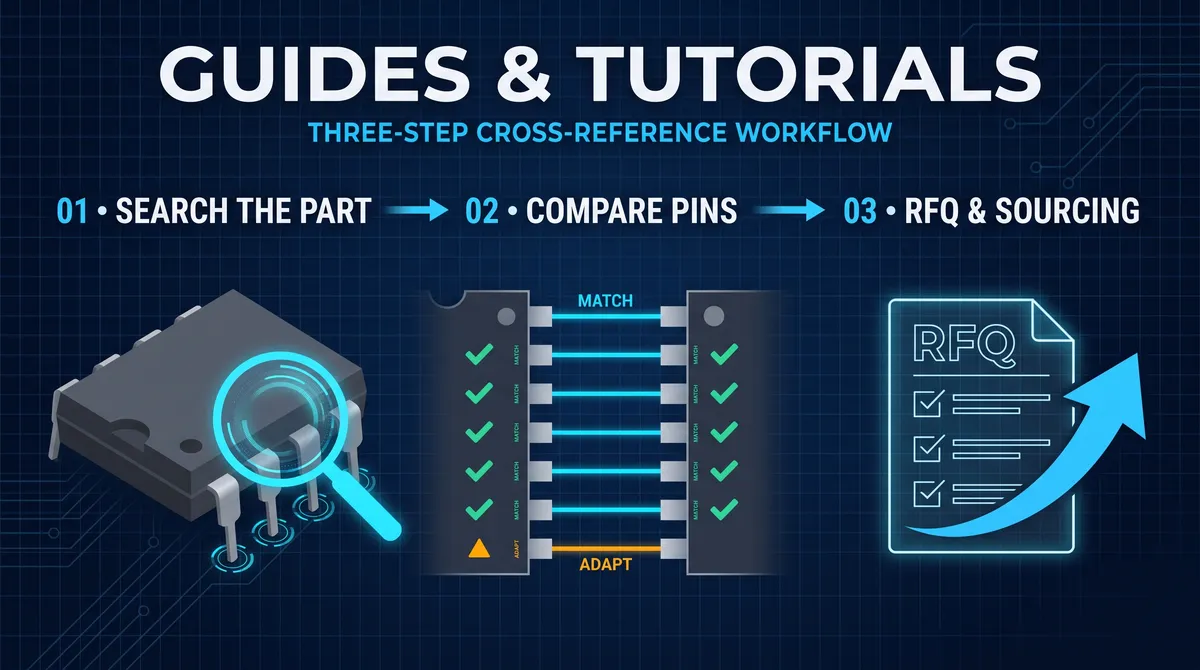
74 Series Logic IC Substitute: Complete Cross Reference Guide for Engineers
Introduction to 74 Series Logic IC Substitutes
The 74 series logic IC family represents one of the most enduring and widely deployed semiconductor families in electronic engineering history, with origins tracing back to Texas Instruments' introduction of the 7400 TTL series in 1964. Engineers working across industrial control systems, consumer electronics, automotive electronics, and telecommunications infrastructure regularly encounter situations requiring a reliable 74 series logic IC substitute when original components become obsolete, unavailable, or when cost optimization demands alternative sourcing. This 74 series logic IC substitute guide addresses the fundamental challenge faced by design engineers and procurement specialists: identifying drop-in compatible replacements that maintain signal integrity, timing characteristics, and electrical specifications without requiring schematic modifications or PCB redesigns. The complexity of modern electronics supply chains, combined with continued demand for mature technology nodes, has made cross-referencing a critical skill for engineering teams maintaining legacy systems or scaling production of established designs. Understanding the systematic approach to logic IC substitution enables engineers to reduce part count risk, negotiate favorable pricing through multi-source procurement, and ensure continuity of manufacturing programs spanning decades of product lifecycle management.
Understanding the 74 Series Logic IC Architecture
The 74 series logic IC family encompasses a comprehensive range of digital logic functions organized into distinct subfamilies, each representing different semiconductor technologies and performance characteristics. The original 74 TTL (Transistor-Transistor Logic) family established industry standards for propagation delay, input and output current specifications, and noise margins that subsequent CMOS-based 74HC, 74HCT, and 74LV families have maintained while offering reduced power consumption and expanded operating voltage ranges. Understanding these architectural differences proves essential when selecting a 74 series logic IC substitute, as compatibility extends beyond simple pin alignment to encompass electrical characteristics, timing parameters, and interface requirements. The 74 series architecture follows a consistent pinout convention where pin 14 hosts VCC and pin 7 provides ground connection across most dual-inline package (DIP) devices, enabling mechanical compatibility across different logic functions. Manufacturers including NXP Semiconductors, Texas Instruments, ON Semiconductor, Diodes Incorporated, and Toshiba continue producing 74 series devices in both traditional DIP packages and surface-mount formats such as SOIC, TSSOP, and VSSOP, ensuring continued availability for new designs and replacement applications. The modular nature of 74 series logic IC architecture facilitates substitution when engineers carefully evaluate the electrical and timing specifications of replacement candidates against original device requirements.
TTL vs CMOS Subfamily Characteristics
The transition from TTL to CMOS technology within the 74 series family introduced significant electrical differences that engineers must understand when evaluating substitute components. Standard TTL devices (7400, 74LS00, 74F00) operate at 5V nominal supply voltage with typical propagation delays of 10-25 nanoseconds and moderate power consumption ranging from 10-20 milliwatts per gate. CMOS variants including 74HC00 (High-Speed CMOS) and 74HCT00 (High-Speed CMOS with TTL-compatible inputs) deliver propagation delays under 10 nanoseconds while consuming microwatts of power during static operation, though they require careful consideration of input switching thresholds. The 74LV (Low-Voltage CMOS) family extends operating ranges down to 2.0V, making these devices suitable for modern 3.3V and 2.5V systems while maintaining compatibility with legacy 5V logic through careful voltage level translation. Engineers selecting a 74 series logic IC substitute must verify that input logic thresholds align with output drive characteristics of upstream devices in their signal chain, as mismatched logic families can result in insufficient noise margin and unreliable operation. Temperature range specifications vary significantly across manufacturers and subfamilies, with commercial grade (-40°C to +85°C), industrial grade (-40°C to +85°C), and automotive grade (-40°C to +125°C) variants offering different reliability certifications that may be required for specific applications.
Package Types and Pinout Compatibility
The physical package configuration of 74 series logic ICs directly impacts substitution options, as mechanical compatibility with existing PCB footprints determines whether a component qualifies as a drop-in replacement. DIP (Dual Inline Package) with 7.62mm (300mil) body width remains common for through-hole applications and legacy equipment, while SOIC (Small Outline Integrated Circuit) packages with 3.9mm body width provide surface-mount compatibility with existing pad patterns designed for legacy through-hole devices. TSSOP (Thin Shrink Small Outline Package) and VSSOP (Very Thin Shrink Small Outline Package) offer reduced board space requirements but may require footprint modifications for substitution in existing designs originally populated with larger packages. The 14-pin, 16-pin, and 20-pin variants follow consistent pin numbering conventions where odd-numbered pins occupy the left side when viewing the device from the top with the orientation notch facing left. Pinout compatibility requires verification beyond simple pin count, as some 74 series devices share package sizes but assign different functions to specific pins, necessitating careful cross-reference checking before substitution. Engineers should obtain complete datasheets for both original and substitute components, comparing absolute maximum ratings, recommended operating conditions, and electrical characteristics across the full temperature range of intended operation.
Why Engineers Need 74 Series Logic IC Substitutes
The semiconductor industry experiences continuous consolidation, with manufacturers discontinuing mature products when demand no longer justifies production at current technology nodes, driving engineers to identify suitable 74 series logic IC substitute options for ongoing programs. Legacy equipment maintenance represents a significant driver of substitution demand, as industrial automation systems, medical devices, aerospace electronics, and military equipment often remain operational for 20-30 years while component availability steadily diminishes. When Texas Instruments, historically the primary source for 74 series logic ICs, announced end-of-life schedules for various TTL variants, engineering teams faced pressure to validate alternative sources before inventory depletion threatened production continuity. Cost optimization strategies frequently motivate substitution efforts, as multi-source procurement across competing manufacturers enables volume pricing negotiations and reduces single-source vulnerability to supply disruptions. Counterfeit component prevention has emerged as an increasingly important substitution driver, as authorized distributors offering genuine replacements from secondary manufacturers provide traceability and quality assurance that independent brokers cannot guarantee. The global semiconductor shortage of 2021-2023 demonstrated the systemic risk of single-source component selection, prompting many engineering organizations to implement approved alternate parts databases including validated 74 series logic IC substitute recommendations.
Obsolescence Management Strategies
Effective obsolescence management requires systematic approaches to component lifecycle tracking, alternative part identification, and risk assessment that engineering teams should integrate into design and maintenance processes. The JEDEC Solid State Technology Association establishes standards for component lifecycle documentation, including datasheet revision tracking and manufacturing change notifications that alert designers to pending discontinuances. Passive and active monitoring services aggregate product change notifications from major semiconductor manufacturers, enabling proactive substitution planning before supply disruptions impact production schedules. Design for Manufacturability (DFM) guidelines recommend selecting components with multiple qualified sources as a standard practice, though legacy designs often predate these recommendations and require retroactive substitution validation. Engineers should maintain cross-reference databases organized by original manufacturer part number, function type, and package configuration, enabling rapid identification of substitute candidates when obsolescence notifications arrive. The military and aerospace industries have developed rigorous qualification processes for alternate component sourcing, including extended temperature testing, radiation tolerance verification, and long-term reliability studies that ensure substitute components meet demanding application requirements. Commercial applications benefit from similar systematic approaches scaled to appropriate risk levels, with safety-critical systems warranting comprehensive validation while non-critical circuits may accept substitute components with limited additional testing.
Supply Chain Resilience Considerations
Supply chain resilience planning has elevated component substitution from a reactive troubleshooting activity to a proactive engineering discipline integrated into product lifecycle management. Single-source component dependencies create vulnerability to price increases, delivery delays, and supply interruptions that can cascade into production stoppages and customer delivery failures. Diversifying the supplier base for critical 74 series logic IC functions requires identifying drop-in compatible replacements that maintain electrical specifications across operating conditions. Just-in-time inventory models amplify supply chain risk, as limited buffer stock provides minimal protection against sudden availability changes for long-lead-time components. Engineers working with contract manufacturers should verify that production facilities maintain adequate safety stock for legacy components or have validated substitution procedures ready for implementation. The tiered distribution network for electronic components includes authorized distributors with guaranteed authenticity, independent brokers offering potentially lower pricing but increased counterfeit risk, and OEM direct fulfillment for high-volume applications. Cross-referencing across multiple manufacturers requires attention to date code management, as components from different sources may exhibit subtle processing variations affecting long-term reliability. Supply chain mapping tools help engineering teams visualize component dependencies and identify concentration risks requiring substitution planning to ensure manufacturing continuity.
Cross-Reference Methodology for Logic IC Substitution
Systematic cross-referencing for 74 series logic IC substitution follows established engineering principles that balance verification thoroughness against implementation timelines and testing resource availability. The substitution process begins with functional identification, determining the exact logic function required (AND, OR, NAND, NOR, XOR, flip-flop, counter, shift register, decoder, encoder, multiplexer, buffer, or driver) and the specific variant within that family. Package and pinout verification follows functional matching, confirming that physical dimensions and pin assignments align between original and substitute components. Electrical specification comparison encompasses logic thresholds, input current requirements, output drive capability, propagation delay, and power consumption characteristics that determine functional equivalence. Timing parameter verification addresses setup time, hold time, maximum clock frequency, and propagation delay variations that may affect circuit operation in timing-sensitive applications. Environmental testing under actual operating conditions provides final validation that substitute components perform reliably in the target application environment. Documentation of the substitution decision, including technical justification, testing performed, and approval records, supports future maintenance activities and regulatory compliance requirements.
Functional Equivalence Assessment
Functional equivalence assessment requires systematic comparison of logic function implementation across different manufacturers, as subtle architectural differences may affect circuit behavior despite identical truth tables. The basic logic gates (AND, OR, NAND, NOR, XOR, NOT) exhibit highly consistent implementations across 74 series manufacturers, with most variations limited to propagation delay and drive strength differences. Complex functions including flip-flops (D, JK, SR), counters (binary, decade, Johnson), shift registers (SISO, SIPO, PISO, universal), and arithmetic logic units require deeper verification of state machine behavior, reset sequences, and clocking requirements. Asynchronous clear and preset inputs on sequential devices may have different priority encodings that affect initialization behavior during power-up or fault conditions. Enable and output enable inputs on tri-state devices require verification of active level and propagation delay characteristics to ensure proper bus arbitration timing. Encoder and decoder functions may implement active-low or active-high outputs differently, requiring attention to logical inversion and bubble notation in schematic interpretation. Arithmetic functions including adders, comparators, and parity generators require numerical verification across edge cases to confirm mathematical correctness of substitution candidates.
Electrical Parameter Comparison
Electrical parameter comparison extends beyond simple voltage and current specification matching to encompass the full range of characteristics affecting reliable circuit operation. Input logic thresholds determine the voltage range required to reliably register a logic high or low, with TTL-compatible inputs (HCT family) accepting 2.0V minimum for high and 0.8V maximum for low while CMOS inputs (HC family) require voltages approaching rail levels for guaranteed switching. Output drive strength, measured in milliamps source and sink capability, must exceed the input requirements of all connected loads plus any current through pull-up or pull-down resistors in the circuit. Propagation delay specifications establish maximum time between input change and corresponding output change, with this parameter critical in synchronous circuits where timing margins determine maximum clock frequencies. Power consumption comparison encompasses both quiescent current (static power draw) and dynamic current (frequency-dependent power draw), important for thermal management and power budget calculations. Input leakage current specifications indicate the current drawn by inputs when held at specific voltage levels, relevant for high-impedance input circuits and multi-device loading calculations. Output voltage specifications define the guaranteed logic high and low levels under load, requiring verification that receiver inputs meet their switching threshold requirements with acceptable noise margin.
Complete Cross-Reference Tables by Function
The following cross-reference tables organize 74 series logic IC substitutes by function type, enabling rapid identification of compatible replacement options across multiple manufacturers. Each table includes the industry-standard 74 series designation along with functional descriptions and cross-references to equivalent parts from major manufacturers including Texas Instruments, NXP, ON Semiconductor, Diodes Incorporated, and Toshiba. Engineers should verify all specifications against current datasheets, as manufacturing processes and material specifications evolve over time. The tables focus on the most common package options (DIP and SOIC) with standard temperature ranges suitable for commercial and industrial applications. Automotive-grade and military-grade variants with extended temperature ranges and enhanced quality certifications may require separate verification with specific manufacturers.
Logic Gates Cross-Reference
| Function | TI | NXP | ON Semi | Diodes | Toshiba |
|---|---|---|---|---|---|
| Quad 2-input NAND | SN74LS00 | 74LS00 | DM74LS00 | 74LS00 | TC74LS00 |
| Quad 2-input NAND (CMOS) | SN74HC00 | 74HC00 | MC74HC00 | 74HC00 | TC74HC00 |
| Quad 2-input NOR | SN74LS02 | 74LS02 | DM74LS02 | 74LS02 | TC74LS02 |
| Quad 2-input NOR (CMOS) | SN74HC02 | 74HC02 | MC74HC02 | 74HC02 | TC74HC02 |
| Quad 2-input AND | SN74LS08 | 74LS08 | DM74LS08 | 74LS08 | TC74LS08 |
| Quad 2-input AND (CMOS) | SN74HC08 | 74HC08 | MC74HC08 | 74HC08 | TC74HC08 |
| Quad 2-input OR | SN74LS32 | 74LS32 | DM74LS32 | 74LS32 | TC74LS32 |
| Quad 2-input OR (CMOS) | SN74HC32 | 74HC32 | MC74HC32 | 74HC32 | TC74HC32 |
| Triple 3-input NAND | SN74LS10 | 74LS10 | DM74LS10 | 74LS10 | TC74LS10 |
| Triple 3-input NAND (CMOS) | SN74HC10 | 74HC10 | MC74HC10 | 74HC10 | TC74HC10 |
| Dual 4-input NAND | SN74LS20 | 74LS20 | DM74LS20 | 74LS20 | TC74LS20 |
| Dual 4-input NAND (CMOS) | SN74HC20 | 74HC20 | MC74HC20 | 74HC20 | TC74HC20 |
| Hex Inverter | SN74LS04 | 74LS04 | DM74LS04 | 74LS04 | TC74LS04 |
| Hex Inverter (CMOS) | SN74HC04 | 74HC04 | MC74HC04 | 74HC04 | TC74HC04 |
| Triple 3-input AND | SN74LS11 | 74LS11 | DM74LS11 | 74LS11 | TC74LS11 |
| Triple 3-input AND (CMOS) | SN74HC11 | 74HC11 | MC74HC11 | 74HC11 | TC74HC11 |
Flip-Flop Cross-Reference
| Function | TI | NXP | ON Semi | Diodes | Toshiba |
|---|---|---|---|---|---|
| Dual D-type FF | SN74LS74 | 74LS74 | DM74LS74 | 74LS74 | TC74LS74 |
| Dual D-type FF (CMOS) | SN74HC74 | 74HC74 | MC74HC74 | 74HC74 | TC74HC74 |
| Dual JK-type FF | SN74LS76 | 74LS76 | DM74LS76 | 74LS76 | TC74LS76 |
| Dual JK-type FF (CMOS) | SN74HC76 | 74HC76 | MC74HC76 | 74HC76 | TC74HC76 |
| Dual SR-type FF | SN74LS279 | 74LS279 | DM74LS279 | 74LS279 | TC74LS279 |
| Octal D-type FF | SN74LS273 | 74LS273 | DM74LS273 | 74LS273 | TC74LS273 |
| Octal D-type FF (3-state) | SN74LS374 | 74LS374 | DM74LS374 | 74LS374 | TC74LS374 |
| Octal D-type Latch | SN74LS373 | 74LS373 | DM74LS373 | 74LS373 | TC74LS373 |
| 4-bit D-type Latch | SN74LS75 | 74LS75 | DM74LS75 | 74LS75 | TC74LS75 |
| Dual D-type Latch | SN74LS375 | 74LS375 | DM74LS375 | 74LS375 | TC74LS375 |
Counter Cross-Reference
| Function | TI | NXP | ON Semi | Diodes | Toshiba |
|---|---|---|---|---|---|
| Binary Counter | SN74LS93 | 74LS93 | DM74LS93 | 74LS93 | TC74LS93 |
| Decade Counter | SN74LS90 | 74LS90 | DM74LS90 | 74LS90 | TC74LS90 |
| 4-bit Up Counter | SN74LS161 | 74LS161 | DM74LS161 | 74LS161 | TC74LS161 |
| 4-bit Up/Down Counter | SN74LS193 | 74LS193 | DM74LS193 | 74LS193 | TC74LS193 |
| Dual 4-bit Binary Counter | SN74LS393 | 74LS393 | DM74LS393 | 74LS393 | TC74LS393 |
| BCD Counter | SN74LS162 | 74LS162 | DM74LS162 | 74LS162 | TC74LS162 |
| 4-bit Decade Counter | SN74LS160 | 74LS160 | DM74LS160 | 74LS160 | TC74LS160 |
| Johnson Counter | SN74LS4017 | 74HC4017 | MC74HC4017 | 74HC4017 | TC74HC4017 |
Shift Register Cross-Reference
| Function | TI | NXP | ON Semi | Diodes | Toshiba |
|---|---|---|---|---|---|
| 8-bit SIPO Shift Register | SN74LS164 | 74LS164 | DM74LS164 | 74LS164 | TC74LS164 |
| 8-bit PISO Shift Register | SN74LS165 | 74LS165 | DM74LS165 | 74LS165 | TC74LS165 |
| 4-bit Universal Shift Register | SN74LS194 | 74LS194 | DM74LS194 | 74LS194 | TC74LS194 |
| 8-bit SIPO (3-state) | SN74LS595 | 74LS595 | DM74LS595 | 74LS595 | TC74LS595 |
| 8-bit PISO (3-state) | SN74LS597 | 74LS597 | DM74LS597 | 74LS597 | TC74LS597 |
| 4-bit Static Shift Register | SN74LS95 | 74LS95 | DM74LS95 | 74LS95 | TC74LS95 |
Decoder and Encoder Cross-Reference
| Function | TI | NXP | ON Semi | Diodes | Toshiba |
|---|---|---|---|---|---|
| 3-to-8 Line Decoder | SN74LS138 | 74LS138 | DM74LS138 | 74LS138 | TC74LS138 |
| Dual 2-to-4 Line Decoder | SN74LS139 | 74LS139 | DM74LS139 | 74LS139 | TC74LS139 |
| 4-to-16 Line Decoder | SN74LS154 | 74LS154 | DM74LS154 | 74LS154 | TC74LS154 |
| BCD-to-7 Segment | SN74LS47 | 74LS47 | DM74LS47 | 74LS47 | TC74LS47 |
| BCD-to-7 Segment (CMOS) | SN74HC4511 | 74HC4511 | MC74HC4511 | 74HC4511 | TC74HC4511 |
| 8-to-3 Line Encoder | SN74LS148 | 74LS148 | DM74LS148 | 74LS148 | TC74LS148 |
| 10-to-4 Line Encoder | SN74LS147 | 74LS147 | DM74LS147 | 74LS147 | TC74LS147 |
Buffer and Driver Cross-Reference
| Function | TI | NXP | ON Semi | Diodes | Toshiba |
|---|---|---|---|---|---|
| Hex Buffer | SN74LS07 | 74LS07 | DM74LS07 | 74LS07 | TC74LS07 |
| Hex Buffer (3-state) | SN74LS125 | 74LS125 | DM74LS125 | 74LS125 | TC74LS125 |
| Hex Buffer (3-state) | SN74LS126 | 74LS126 | DM74LS126 | 74LS126 | TC74LS126 |
| Quad 2-input NAND Buffer | SN74LS40 | 74LS40 | DM74LS40 | 74LS40 | TC74LS40 |
| Octal Buffer (3-state) | SN74LS244 | 74LS244 | DM74LS244 | 74LS244 | TC74LS244 |
| Octal Bus Transceiver | SN74LS245 | 74LS245 | DM74LS245 | 74LS245 | TC74LS245 |
| Dual 4-input NAND Buffer | SN74LS22 | 74LS22 | DM74LS22 | 74LS22 | TC74LS22 |
Manufacturer-Specific Substitution Considerations
Each semiconductor manufacturer implements 74 series logic ICs with subtle variations in process technology, design architecture, and quality testing that engineers must consider when selecting substitute components. Texas Instruments, as the original developer of the 74 series architecture, maintains the most comprehensive documentation and widest product range, often serving as the specification reference against which substitute candidates are evaluated. NXP Semiconductors, spun off from Philips Semiconductors, inherited the original Signetics 74 series production capabilities and continues manufacturing high-quality alternatives with particular strength in automotive-grade variants. ON Semiconductor (formerly Motorola Semiconductor) offers 74 series devices optimized for noise-critical applications with enhanced input hysteresis and output drive characteristics. Diodes Incorporated provides cost-optimized 74 series alternatives suitable for high-volume consumer applications where component cost dominates specification requirements. Toshiba contributes Japanese-market variants with unique package options and extended temperature range variants suitable for industrial and automotive applications. Understanding these manufacturer-specific characteristics enables informed selection of 74 series logic IC substitute options aligned with application requirements and procurement constraints.
Texas Instruments Alternatives
Texas Instruments manufactures the broadest range of 74 series logic ICs with extensive documentation, application notes, and technical support that simplify substitution planning and implementation. The TI standard defines the electrical and timing specifications that most substitute manufacturers target, making TI devices natural reference points for cross-reference validation. TI offers enhanced variants branded as "A" suffix devices (SN74ALS00, SN74AHCT00) that provide improved speed and drive characteristics compared to standard versions. The TI "logic portfolio" extends beyond traditional 74 series to include advanced functions with equivalent pinouts and functionality, enabling substitution of obsolete discrete logic with more integrated solutions. TI SPICE models and IBIS models for 74 series devices facilitate signal integrity simulation when evaluating substitutes in high-speed applications. The TI Parameter and Bench Database provides measured electrical characteristics for production units, enabling statistical comparison against datasheet specifications and substitute candidates. TI application engineers provide technical support for substitution questions, including cross-reference recommendations and compatibility assessment for specific application requirements.
NXP and ON Semiconductor Alternatives
NXP Semiconductors and ON Semiconductor offer 74 series logic ICs with manufacturing processes optimized for specific application segments, creating differentiated substitution options beyond simple functional equivalence. NXP 74HC and 74HCT families feature input protection circuits optimized for industrial environments with enhanced electrostatic discharge (ESD) tolerance exceeding 2kV Human Body Model specifications. The NXP 74AHC (Advanced High-Speed CMOS) family provides reduced propagation delay compared to standard HC variants while maintaining CMOS input characteristics, useful for timing-critical substitution applications. ON Semiconductor emphasizes power efficiency in their 74 series offerings, with quiescent current specifications typically 50% lower than competing manufacturers for equivalent functions. The ON Semiconductor "LCX" family (74LCX00) operates at reduced supply voltages down to 2.0V while tolerating 5V inputs, enabling 3.3V system substitution of legacy 5V logic. Both manufacturers maintain automotive-qualified (AEC-Q100) 74 series product lines with extended temperature range and enhanced reliability testing required for vehicle electronics. Cross-reference between NXP and ON Semiconductor devices typically requires minimal verification beyond standard datasheet comparison, as both maintain close adherence to industry-standard specifications.
Diodes Incorporated and Budget Alternatives
Diodes Incorporated and similar value-focused manufacturers provide cost-competitive 74 series logic IC substitutes suitable for applications where component cost dominates specification requirements. Budget manufacturers typically achieve cost reductions through simplified packaging, reduced testing coverage, and optimization for high-volume production rather than specification enhancement. Engineers selecting budget 74 series logic IC substitute options should verify electrical characteristics at temperature extremes, as some cost-optimized processes exhibit wider parameter distributions than premium alternatives. The Diodes 74HC and 74HCT families offer reasonable quality at competitive pricing, with datasheet specifications matching industry standards for most parameters. Supply continuity with budget manufacturers requires careful monitoring, as lower-volume products may face discontinuation sooner than established mainstream alternatives. Counterfeit prevention becomes more important when sourcing budget alternatives, as price pressure creates economic incentive for component remarking and fraudulent representation. Engineering teams should establish approved vendor lists specifying authorized distributors for budget 74 series substitutes to ensure component authenticity and traceability.
Application-Specific Substitution Guidelines
Different application categories impose varying requirements on 74 series logic IC substitute selection, with safety-critical, high-speed, low-power, and harsh-environment applications each demanding specific evaluation criteria beyond basic functional equivalence. Industrial control systems operating in electrically noisy environments benefit from substitution candidates with enhanced noise margins and input hysteresis, characteristics that standard datasheet specifications may not fully characterize. High-speed data acquisition and signal processing applications require attention to propagation delay matching and skew specifications that can affect system timing budgets and setup/hold margin calculations. Portable and battery-powered equipment emphasizes quiescent current specifications and operating voltage ranges that determine battery life and charging frequency requirements. Automotive and aerospace applications mandate extended temperature range verification, vibration tolerance, and regulatory compliance documentation that may not be available for commercial-grade substitutes. Medical device applications involve regulatory compliance considerations including documentation traceability and manufacturing change notification requirements that affect substitution approval processes. Understanding application-specific requirements enables targeted evaluation of substitute candidates, focusing verification efforts on parameters most relevant to successful deployment.
Industrial Control Applications
Industrial control systems frequently utilize 74 series logic ICs in PLC input conditioning, output drive interfaces, and control logic implementation where long service life and wide temperature range operation are essential requirements. The electrically noisy environment of industrial facilities demands 74 series logic IC substitutes with robust input switching characteristics and adequate noise margins to prevent false triggering from electromagnetic interference. Industrial applications often operate across -40°C to +85°C temperature ranges, requiring substitute components with guaranteed specifications across this span rather than room-temperature performance only. Output drive requirements in industrial environments frequently exceed standard specifications due to long cable runs, multiple parallel loads, or inductive loads requiring higher current capability. Engineers should verify that substitute components include adequate ESD protection and latch-up immunity for the harsh handling conditions encountered in industrial deployment. The long service life expected for industrial equipment justifies thorough substitution validation, including accelerated life testing where feasible to verify reliability over decades of operation.
Consumer Electronics Applications
Consumer electronics applications leverage 74 series logic IC substitutes primarily for cost reduction and supply diversification in products with aggressive pricing requirements and moderate reliability expectations. Consumer product substitution priorities include cost per unit, delivery lead times, and multi-source availability rather than extended temperature range or enhanced reliability grades. The rapid product cycles in consumer electronics create opportunities for substitution when new product introductions enable component redesign, unlike long-lifecycle industrial applications where substitution requires extensive backward compatibility validation. Power consumption becomes more critical in battery-powered consumer products, favoring CMOS-based 74 series substitutes with lower quiescent current compared to TTL alternatives. Surface-mount packaging options including TSSOP and VSSOP provide cost and size advantages for consumer applications where board space optimization affects product competitiveness. Consumer electronics manufacturers often negotiate custom 74 series part numbers with guaranteed pricing and supply commitments through authorized distributor relationships.
Automotive Electronics Applications
Automotive electronics impose the most demanding requirements on 74 series logic IC substitute selection, including extended temperature range, vibration tolerance, voltage transient protection, and AEC-Q100 qualification compliance. The automotive operating environment spans -40°C to +125°C or even -40°C to +150°C for under-hood applications, requiring substitute components with guaranteed performance across this extreme range. Supply voltage variations in automotive systems include battery discharge conditions, load dump transients, and jump-start scenarios that test component robustness beyond normal operating specifications. Automotive manufacturers require Production Part Approval Process (PPAP) documentation from component suppliers, including process capability studies, measurement system analysis, and failure mode effects analysis documentation. The functional safety requirements of ISO 26262 mandate traceability and change control for components in safety-critical automotive systems, affecting substitution approval workflows. Only a subset of 74 series logic IC manufacturers maintain automotive-qualified product lines, limiting substitution options for automotive applications compared to commercial and industrial alternatives.
Pin-Compatible Alternatives and Drop-In Replacements
True pin-compatible alternatives enable drop-in substitution without PCB modification, though engineers must verify that mechanical compatibility translates to functional equivalence for their specific application. Pin compatibility requires matching package type, body size, pin count, and pin assignments between original and substitute components, typically verified through side-by-side comparison of datasheet pinout diagrams. Drop-in replacement validation extends beyond mechanical fit to encompass electrical and timing characteristics that affect circuit operation under actual operating conditions. The most reliable pin-compatible alternatives come from manufacturers that explicitly market cross-reference products designed to replace specific competitor part numbers, with application support and documentation tailored to substitution engineers. Secondary manufacturers often provide "form, fit, and function" equivalent products with datasheets formatted for easy comparison against original specifications. Some pin-compatible alternatives offer enhanced specifications beyond the original device, providing performance margin that may benefit application reliability or enable future feature enhancements.
Direct Cross-Reference Part Numbers
Direct cross-reference part numbers explicitly indicate substitution compatibility, with manufacturers designing products to serve as drop-in replacements for competitor offerings. Texas Instruments "substitute" (replacement) part numbers include suffix variations indicating direct replacement compatibility for specific competitive devices. NXP cross-reference products provide pin-compatible alternatives with datasheets highlighting differences from replaced components in specification sections relevant to substitution decisions. Several independent distributors maintain cross-reference databases
Enhanced Performance Substitutes
Enhanced performance substitutes leverage advances in semiconductor process technology to provide drop-in compatible alternatives with improved specifications compared to original components. Modern CMOS processes enable 74HC and 74HCT variants with propagation delays under 10 nanoseconds compared to 20-25 nanoseconds typical of original TTL implementations, providing timing margin that may benefit high-speed applications. Reduced power consumption in enhanced substitutes benefits thermal management and power budget calculations, particularly in high-density designs where heat dissipation constrains system capability. Wider operating voltage ranges in enhanced CMOS variants provide flexibility for system power supply design while maintaining compatibility with existing 5V logic levels. Engineers selecting enhanced substitutes should verify that improved specifications do not introduce unintended behavioral changes, such as faster edge rates affecting signal integrity in transmission line environments. Some enhanced substitutes include additional features beyond the original function, such as integrated level translation or enhanced ESD protection that may require circuit attention during substitution.
Testing and Validation Procedures
Systematic testing and validation procedures ensure that 74 series logic IC substitutes perform reliably in target applications, identifying potential compatibility issues before production deployment. The validation process should begin with datasheet comparison, identifying any specification differences that might affect application performance and prioritizing testing for those parameters. Functional testing verifies basic logic operation across all inputs and state combinations, confirming that substitute components implement the expected truth table correctly. Timing characterization measures propagation delay, setup time, hold time, and maximum clock frequency under actual circuit conditions, comparing results against original component performance and application requirements. Environmental testing at temperature extremes exposes weaknesses in substitute components that may not appear at room temperature, particularly important for industrial and automotive applications. Long-term reliability testing including accelerated life testing provides confidence in substitution decisions for applications with extended service life requirements. Documentation of all validation activities supports regulatory compliance, engineering change control processes, and future maintenance activities.
Functional Verification Methods
Functional verification confirms that substitute 74 series logic ICs implement expected logic functions correctly, providing confidence in basic operation before proceeding to detailed characterization testing. Automated test equipment can exercise all input combinations and verify corresponding outputs against expected truth table values, identifying any functional discrepancies between original and substitute components. Boundary scan testing using JTAG interfaces provides functional verification for components with scan chain support, enabling efficient testing of high-density PCB assemblies. In-circuit functional testing verifies behavior within the actual application circuit, confirming that substitute components interact correctly with surrounding circuitry including bus interfaces, signal conditioning, and power supply connections. Oscilloscope-based observation of input and output waveforms during normal circuit operation provides real-time verification of functional correctness and timing integrity. Logic analyzer capture of digital bus activity confirms correct data processing through substituted components in complex digital systems. Engineers should document functional test procedures and results to support engineering change control documentation and future troubleshooting activities.
Timing and Electrical Characterization
Timing and electrical characterization quantifies the performance differences between original and substitute 74 series logic ICs, identifying variations that may affect application operation despite datasheet conformance. Propagation delay measurement requires careful test setup with proper high-speed probing techniques to avoid measurement artifacts that might mask actual device performance. Setup and hold time verification determines the timing margins available in synchronous circuits, with reduced margins potentially limiting maximum clock frequencies or requiring design modifications. Output drive capability testing under load conditions matching the actual application confirms adequate drive strength for reliable operation across all specified operating conditions. Input threshold verification using a precision voltage source determines the actual switching points of substitute components, confirming compatibility with upstream signal sources. Noise margin calculation based on measured input thresholds and guaranteed output levels quantifies the immunity to interference, important for electrically noisy application environments. Comparison of characterization results against application requirements determines whether substitute components provide adequate performance margin for reliable long-term operation.
Procurement and Sourcing Best Practices
Effective procurement and sourcing strategies ensure reliable availability of 74 series logic IC substitutes throughout the product lifecycle while managing cost and quality risks. Authorized distributor relationships provide genuine components with full traceability, manufacturer support, and warranty coverage that independent brokers cannot guarantee. Multiple source qualification enables procurement flexibility, with pre-approved alternate components ready for deployment when primary sources experience availability constraints. Inventory management strategies including safety stock calculations, kanban replenishment, and lifecycle planning reduce exposure to supply disruptions for critical substitute components. Price negotiation leverage improves with multi-source qualification, as competition among approved suppliers creates opportunities for cost reduction and favorable contract terms. Component authentication becomes increasingly important with budget substitute sources, as counterfeit parts create reliability and liability risks that outweigh cost savings. Supply chain visibility tools track component availability, pricing trends, and manufacturer health indicators, enabling proactive response to emerging supply constraints.
Authorized vs Independent Distribution
The choice between authorized and independent distribution channels significantly impacts component quality assurance, supply continuity, and counterfeit risk for 74 series logic IC substitutes. Authorized distributors including Arrow Electronics, Avnet, Mouser Electronics, and Digi-Key maintain direct relationships with manufacturers, providing genuine components with manufacturer traceability and technical support access. Authorized distribution pricing typically exceeds independent broker pricing but includes warranty coverage, technical documentation access, and dispute resolution support that independent sources cannot match. Independent brokers offer potential cost savings and availability for obsolete or allocated components but carry elevated counterfeit risk and limited recourse in case of component failures. Engineering teams should establish approved vendor lists distinguishing authorized sources preferred for production quantities from independent sources acceptable for prototype and maintainence applications. Counterfeit detection services including X-ray inspection, decapsulation analysis, and electrical testing provide verification confidence when independent distribution sources must be utilized. The Total Cost of Ownership for independent distribution often exceeds authorized pricing when counterfeit detection, quality escapes, and supply reliability risks are properly accounted.
Lifecycle and Obsolescence Planning
Lifecycle and obsolescence planning enables proactive management of 74 series logic IC substitute availability, reducing reactive scramble when components face discontinuation. Product lifecycle management systems track component ages, sales volumes, and market trends to predict obsolescence timing and trigger substitution activities before supply constraints develop. Manufacturer Product Change Notifications (PCNs) provide advance warning of specification changes, manufacturing location transfers, or discontinuation decisions, enabling orderly substitution rather than crisis-driven response. Lifetime buy strategies involve purchasing multi-year inventory for components approaching end-of-life, trading inventory carrying costs against future availability risks. Design for upgradeability includes socket mounting for 74 series logic ICs, enabling field substitution without soldering equipment when components require replacement. Second-source qualification programs establish alternate component sources before primary sources experience problems, reducing substitution timelines when availability issues emerge. Industry databases including IHS Markit, Silicon Expert, and Supply Frame provide obsolescence forecasting and cross-reference tools supporting proactive lifecycle management.
Summary and Recommendations
This comprehensive 74 series logic IC substitute guide provides engineering teams with systematic approaches to identifying, validating, and deploying compatible replacement components when original sources become unavailable or suboptimal. The enduring popularity of 74 series logic ICs ensures continued availability from multiple manufacturers, though supply chain complexity and manufacturing consolidation require active management to ensure component access throughout product lifecycles. Engineers should establish cross-reference databases and approved alternate parts lists during initial design phases, avoiding reactive substitution decisions that pressure testing timelines and increase deployment risk. Application-specific requirements drive substitution priorities, with industrial, automotive, and consumer applications each demanding different evaluation criteria beyond basic functional equivalence. Multi-source qualification reduces single-source dependency and creates procurement leverage that benefits cost, delivery, and supply continuity across production programs. Testing and validation procedures appropriate to application criticality provide confidence in substitution decisions, with safety-critical applications requiring comprehensive characterization and documentation. Procurement strategies balancing authorized distribution authenticity with independent source flexibility optimize cost and availability while managing quality and counterfeit risks. The methodologies and cross-reference information provided in this guide support informed substitution decisions that maintain product reliability while ensuring manufacturing continuity for systems depending on 74 series logic IC technology.
Not sure which sensor fits your project?
Talk to our mmWave application engineers for a free consultation.
Specify your hotel project with our engineers
Send your room count, ceiling type, and protocol preference. We will return a sample plan and quote within 24 business hours.
- Move from general guidance into a product or application discussion.
- Use RFQ when pricing, drawings, MOQ, or launch timing needs structure.
- Keep a direct contact path visible for fast clarifications and handoff.